
French-designed underwater drones have become a major export success, after a new multi-million-euro agreement took their order book past 1,000 units and elevated a specialist manufacturer into a significant player in a fast-growing sector.
France’s stealth rise as a subsea drone power
Exail, the French underwater robotics specialist formed through the merger of ECA Group and iXblue, is at the heart of this development. The company has won a contract valued at roughly €40 million to provide several hundred K-STER C underwater drones to unnamed foreign navies. It comes after a bigger deal, thought to be worth €60 million, was signed in 2024.
Together, these two agreements give Exail an order book of more than 1,000 autonomous underwater systems. For a business that is still comparatively new in its present form, such volumes mark a substantial transition from supplying sophisticated prototypes to operating as an industrial-scale manufacturer.
The new contract confirms that French-built underwater drones are no longer experimental gadgets but frontline operational tools bought in bulk.
The identities of the customers are classified. However, European and Asian defence sources indicate that Western and Asian navies are among those upgrading their mine countermeasures and coastal-defence capabilities. Their aim is to handle one of naval warfare’s least expensive but most disruptive weapons-sea mines-without placing sailors in danger.
Meet the K-STER C, a small mine killer with a big impact
A disposable robot built for the most dangerous minutes
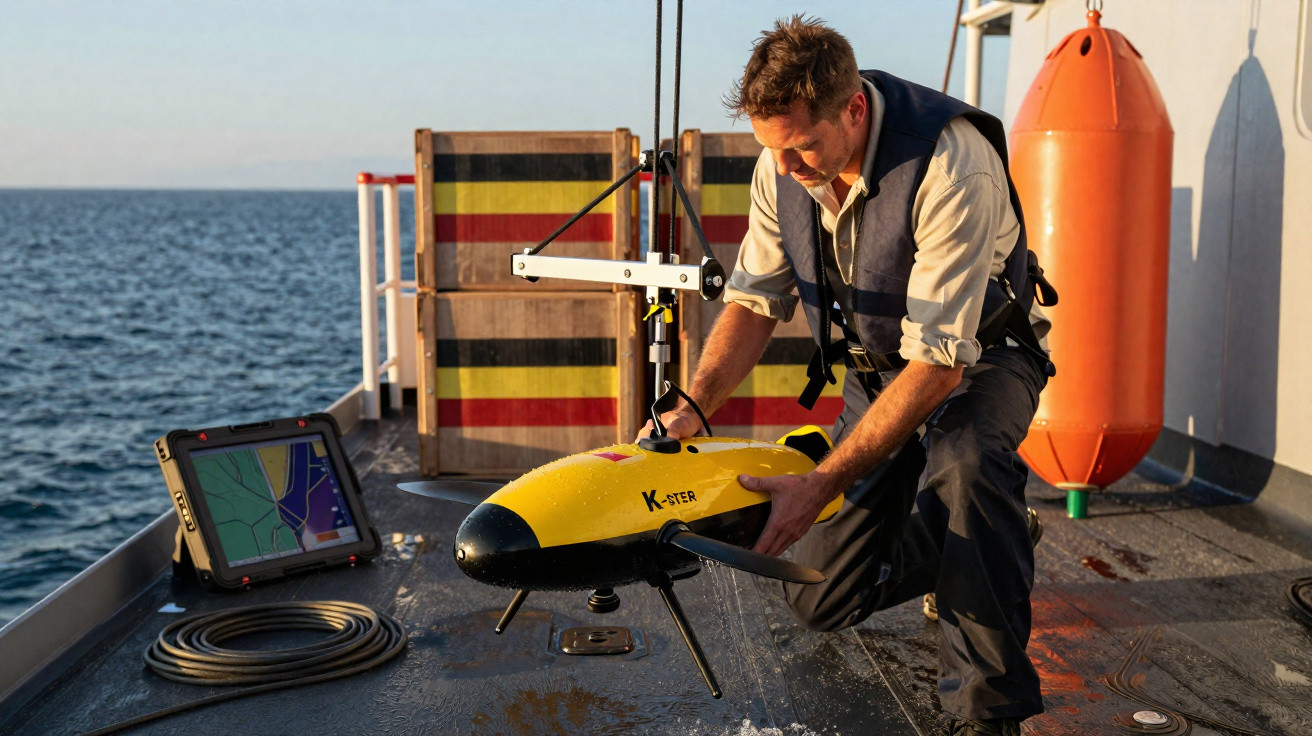
At only 1.5 metres in length and around 55 kg dry weight, the K-STER C is compact. Nevertheless, it is intended for mine warfare’s highest-risk stage: the final approach to, and destruction of, a mine.
Where larger unmanned underwater vehicles (UUVs) are used for detection or mapping, the K-STER C is a “one-way” system. It is directed towards a suspected mine, uses its sensors to identify it, positions its explosive head and detonates either on impact or nearby. Losing the robot is integral to the concept, as it takes the place of a human diver.
- Length: 1.5 m
- Operational range: 1,500 m
- Maximum depth: 300 m
- Endurance: about 1 hour
- Warhead: roughly equivalent to 3 kg of TNT
The drone’s four thrusters-two horizontal and two vertical-provide highly precise control. Operators can examine suspicious objects on the seabed or suspended in mid-water using dual-frequency sonar, a colour day/night camera and an integrated light. Its explosive head rotates through ±90°, enabling accurate engagement whether a mine is lying on the seabed or suspended from a mooring cable.
Designed as a consumable munition, the K-STER C turns mine neutralisation into a repeatable, industrial-scale process instead of a handcrafted, diver-led operation.
Why mines are back at the centre of naval strategy
For many years, naval mines were regarded as Cold War leftovers, linked to Soviet-era arsenals and basic coastal-defence forces. That view is shifting rapidly. Mines are inexpensive, fairly simple to lay and difficult to defeat in large numbers. At a fraction of the cost of a missile or submarine, they can block straits, endanger ports and interrupt offshore energy infrastructure.
Events in the Black Sea, tensions around the Taiwan Strait and attacks on subsea pipelines have led maritime planners to reconsider mine warfare. Navies require methods of keeping sea lanes open without deploying divers or costly warships into densely mined waters.
This is the role of systems such as the K-STER C. They make mine clearance a distributed operation performed by numerous small robots, which can be launched from rigid-hulled inflatable boats (RHIBs), surface vessels or unmanned surface vehicles (USVs). The principle is straightforward: sacrifice robots rather than people.
An industrial line in Belgium feeding a global market
From French design to Belgian assembly
A detail that may surprise observers is that Exail assembles the K-STER C in Ostend, on Belgium’s coast, rather than in France. The company established a dedicated line there both to fulfil high-volume orders and to remain close to North Sea testing grounds and European clients.
Rather than producing bespoke, manually built prototypes, the site is configured for serial production. Industry insiders say it can manufacture several hundred drones annually, while output could be increased should a naval crisis or urgent procurement programme demand it.
A production line tuned for volume signals that underwater drones have moved from R&D showcase to standard item on defence shopping lists.
At the Belgian facility, the hulls are assembled and fitted with propulsion, electronics, sonar equipment and warheads. Pool and sea trials are then completed before delivery. This production model matters because navies are purchasing not one or two robots for evaluation, but fleets of expendable systems for repeated combat operations.
Signals from a changing defence market
In isolation, €40 million is modest beside frigate or submarine projects costing many billions of euros. Analysts nevertheless regard the agreement as evidence of changing procurement priorities. Rather than concentrating expenditure solely on a small number of large vessels, many navies are distributing it across systems in the air, on the surface and underwater.
For France, the contract has strategic importance. It demonstrates that French-origin technology can be exported at scale in underwater autonomy, a field where the United States, Israel and South Korea are advancing strongly. It also reinforces Europe’s ability to deploy its own underwater systems instead of relying wholly on American or Asian supply chains.
A booming underwater drone market
From niche to mainstream
The worldwide market for unmanned underwater vehicles is moving into a period of more structured growth. Projections indicate that it could rise from approximately $5.9 billion in 2025 to about $8.7 billion in 2030, at average annual growth of around 8%. Annual deliveries, meanwhile, are forecast to exceed 33,000 systems by 2030, up from just under 20,000 in 2024.
Defence is still a major source of demand, particularly for mine countermeasures, anti-submarine warfare support and port protection. Civilian applications are growing as well. Energy businesses seek UUVs for inspecting offshore wind farms, pipelines and drilling platforms, while scientists use them for seabed mapping, environmental monitoring and deep-sea research.
Underwater drones are becoming a standard maritime tool, sitting alongside patrol boats, satellites and aircraft in security and energy planning.
Improvements in battery endurance, navigation algorithms and acoustic communications are increasing autonomy. Modern systems can survey extensive areas with limited operator involvement before returning to a mothership or harbour to upload their data.
Why this matters for navies, and for France
Strategic leverage for a mid-sized power
For France, a country with worldwide maritime interests but limited defence budgets, underwater drones present an appealing proposition. They expand surveillance and mine-clearance capacity without requiring the expense of new high-end combat ships. They also suit France’s established strengths in optics, inertial navigation and defence electronics, fields in which Exail has considerable expertise.
The consecutive contracts for hundreds of K-STER C units allow Exail to invest with confidence in research and development and manufacturing capacity. In turn, this supports a wider network of engineers and suppliers, ranging from sonar specialists to composite-material manufacturers.
For the French Navy, a domestic leader in this area lowers reliance on imported technologies and provides influence in joint European programmes, where interoperability and shared standards are increasingly important.
What underwater drones change at sea
From manned missions to robotic “consumables”
The K-STER C sits within a class of systems increasingly described by militaries as “expendable” or “attritable”: affordable enough to be deployed, lost and replaced without major concern. Previously, that model was largely limited to artillery shells and missiles; it is now extending into robotics.
During a crisis, a navy might send dozens of these drones to clear an access channel to a harbour or offshore LNG terminal. Some could malfunction or be destroyed, while others would reach and neutralise their targets. Crucially, divers would not have to operate in heavily mined water, and frigates would not need to sail through an uncleared minefield.
The change brings further challenges. Logistics teams must manage drone stockpiles as they do ammunition. Commanders need to account for electronic warfare and cyber protection across networks of small robots. Legal specialists must assess how rules of engagement apply to autonomous or semi-autonomous systems operating beneath the sea.
Benefits and risks beyond the military sphere
Comparable technology can be repurposed for peaceful uses outside defence. A K-STER-like vehicle with no explosive charge could carry sensors for inspecting subsea cables, wind farm foundations or infrastructure damaged during a storm. Coastal nations could also use such systems to observe illegal dumping or fishing on sensitive seabeds.
Risks exist too. As the technology becomes more widespread and cheaper, non-state groups may attempt to build rudimentary underwater drones from commercially available parts. Maritime security services would then require detection capabilities of their own-potentially involving other robots-to counter improvised devices placed close to ports or maritime chokepoints.
For now, however, companies such as Exail hold the momentum. Through compact design, serial manufacturing and a clearly defined mission-mine destruction-the K-STER C has helped place France among the leading producers of underwater drones, as navies quietly reconsider how 21st-century wars at sea may actually be fought.





Comments
No comments yet. Be the first to comment!
Leave a Comment