
A cluster of parents gathers beside the bike racks, phones out and voices hushed as a screenshot is passed between screens. “I’m telling you, they just put on a video and sit there,” one mum says, her expression tense with frustration. A father wearing a hi-vis jacket agrees while typing into the parents’ WhatsApp group: We need cameras in every classroom. No more lazy teaching.
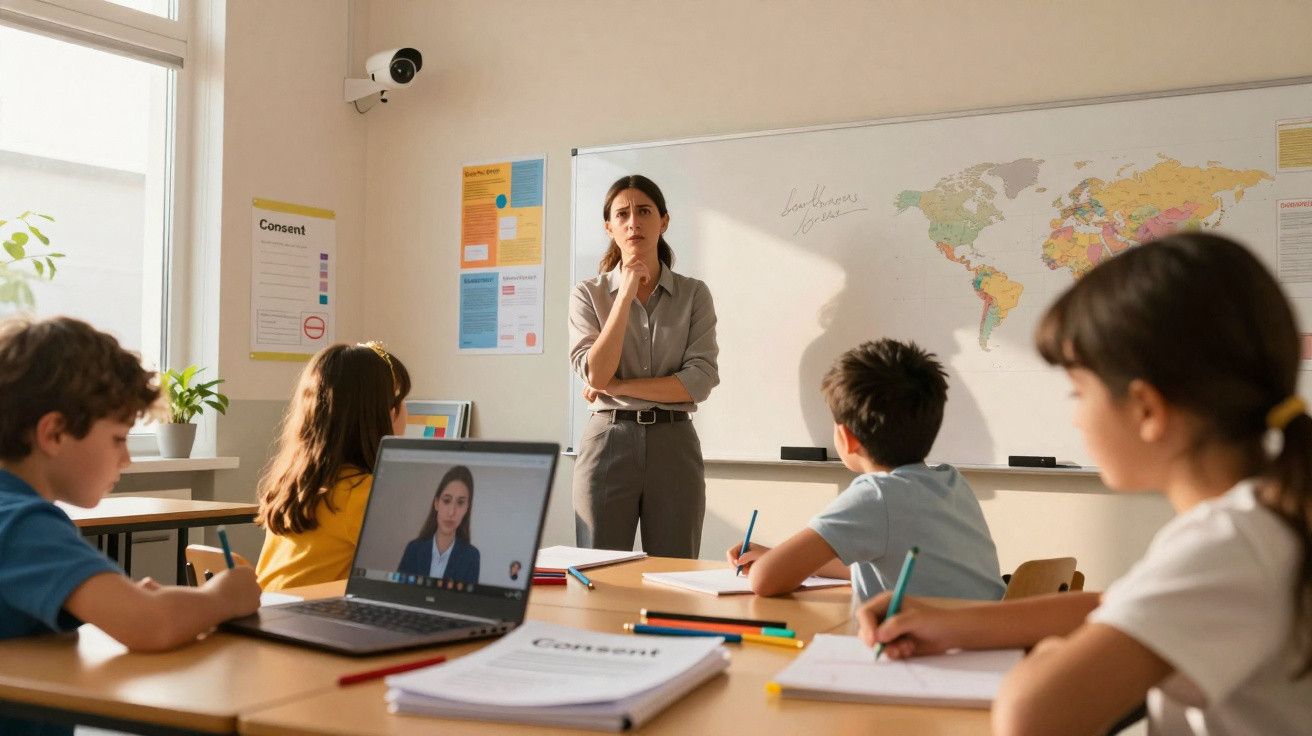
In the school, a Year 5 teacher rests against her desk, drained before the day has even begun. She has seen the local Facebook discussion and read claims that she scrolls through her phone while pupils “teach themselves”. None of those posting were present the previous evening, when she worked until 7 pm preparing lessons. Even without a camera in place, she already feels under observation. That is where this story begins.
Parents want cameras in classrooms – while teachers feel betrayed
Across the UK, the US and parts of Europe, more parents are pushing for CCTV-style cameras in every classroom. Their concern is not limited to safeguarding or security: they also want to watch the quality of teaching as it happens. They say their children report “boring lessons”, repeated worksheets and supply teachers who scarcely look away from their laptops. To some parents, cameras appear to offer a straightforward answer: a permanent record of what really occurs from 9 am until 3 pm.
Teachers interpret that request very differently. To them, calls for cameras amount to a public declaration of no confidence. Many are already managing packed classes, rigid behaviour policies and data targets that consume their evenings. They now picture every frown, weary exhale and on-the-spot explanation captured on film, replayed and picked apart by strangers in a Facebook group. What is presented as “transparency” can feel much more like intimidation.
At one primary school in the Midlands, a petition demanding classroom cameras attracted 2,000 signatures within a week. It began with one allegation: a parent said her son’s teacher “just handed out worksheets and sat at the desk every lesson”. The claim spread rapidly through local social media. Images of poorly copied resources and incomplete worksheets were treated as proof of “lazy teaching”. Days later, the school was dealing with furious emails calling for live-streamed lessons and recorded footage from every class.
The headteacher arranged a meeting in an effort to ease the situation. He explained that several children in the class had complex needs, and that periods of “silent work” formed part of a planned routine. He also revealed that the teacher had been taking additional lessons because colleagues were ill. That explanation did not go viral. Instead, people shared a clip from an earlier open day, edited to suggest the teacher was using her phone while pupils worked independently. Context disappeared, while the “lazy teachers” storyline took hold.
Underneath the dispute lies a more fundamental issue: what do we expect teaching to look like? Many parents carry an image of the ideal lesson: animated debate, bright experiments and continual activity. When a child says, “We just copied from the board,” it can therefore sound like something has gone wrong. But classrooms in real life are untidy and inconsistent. They include extraordinary moments alongside lengthy periods of quiet effort. In a class of 31 children, no two pupils will experience precisely the same lesson. Cameras may seem to offer certainty, yet they can reduce that complexity to one unforgiving viewpoint.
Teaching also involves emotional labour that a camera cannot show. It does not record the impact of a child having had a difficult night, the unspoken distress of a pupil unable to read the board, or the careful bargaining behind a teacher’s calm voice. A teacher who appears to be “sitting at their desk” may actually be helping a distressed pupil avoid a meltdown. A frozen image can look persuasive while being entirely misleading.
Building trust between home and school without cameras
Rather than installing permanent surveillance, some schools are discreetly trying a different approach: direct, human-scale transparency. Instead of cameras, they create more opportunities for parents to see school life. Once each term, parents may be invited to sit at the back of a lesson as visitors rather than inspectors. Teachers send brief, plain-English weekly updates explaining what has been taught, what succeeded, what did not and what comes next. This is not polished promotion; it is a closer reflection of the imperfect reality of teaching.
One London secondary school tested a straightforward idea. Each Friday, tutors made a two-minute audio message for parents: an unedited account of the week. There was no script and no public-relations gloss. It was simply: “Here’s where your child’s class struggled, here’s where they did brilliantly, here’s what I’m trying next week.” Parents could listen while travelling on the bus or making dinner. Complaints fell markedly. That was not because school suddenly became perfect, but because parents felt involved in the process rather than excluded and distrustful.
Let us be honest: hardly anyone reads every line of a 10-page school newsletter each week. What parents do pick up on is the tone. If communication sounds defensive, they may conclude that something is being concealed. If it is frank – “This didn’t go as planned; I’m changing tack” – it leaves room for understanding. Practically, modest changes often achieve more than any camera: providing one realistic communication channel rather than five; responding to recurring concerns collectively instead of one by one; and setting out clearly what parents should expect from an ordinary lesson.
Some teachers now tell pupils directly why a lesson may appear “boring” to an outsider. They explain, “Today is a quiet practice day. It won’t feel exciting, but this is how you get better.” When children bring that explanation home, it changes the conversation at the dinner table. That, too, is communication.
Teachers often describe the cameras debate as a conversation held about them rather than with them. Both sides carry hurt beneath the anger. One Year 3 teacher told us:
“When parents say they want cameras to catch ‘lazy teaching’, it feels like they’re calling me a liar. They don’t see the 10 pm marking, or me buying glue sticks with my own money. They only see what a tired seven-year-old reports after a long day.”
Parents, meanwhile, can feel labelled “pushy” or “toxic” as soon as they raise concerns. Many have their own painful memories of school and are determined not to let their children repeat them. On a difficult day, everyone feels triggered and no one is truly listening.
To break that deadlock, some schools are relying on straightforward, low-tech measures:
- Brief “learning snapshots” every fortnight, including one photograph or example of classwork.
- Regular open classrooms, allowing parents to drop in informally for the final 15 minutes of a lesson.
- Firm email boundaries, with defined response periods so teachers are not replying at midnight.
- Parent panels that include genuinely critical voices, rather than only those who already support the school.
- Student-led conferences in which children describe their own learning instead of adults speaking on their behalf.
These steps may not attract headlines like “Cameras in every classroom now”. They are slower, more personal and occasionally uncomfortable. But they keep the essential relationship between child, parent and teacher at the heart of the matter, rather than placing an unblinking lens on the wall.
A safer future for children, parents and teachers
Once a camera is mounted on a ceiling, it changes the atmosphere without saying a word. Teachers begin to consider how each lesson might appear when replayed. Children may perform for the camera or retreat from view, knowing they are technically being recorded. Parents may become distant auditors rather than partners. Safety is the promise; trust is the price.
A broader cultural change is also taking place beyond schools. We already monitor our steps, sleep and screen time. Work meetings are recorded “for training purposes”. Doorbells send live alerts when a fox walks across the drive. Surveillance has become routine in almost every part of life, making its arrival in classrooms seem logical. Yet education depends on things cameras handle poorly: vulnerability, uncertainty and the freedom to get things wrong without an immediate replay.
We can all recall a teacher losing their temper, rescuing a lesson with a joke or taking us aside to ask, “Are you really OK?” Those moments did not unfold beneath studio lights. They were delicate, spontaneous and profoundly human. If every misstep is potentially exhibit A in a complaint, how many of those moments will survive? What do children learn from a world in which every adult before them is visibly preparing for scrutiny?
There is another uncomfortable reality: some teaching is lazy. Some lessons are improvised with little care, some teachers are exhausted or disengaged, and some schools conceal difficulties rather than addressing them. Cameras offer the appealing fantasy that the worst practice could be caught, clipped and corrected. In practice, weak teaching usually first becomes visible in outcomes, behaviour and the way children describe themselves as learners. It emerges gradually and over time, and footage alone cannot put it right.
Parents are not wrong to seek accountability, and teachers are not wrong to want professional dignity. The real issue is how far society is prepared to travel down a route where everyone monitors everyone else at all times. Other routes exist: improved training, meaningful support for staff who are struggling, empowered school governors who genuinely visit lessons, and more candid discussions about workload and class sizes.
The argument over classroom cameras asks us to consider what a “good” classroom feels like, rather than simply how it appears on screen. Must it be silent, with every pupil looking forwards? Should it be loud and alive with group work? Must the teacher always be standing and talking? The truth is less tidy: extended quiet practice, bursts of disorder, ripples of laughter, periods of boredom and flashes of connection. No camera lens can capture all of that honestly. People may be able to.
| Key point | Detail | Why it matters to readers |
|---|---|---|
| Parents demand cameras | Increasing calls for CCTV-style monitoring to tackle “lazy teaching” | Understand where the controversy comes from and why it is escalating now |
| Teachers feel under siege | Surveillance is viewed as a vote of no confidence and a threat to trust | See the other side of the issue, behind the classroom door |
| Alternatives to surveillance | Open classrooms, candid updates and student-led conferences | Explore practical ways to strengthen school-family relationships without cameras |
FAQ
- Are classroom cameras already legal and common in schools? In many countries, cameras are permitted in corridors and entrances for security, but recording inside classrooms is heavily regulated or discouraged. Where it is used, it is generally for safeguarding or training rather than live monitoring by parents.
- Would cameras actually improve teaching quality? They may identify extreme cases, but most research into professional development favours coaching, observations with feedback and training over constant surveillance. Fear rarely produces excellent teaching.
- Can parents demand access to recorded lessons? Access is determined by local privacy law and school policy. Footage commonly includes several children, creating serious data-protection concerns that make broad parental access highly complicated.
- What are the main risks of filming every lesson? Potential risks include privacy breaches, children performing for the camera, teachers avoiding creative or sensitive discussions, and a collapse in trust between home and school when footage is edited and shared without context.
- How can parents raise concerns without asking for cameras? Begin with calm, specific questions about learning rather than personal criticism. Ask to view samples of work, arrange a meeting with the teacher and, where necessary, the headteacher. Propose regular updates or open-classroom sessions instead of surveillance.



Comments
No comments yet. Be the first to comment!
Leave a Comment