
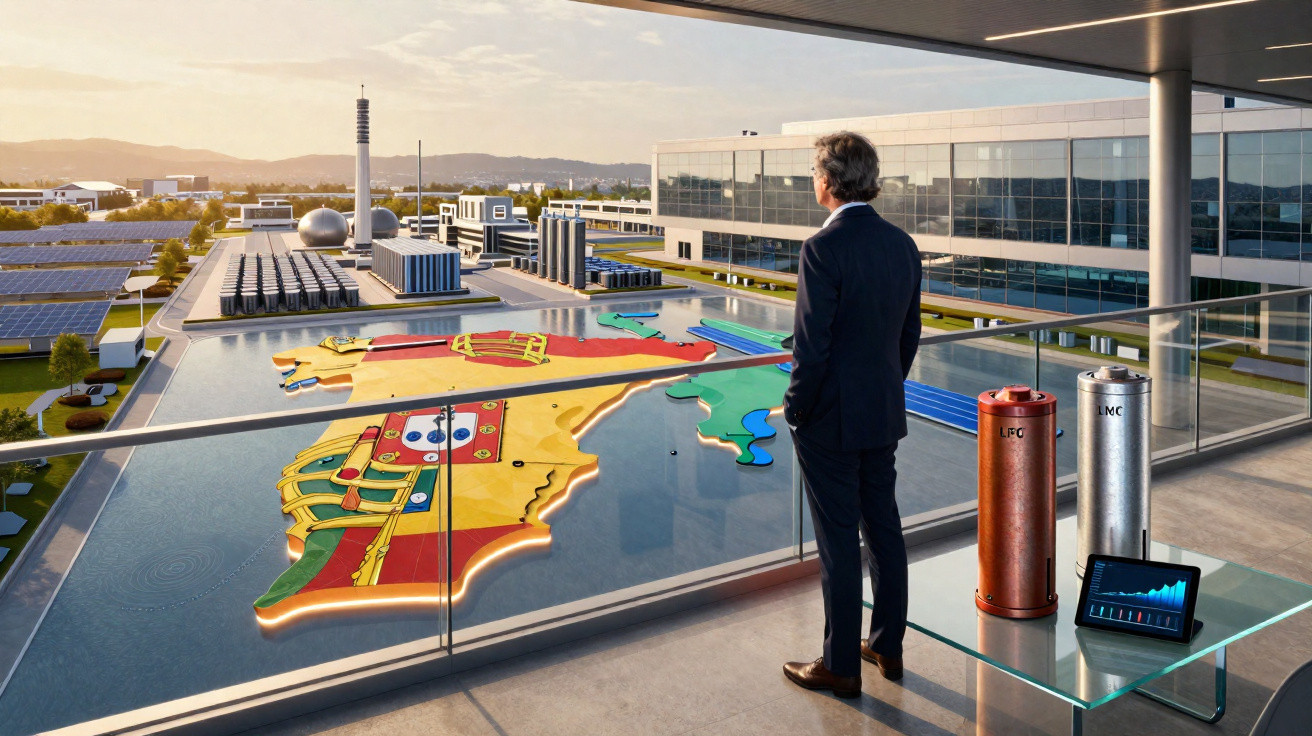
Carlos Tavares, Stellantis CEO, has placed the Iberian Peninsula - Portugal and Spain - among the potential locations for the group’s next battery factory.
During a round-table discussion attended by Razão Automóvel, held alongside the announcement that the Stellantis Production Centre in Mangualde will build electric cars from 2025, Carlos Tavares said that the final location for the group’s new battery plant will be announced shortly.
For now, the only certainty is that it will be in the Iberian Peninsula. Once again, however, Portugal and Spain are competing to secure this substantial investment.
Stellantis battery factory: Portugal or Spain?
With only a few months remaining before the location of the group’s fourth battery factory is revealed, Portugal’s chances appear strong. As Tavares explained: “Nothing has been finalised yet. We intend to close this matter in the coming weeks.” He also identified Portugal’s main advantage:
“One of Portugal’s competitive advantages is its energy production, which includes 60% renewable energy, and that is a very important factor when choosing a factory.”
Carlos Tavares, Stellantis chief executive
Carlos Tavares did not only highlight the country’s competitive strengths. He also addressed the risks:
“Portugal must reduce bureaucracy and speed up its processes.”
Carlos Tavares, Stellantis chief executive
As for Stellantis, the company is doing what is required, according to Carlos Tavares: “At the moment, nothing has been negotiated, but we are doing our share of the work. We are talking to partners, defining the economic conditions, the required capacities and the battery chemistry. By the end of the summer, we should have all the answers.”
That naturally raises the question of whether Portugal is also doing its share of the work.
“Not yet, because we have not made a proposal. But it may be, and I already have assurances from the Portuguese State that they are clearly interested in that possibility. In fact, Portugal and Spain, and all the countries in southern Europe.
This is because our logic is very simple: we want to build cars close to the points of consumption. It is in southern Europe that demand for smaller cars is concentrated.”
Carlos Tavares, Stellantis chief executive
LFP vs NMC
Stellantis currently has three battery factories in Europe through ACC, its joint venture with TotalEnergies and Mercedes-Benz for battery production: France, Italy and Germany. Battery production is expected to begin in France this year, in Italy in 2024 and in Germany in 2025.
How the fourth Stellantis battery factory will differ
This new fourth European battery factory for Stellantis will differ from the others because of the batteries it will manufacture. While ACC’s three European plants will produce NMC lithium batteries - nickel, manganese and cobalt - the new factory will focus on lithium iron phosphate batteries, better known as LFP.
“The Iberian Peninsula is the region that makes the most sense for LFP battery production, because this is where demand for affordable vehicles is greatest.”
Carlos Tavares, Stellantis chief executive
The main difference between LFP and NMC batteries is their lower cost, by around 20%. This is crucial to reducing the price of electric vehicles, particularly in the lower segments, where prices remain very high.
Chinese manufacturers - BYD, for example - and, to some extent, Tesla, have been the companies investing most heavily in LFP batteries for precisely that reason. Their drawback is that they do not offer the same energy density as NMC batteries, meaning they take up more space and weigh more.
A month ago, Carlos Tavares spoke about the need for these batteries: “Stellantis needs LFP batteries and will have them, as they are competitive in cost terms and make it possible to produce electric cars that are affordable for the middle class”.



Comments
No comments yet. Be the first to comment!
Leave a Comment