
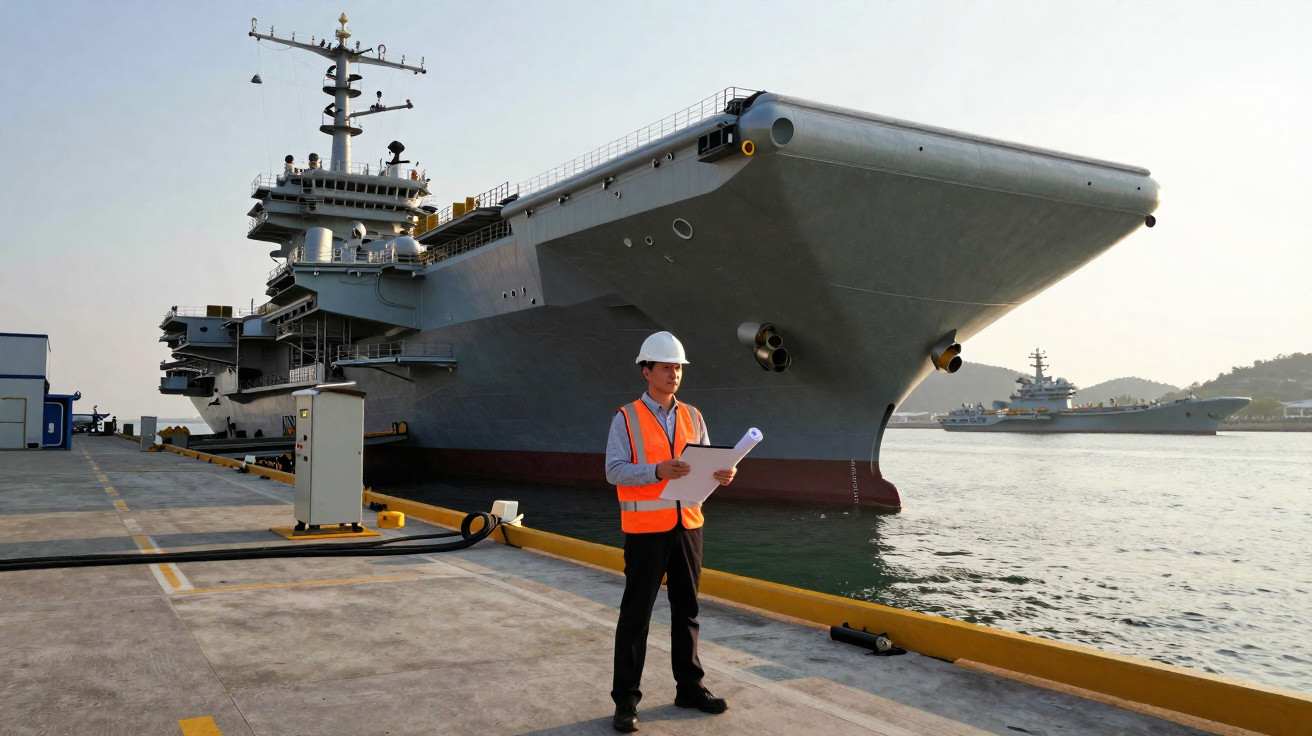
The United States Navy’s nuclear-powered aircraft carrier USS Nimitz (CVN-68) is the subject of a newly awarded contract for Huntington Ingalls Industries (HII) as the vessel approaches retirement. It covers the modernisation of infrastructure that will support the carrier’s deactivation and eventual decommissioning. Worth US$11,048,000, the contract modification was issued to HII’s Newport News Shipbuilding division for improvement work at Pier Three North in Newport News, Virginia, overseen by the Naval Sea Systems Command (NAVSEA).
USS Nimitz deactivation facilities at Newport News
Official information published by the Department of War states that the contracts will chiefly support the removal of the reactor fuel that powered the aircraft carrier for more than 50 years. This will be followed by the inactivation of the lead vessel of the Nimitz class. All work is due to take place at Newport News and is scheduled for completion by September 2027, using Navy operation and maintenance funding for fiscal year 2026.
This award builds on investments launched in 2024, when the Navy formally began preparing the industrial infrastructure needed to manage the decommissioning of USS *Nimitz, the United States’ oldest operational aircraft carrier. Recent reports also indicate that the ship has returned to US territory. More precisely, *CVN-68 arrived only days ago in Bremerton, Washington**, following its final Pacific deployment, bringing to a close a career of almost five decades of continuous service across the world’s principal operational theatres.
Technically, retiring a nuclear-powered aircraft carrier is an exceptionally demanding undertaking. Extracting nuclear fuel from its reactor and subsequently inactivating the ship requires purpose-built facilities, rigorous safety procedures and a highly skilled workforce.
Nimitz replacement and HII’s role in the next generation of aircraft carriers
The HII contract extends beyond the withdrawal of USS *Nimitz* and forms part of the wider generational transition under way within the US Navy. Investment in infrastructure is intended not only to support deactivation work, but also the construction, maintenance and testing of Gerald R. Ford-class aircraft carriers, which will gradually replace the ageing Nimitz-class ships.
Newport News Shipbuilding is currently building two nuclear-powered carriers of the new Ford class at the same time, creating significant pressure on the yard’s industrial capacity. One is the aircraft carrier USS Doris Miller (CVN-81), while the other is the future USS Enterprise (CVN-80).
At the same time, preparations are reportedly continuing for the sea trials of USS John F. Kennedy (CVN-79), the second vessel in the new class and a central element of future US naval aviation power. The lead ship, USS Gerald R. Ford (CVN-78), has meanwhile been in service for several years, as illustrated by its latest deployment to the Caribbean in support of Operation Southern Spear within the area of responsibility of U.S. Southern Command (USSOUTHCOM).
The position facing the US aircraft carrier fleet-retiring platforms with decades of operational service while bringing new ships into service-underlines the complexity of the present transition. The United States Navy must retain adaptable, modernised infrastructure to prevent industrial bottlenecks and maintain the operational availability of its combat vessels throughout the process.
Photographs used for illustrative purposes.
You may also like: Introducing the Trump class: the future 40,000-ton battleships of the U.S. Navy






Comments
No comments yet. Be the first to comment!
Leave a Comment