
For anyone balancing family life, work and everyday responsibilities, a dishwasher is hard to do without. It takes care of a chore, but it also adds to household costs every month. A small, often overlooked step involving an ordinary cup can help the appliance run more efficiently again – and make the electricity meter turn a little more slowly.
Why your dishwasher uses so much electricity
A modern dishwasher uses around 1 kWh of electricity per cycle on average. Over a typical year for a family, this adds up to roughly 200 to 260 kWh. At an electricity price of about 18p per kWh, that means around £40 to £50 spent solely on getting the dishes clean.
Most of that electricity is not used by the motor, but to heat the water. Around 80 per cent of the energy goes into the heating element. This is precisely where savings can be made.
“Even a single millimetre of limescale on the heating element can raise consumption by around ten per cent – without you noticing.”
Over time, limescale, grease and food deposits build up on the heating element, spray nozzles and inside the pipes. As a result, the appliance has to heat for longer to bring the water up to temperature. Cleaning performance also declines: glasses come out cloudy and plates may feel greasy. Many people then simply run a second cycle, increasing electricity use even further.
The cup method: how a simple serving of vinegar helps
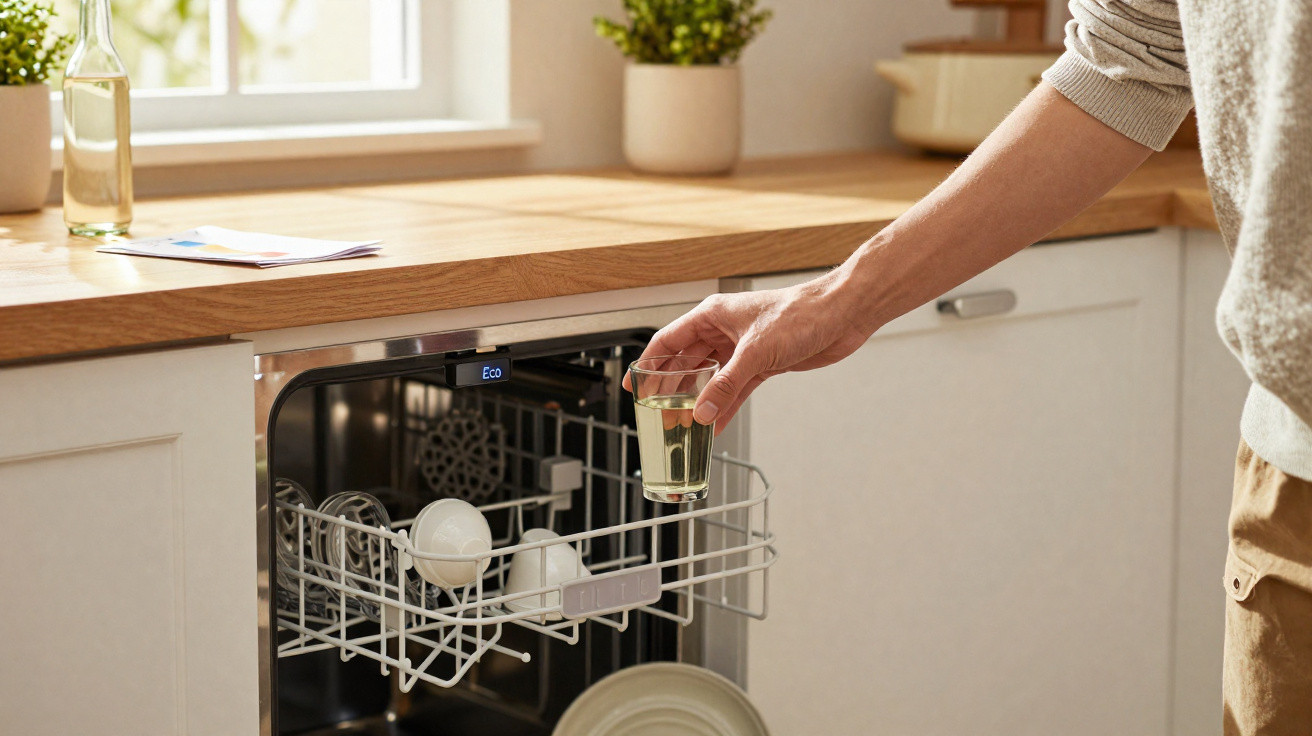
The secret weapon is surprisingly straightforward: a cup filled with vinegar in an empty dishwasher. There is no need for an expensive specialist cleaner – just a household remedy that most people already have in the cupboard.
How the vinegar trick works in a dishwasher
This method uses vinegar’s acidity to break down limescale and grease. In the hot water, the vinegar evaporates and circulates throughout the appliance, reaching the heating element, pipes and spray arms.
In brief, this is how to do it:
- Take a heatproof cup or small bowl.
- Fill it with 150 to 200 ml of clear vinegar, such as household vinegar or white vinegar; use vinegar essence only when heavily diluted.
- Place the cup securely in the upper basket.
- Select a hot programme, ideally around 65°C.
- Run the dishwasher empty, with no plates, pans or glasses inside.
If desired, add a tablespoon of bicarbonate of soda or a little lemon juice. Bicarbonate of soda boosts the degreasing effect, while lemon gives a fresher smell. One point is essential: never combine highly concentrated vinegar essence with chlorine-based products. This mixture can produce harmful gases and damage the appliance.
“One cleaning cycle using a cup of vinegar can effectively provide a ‘light descaling’ treatment for the heating element – saving energy, money and hassle.”
How often should you run a vinegar cycle?
The right frequency depends mainly on two factors: water hardness and how intensively the dishwasher is used. If you live in an area with very hard water and run the dishwasher almost every day, use the vinegar cup around once a month. With softer water or less frequent use, every two to three months is sufficient.
If the machine is left completely unmaintained, thick layers of limescale can form and may no longer dissolve fully in a single cycle. Several hot vinegar cycles, or stronger descalers applied to specific areas, may then be needed. Regular care using the cup method prevents it from reaching that stage in the first place.
What the cup method actually delivers
The benefits are not merely theoretical; they are noticeable in daily use:
- The dishwasher smells neutral rather than musty.
- Glasses regain their shine and become less cloudy.
- Cutlery comes out without a grey film.
- Programmes seem to run more smoothly because the water heats up faster.
Take a numerical example: if an appliance uses 260 kWh a year, a ten per cent increase caused by limescale can push this to about 286 kWh. That is a few extra pounds every year – entirely unnecessarily. Keeping the dishwasher clean helps keep its consumption nearer the lower end of that range.
Save more: habits that enhance the effect
The vinegar cup is a useful starting point, but it works best alongside a few additional everyday habits.
Use the Eco programme instead of constant full power
Many people avoid the Eco programme because its cycle takes longer. From an energy perspective, however, it is worthwhile: the water is heated less intensely, and heating is the biggest factor in electricity consumption.
On a well-maintained dishwasher, the Eco programme can reduce electricity use per wash by around 30 to 45 per cent. Combining vinegar cleaning, a clean filter and the Eco programme can bring an appliance’s annual consumption down from around 260 kWh to roughly 130 to 180 kWh. At the stated electricity price, the yearly cost is then more likely to be between £23 and £32.
Other small adjustments for everyday dishwasher use
- Skip pre-rinsing: Scraping off large food scraps is enough. Pre-rinsing under hot water simply shifts energy consumption to the tap.
- Always run full loads: Half-empty dishwashers use more electricity per plate. It is better to wait until the basket is genuinely full.
- Load it properly: The spray arms must be able to rotate freely, and plates and bowls should not be wedged into one another.
- Clean the filter regularly: A blocked filter prevents water from circulating properly and extends programme times.
- Use off-peak or overnight electricity: If your tariff offers cheaper periods, schedule the dishwasher cycle for those times.
What vinegar actually does inside the appliance
Vinegar contains acid that dissolves limescale and loosens greasy deposits. In moderate quantities, it does not harm a modern dishwasher; on the contrary, it removes residue that can make plastic parts brittle and can therefore help extend the appliance’s lifespan.
There are, however, two rules of thumb:
- Do not use highly concentrated vinegar essence continually.
- Do not add vinegar to every wash; use the cup method only as a cleaning programme.
This maintains the balance between effective care and protecting the appliance’s materials. If you are unsure, check the instruction manual – many manufacturers now recommend regular cleaning cycles themselves.
When an energy-hungry dishwasher deserves a closer look
A dishwasher that takes noticeably longer despite regular care, smells strongly or cleans increasingly poorly may be signalling a problem. Possible causes include clogged spray arms, faulty thermostats or worn seals. In these cases, the vinegar cup can help only to a limited extent. It is worth considering the appliance’s age: older models often use significantly more electricity than newer machines with a good energy efficiency rating.
A rough comparison between the details on the rating plate and current models quickly shows whether replacement could pay off in the medium term. Anyone reluctant to buy a new dishwasher can at least get the most from the existing one through simple maintenance, the cup method and sensible programme choices.
Practical examples for everyday life
In many homes, a simple routine is enough:
- Once a week: clean the strainer and filter under running water.
- Once a month: use the vinegar cup method if you have hard water.
- After heavily soiled loads, such as roast dishes, bakes or greasy cookware: schedule a hot cycle so deposits do not become stuck.
- Every day: use the Eco programme and only start the dishwasher when it is fully loaded.
This creates no significant extra work in everyday life, while the dishwasher operates more reliably and the electricity bill remains manageable. One cup from the kitchen cupboard thus becomes a small but effective money-saving tool for the household.






Comments
No comments yet. Be the first to comment!
Leave a Comment