
Few industries are investing as heavily in decarbonising their operations as the automotive sector. This transformation is taking place across the entire supply chain, even before manufacturing begins, and the associated costs are being passed on in the final price of cars.
There are countless routes to meeting these emissions targets: electrified combustion engines, combustion engines running on e-fuels, battery-electric motors and, lastly, fuel-cell electric vehicles powered by hydrogen - or, if you prefer, fuel cells.
When it comes to this final option, several manufacturers are backing a future powered, at least in part, by hydrogen. And it does not seem to me to be merely marketing. If it were, it would be the worst marketing campaign ever. Consumers are not especially keen to hear about these solutions, so it can only be driven by conviction, necessity, or both.
Only this week, we reported on a hydrogen joint venture between Toyota and BMW. Stellantis, Renault and Hyundai can also be included. Each of these brands has projects, at different stages, involving hydrogen as an energy source for their motors.
However, there is a long road from announcements to production, with major challenges along the way. Toyota is the best-known and most widely reported example. The Japanese brand has a natural inclination towards taking complex routes. That was the case with hybrids in 1997 - a technology that has now earned the brand a TOP 2 position in the European market - and it is the case again with hydrogen technology.
These two examples share one factor: very few people believed in either technology when it first arrived on the market. So why “take on” this problem? Because, as we will see, some solutions cannot be put off.
The emissions problem
In Europe, Diesel vehicles are increasingly living on borrowed time, and the first casualties have already appeared. The new Mitsubishi L200, for instance, is sold in almost every part of the world but no longer complies with European regulations, meaning it is not available in our market.
It would be simple to present electric pick-ups as the answer, but in many situations they are not an answer at all. That is true here, where the charging network remains limited or unsuitable for consumers’ everyday needs, and on the other side of the world, where economies cannot absorb additional costs and therefore require these low-cost pick-ups.
For that reason, the most radical environmentalists, who want an immediate end to fossil fuels, should not read what I am about to say: the good old Diesel engine still keeps thousands of businesses moving every day. Without it, the world would stop.
Since stopping the world is not a solution, thousands of engineers are working day and night to find alternatives. The Toyota Hilux with the Diesel engine we know could be the next victim.
Toyota Hilux FCEV: the alternative to battery-electric pick-ups
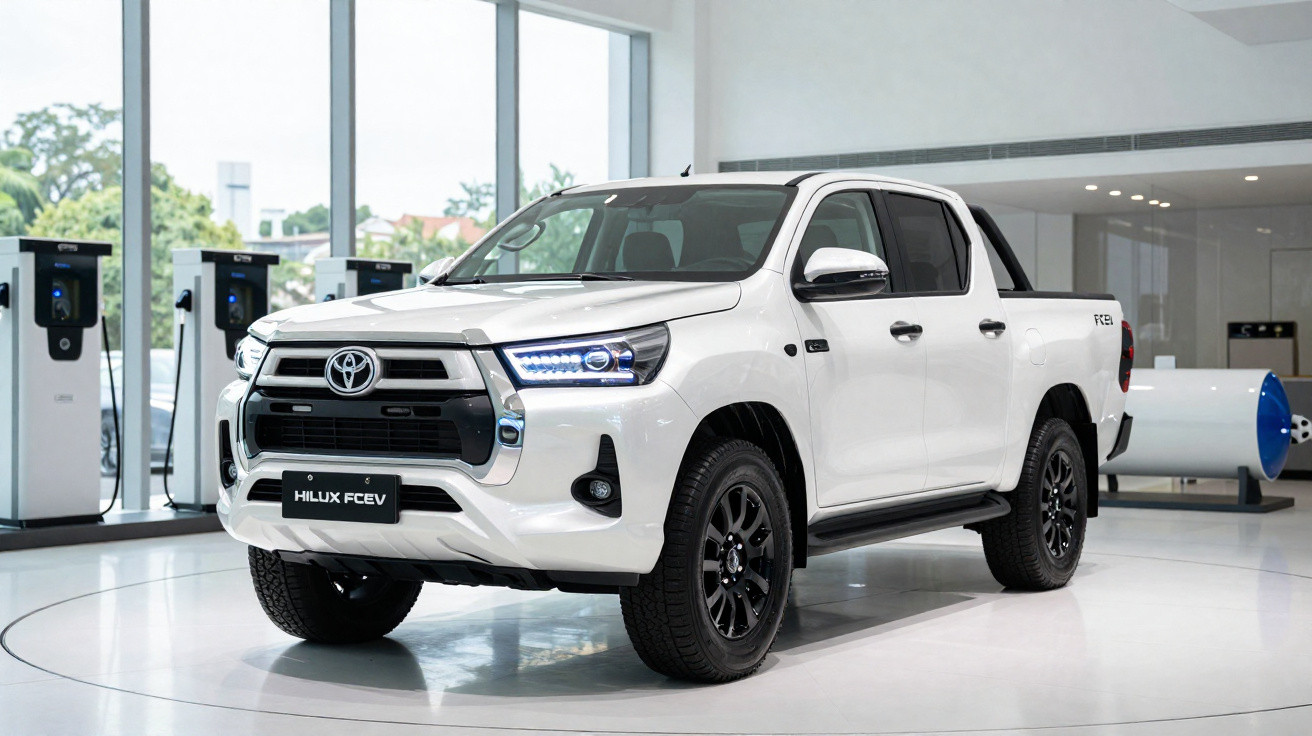
This is where the Toyota Hilux FCEV (fuel cell electric vehicle) comes in, as an alternative to fully electric pick-ups.
We drove one of this model’s prototypes and show you everything in this video:
From a technological perspective, it is easy to discuss the advantages of the fuel cell, as they are almost self-evident. The hydrogen tanks can be refilled in just over five minutes, delivering a range that can exceed 500 km. The end result is simply water from the exhaust and zero emissions.
Its problems are equally easy to identify. Where do we refuel? Not to mention hydrogen production, storage and distribution. There is plenty to discuss on all of that.
My proposal is different: to look at how Toyota’s engineers are tackling the issue. It is a distinctly Japanese approach: one problem at a time.
The problem Toyota is tackling
We finally arrive at the question raised at the beginning of this Autopédia article: the problem Toyota is seeking to solve with the Toyota Hilux FCEV. It is called packaging or, if you prefer, fitting everything in. It does not sound quite as good in Portuguese, does it?
Even if we assumed that hydrogen refuelling had been solved and that costs were comparable with Diesel, one issue would remain: the Diesel version is still more capable than this FCEV version.
At present, fitting the fuel cell, hydrogen tanks and battery into the Hilux means there is no room for the four-wheel-drive system, while the load bed loses space. Those are two essential qualities for a working pick-up. No pick-up can succeed like that.
Toyota’s engineers are therefore now faced with the challenge of incorporating all these systems into the Hilux without sacrificing either the 4X4 system or load capacity. There are other matters to address, but they have already been resolved.
When all is said and done, we do not know whether hydrogen vehicles will succeed - I doubt anyone does… - but one thing is certain: if the development of fuel-cell vehicles is halted, they will definitely never become an alternative.
According to the Toyota technicians we had the opportunity to speak with, the question of production costs has already been partly addressed. With every new generation, fuel-cell costs are falling dramatically. Consider that the Toyota Mirai currently on sale is priced at around €65,000 - very close to an equivalent electric saloon.
There is therefore no option other than keeping engineers happy. In other words, funding R&D departments so engineers can do what they enjoy most: solve problems.





Comments
No comments yet. Be the first to comment!
Leave a Comment