
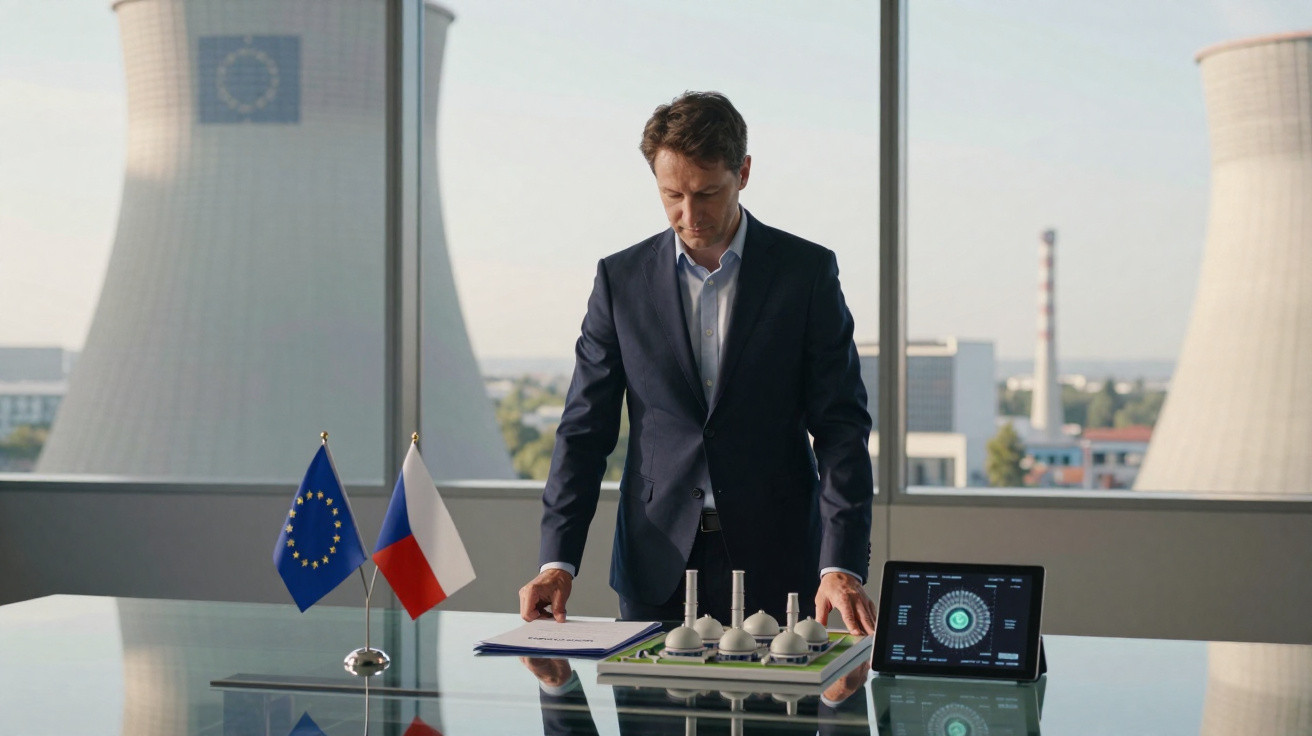
The French energy group had largely been considered out of contention for a landmark Czech nuclear scheme. A possible move by the European Commission could now transform the situation, reviving a competition that industry figures describe as a once-in-a-generation contract.
The nuclear project at the heart of the storm
The tender concerns a significant expansion of nuclear generation in the Czech Republic, where nuclear energy already makes up a substantial part of the electricity mix. Prague wants to secure lasting energy independence as it moves away from coal and cuts gas imports from Russia.
The government began a major procurement programme for new reactors, regularly characterised as the country’s most important energy investment of the decade. The successful bidder is due to design, construct and support the operation of at least one large reactor, with the possibility of several further units.
The contract is valued at around €16.4 billion, a figure that would reshape the balance of power among European nuclear suppliers.
A number of leading groups showed interest, among them France’s EDF, which is putting forward its EPR technology, alongside competitors from the United States and Asia. Following a lengthy assessment and political debate, Prague indicated its preferred partner, while EDF was widely depicted as having been eliminated from the contest.
Why Brussels could still change everything
The Czech decision is not necessarily the final chapter. Major nuclear developments within the European Union must meet demanding rules on state aid, competition and procurement. A complaint or a detailed review by Brussels could postpone, or even overturn, a national decision.
Officials familiar with the process say the European Commission is considering whether the Czech government’s selection complies with EU competition law, and whether state guarantees or subsidies could distort the market.
If the Commission concludes that the tender breached EU rules, the selection of EDF’s rival could be invalidated, reopening the tender or forcing fresh negotiations.
EU examination of nuclear schemes is far from exceptional. Earlier cases in Hungary and the UK demonstrated that Brussels closely reviews long-term power purchase agreements, guaranteed prices and public funding. In both instances, the Commission sought changes intended to protect competition and reduce the cost to taxpayers.
EDF’s nuclear ambition in central Europe
EDF has for many years viewed central and eastern Europe as an important growth market. Ageing reactors dating from the Soviet era, rising electricity demand and decarbonisation objectives provide a natural market for new nuclear construction.
Securing the Czech contract would deliver:
- A revenue stream from construction and maintenance lasting several decades
- Closer political links between Paris and Prague
- A strong reference project for pursuing other regional contracts
- Joint industrial work for Czech engineering businesses and French suppliers
The consequences for Paris are strategic as well. The French state holds a majority stake in EDF and has made nuclear power central to its energy policy. Winning major overseas contracts helps support substantial domestic investment and sustain a broad industrial ecosystem.
Rival technologies facing Brussels’ filter
The Czech tender brings competing nuclear designs into direct competition. Each has its own approach to costs, construction schedules and safety. EU officials will not decide which technology is selected, but their legal assessment may affect which proposals remain feasible.
| Criterion | EDF offer | Main rival offer |
|---|---|---|
| Reactor type | Large European pressurised reactor (EPR/EPR2) | Advanced pressurised water reactor design |
| Construction record | Mixed: delays and overruns, but experience in Europe | Projects in Europe and abroad, varied track record |
| Local supply chain | Commitment to Czech industry participation | Similar localisation promises, different partners |
| Financing model | Heavy involvement of state backing from France and the Czech Republic | Combination of vendor financing and state support |
These technical and financial factors form part of Brussels’ review, particularly where public guarantees and mechanisms for long-term electricity prices are concerned.
State aid, competition and the nuclear tightrope
At the centre of the EU’s possible involvement is a straightforward issue: does the selected financing package comply with single-market rules? Large nuclear stations usually depend on government guarantees, regulated pricing or direct injections of capital.
EU law does not prohibit state aid in every instance. Instead, it requires support to be transparent, justified by a defined public interest and restricted to what is needed. In reality, this often results in complicated talks between national governments and the Commission.
Brussels seeks to balance national energy security ambitions with fair competition between companies bidding for huge, long-term contracts.
Should the Commission find that Prague gave one bidder an unfair advantage through non-transparent guarantees or discriminatory conditions, it could require alterations. In the most serious circumstances, it could demand that the tender be restarted or substantially changed.
What a reversal would mean for the Czech Republic
An unfavourable view from Brussels would cause both political and economic difficulties for Prague. The country requires additional capacity to replace coal-fired plants and preserve dependable electricity exports. Delays would mean greater dependence on gas and imported electricity.
Restarting the tender, or making major changes to it, would:
- Delay the start of construction on new reactors by several years
- Raise costs for the state and consumers because of inflation and financing risks
- Intensify domestic political arguments over energy policy and relations with Brussels
- Put pressure on local industrial partners awaiting contracts
However, a reopened process could also produce improved financial terms if bidders strengthen their proposals. If EDF sees a renewed opportunity, it would probably revise its pricing, risk-sharing arrangements and commitments on local employment.
EDF’s leverage and vulnerabilities
EDF would enter a possible second round with clear advantages as well as notable weaknesses. Its strengths include extensive experience of running and maintaining large nuclear fleets across Europe. It can provide integrated support from design through to decommissioning.
Its weaknesses include delays and cost overruns at flagship EPR developments in Finland, France and the UK, which have given competitors and critics material to use against it. Investors and regulators are closely observing how EDF addresses these issues before approving further megaprojects.
For EDF, the Czech plant is not just a contract; it is a test of credibility for its new generation of reactors.
French backing is also significant. Paris has actively promoted EDF internationally, treating nuclear exports as an instrument of foreign policy. Any renewed Czech procedure would almost certainly prompt intense diplomatic lobbying.
How EU scrutiny unfolds in practice
A typical EU review timetable helps illustrate what could happen next. Once a member state notifies the Commission of its intended support scheme, the Commission may:
- Grant rapid approval where the scheme appears consistent with EU rules
- Open an in-depth investigation and request further documents and market feedback
- Put forward conditions or changes before giving approval
- Block the scheme entirely in rare cases
Throughout this process, uncertainty affects investors and suppliers. Building timetables, finance agreements and recruitment plans could all be paused until the legal position is resolved.
Key concepts behind the political drama
A number of technical expressions shape the debate, and understanding them helps explain what is at stake.
State aid: This means benefits provided by public authorities to particular companies or sectors. In energy, this commonly includes guarantees for project debt, fixed-price long-term contracts or tax relief. EU law aims to prevent such measures from distorting competition excessively.
Security of supply: For the Czech Republic, investing in nuclear power is about more than climate targets. It also means securing dependable winter electricity, withstanding volatility in gas prices and lowering reliance on politically sensitive imports.
Levelised cost of electricity (LCOE): This measure compares the total lifetime cost of generating electricity from different sources. Nuclear power involves substantial upfront spending, but its long operational lifespan and low fuel costs can make it competitive with gas and even with certain renewables supported by storage.
Scenarios for the next few years
Several outcomes remain possible. Under one scenario, the Commission clears the Czech selection with limited amendments and EDF accepts that it has lost. The rival contractor proceeds, although delays would still be probable on such a complicated project.
In another scenario, Brussels finds major problems and requires a revised tender. EDF could return with a more developed proposal, potentially working more closely with Czech companies and revising how risks are shared with the state. A more open competition might lower costs, but it would extend the timetable.
A third possibility is a lengthy legal battle, involving complaints from unsuccessful bidders or non-governmental organisations. This would create the greatest uncertainty and could leave Prague relying on temporary measures to maintain electricity supplies while defending its position in Brussels and domestic courts.
For households and companies in central Europe, these institutional processes may appear remote. Nevertheless, they influence long-term electricity bills, the carbon footprint of the power mix, and employment in heavy industry and high-technology engineering.
The Czech nuclear contract lies where national sovereignty, EU law and industrial policy meet. EDF has not definitively lost this €16.4 billion prize, but its prospects now depend largely on how Brussels assesses the balance between competition rules and energy-security objectives.




Comments
No comments yet. Be the first to comment!
Leave a Comment