
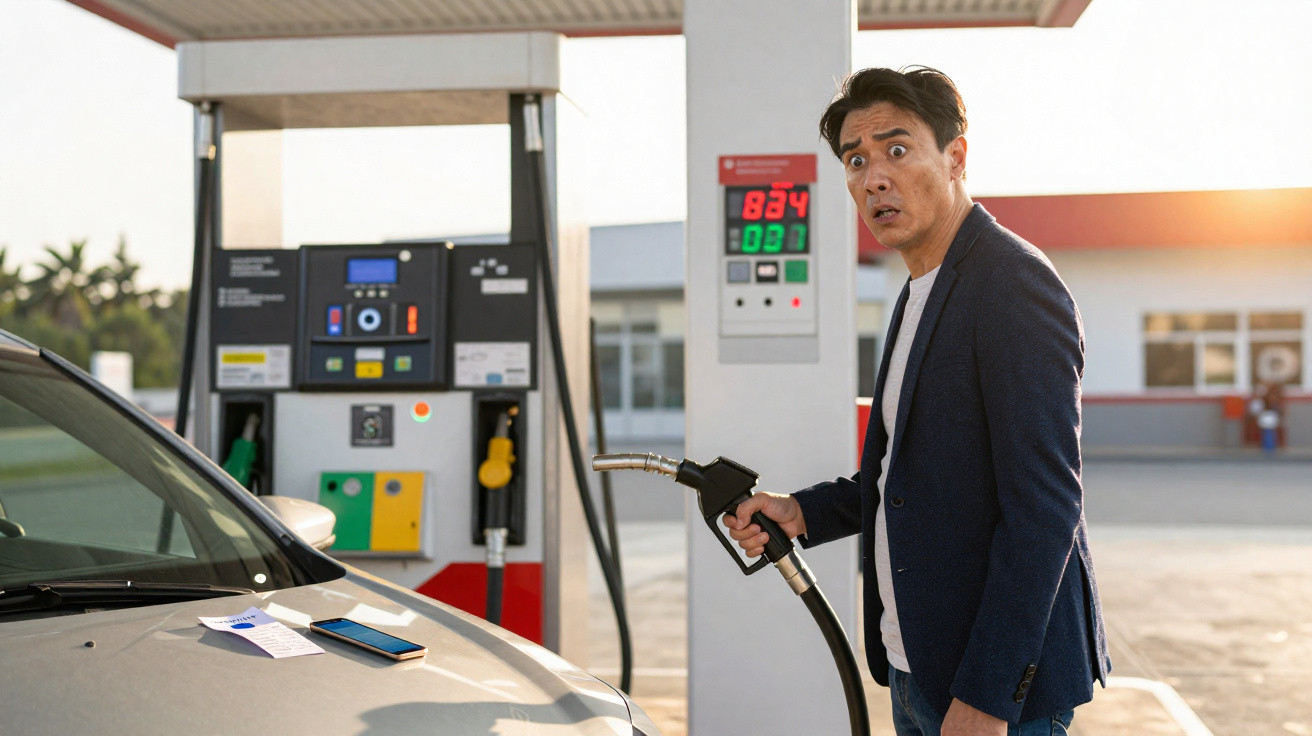
The conflict in Iran and the resulting closure of the Strait of Hormuz have pushed up the price of a barrel throughout the week, with the effect feeding through to fuel prices. Yet this alone does not account for the gap between the expected rise in diesel and petrol prices: an extra 23p per litre versus “only” seven pence per litre, respectively.
So what accounts for this difference? The explanation does not lie solely in the Middle East. It is rooted in decades of European decisions that have steadily weakened the continent’s ability to produce its own fuel. The trigger came from outside Europe, but the issue is structural.
A Europe that stopped investing in refining
European refining capacity has been stagnant for decades and is technically ill-suited to processing increasingly heavy crude oils with higher sulphur content.
Investment in the sector has all but ceased: no refineries have been built on the continent for more than 30 years, while almost 30 sites have closed since 2009. Others are being converted into biorefineries, producing sustainable aviation fuels and hydrogen in an effort to keep those facilities viable.
This has been compounded by growing political pressure arising from policy choices aimed at carbon neutrality. That has meant liquid fuels being progressively sidelined, with the ambition for their role in road transport to become, quite literally, zero in the future.
This approach has also reduced investor appetite for fuel production. Since the end of 2021, the European Investment Bank (EIB) has stopped financing most fossil-fuel projects, including conventional refining. With public finance withdrawn and regulatory pressure mounting, private capital has also moved away from the sector.
The practical consequence is that European refineries - currently competitive and among the most environmentally responsible in the world - could close prematurely, without being given the opportunity to decarbonise or convert to producing low-carbon renewable fuels.
Dependence on Russia and the 2022 shock
As Europe’s refining capacity contracted, its reliance on external supplies of already refined diesel grew. For a long time, that product came roughly half from Russia and half from the Middle East. While this appeared to be a comfortable model during periods of geopolitical stability, it was bound to prove deeply fragile if that stability broke down.
That is precisely what happened in February 2022, following Russia’s invasion of Ukraine. Whether by choice or through sanctions, purchases from Russia were halted. Suddenly, the European market had to find alternative suppliers for the vast volumes of diesel that had been arriving from Russia - both refined diesel and crude oil destined for European refineries.
Dependence on the Middle East has increased since then, although Europe has sought new suppliers, including the United States and India, even if they do not currently carry the same weight. The supply route has changed too, shifting from pipelines to seaborne transport. This alternative is not merely more expensive; it is structurally more exposed to crises such as the current one, making it more vulnerable.
The current trigger: the Middle East has also failed
That vulnerability has now become a reality. The closure of the Strait of Hormuz to shipping - one of the main arteries of global trade in oil and petroleum products, responsible for around 20% of worldwide crude traffic - abruptly cut the flow of refined diesel on which Europe has depended since 2022.
The effect was immediately visible in international prices. Refined diesel rose far more sharply than crude oil itself - three times as much - because the problem is not a shortage of crude. What is being paid for is the scarcity of the processed product and the risk of being unable to bring it to Europe.
Petrol has a different market profile. Europe is comparatively less reliant on imports through this route for its petrol supply, while its domestic production base still has greater capacity to meet demand independently. That is why the price rises for the two fuels differ.
What now?
No short-term solution addresses the underlying issue: Europe has built up a dependence on refined diesel from the other side of the world, dismantled its capacity to produce it at home, and is now discovering that, in an increasingly volatile world, this equation comes at a cost.
And that cost always ends up in the same place: at the pump, paid litre by litre by all of us.





Comments
No comments yet. Be the first to comment!
Leave a Comment