
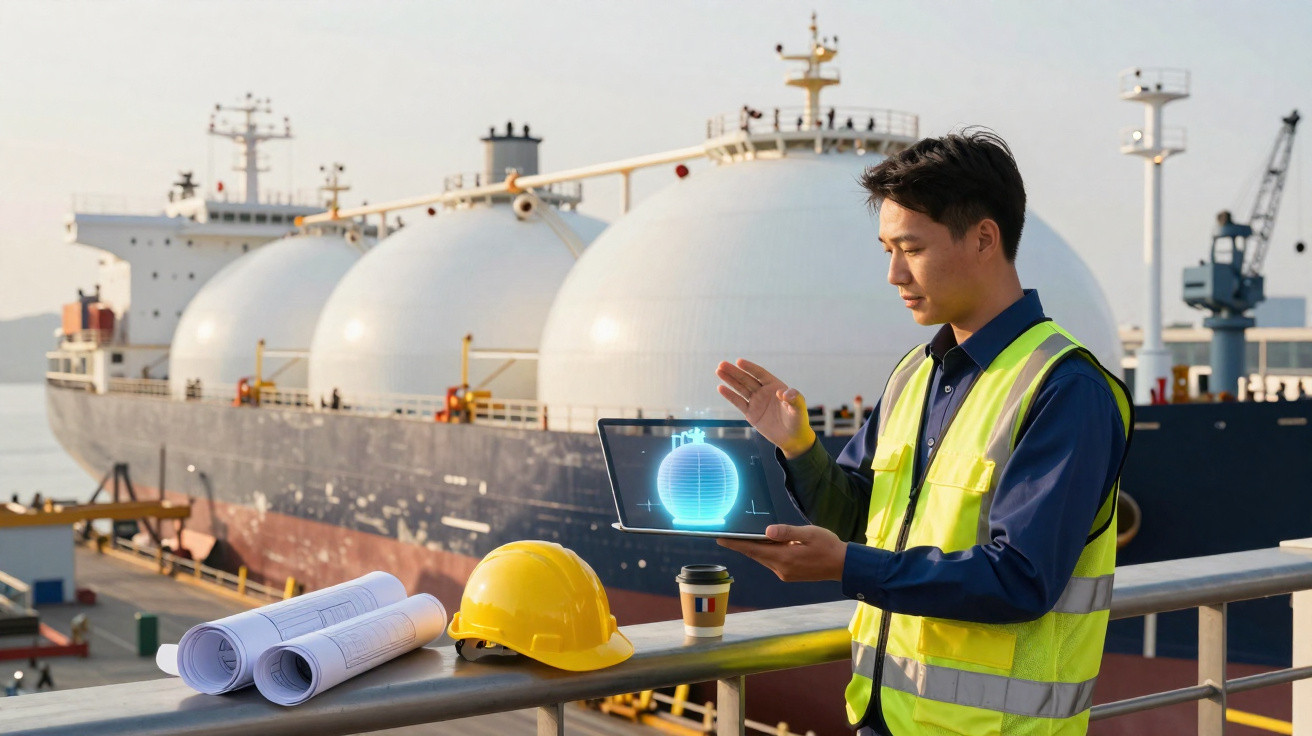
While technology and AI command the headlines, a discreet French engineering group is riding a multibillion-euro energy wave.
Away from household brands and eye-catching apps, Gaztransport & Technigaz (GTT) has transformed a little-known maritime speciality into a major growth driver, precisely as worldwide demand for liquefied natural gas (LNG) redraws energy-trade routes.
GTT, the unseen French force behind the LNG fleet
Most people have not heard of GTT. Its logo is absent from supermarkets, smartphones and streaming platforms. However, the group, headquartered near Paris, occupies a pivotal place in one of global shipping's most profitable markets: LNG megatankers.
GTT develops cryogenic containment systems: highly engineered membranes that hold liquefied natural gas at roughly –163 °C within enormous cargo tanks. The systems must stop leaks, withstand severe mechanical forces and accommodate a vessel's movement in rough seas, while staying as light and space-efficient as possible.
GTT’s technology is now installed on a large share of the LNG carrier fleet under construction worldwide, giving France a quiet but strategic role in global gas trade.
This specialised expertise gives the company a key role in the LNG value chain. LNG has emerged as a transition fuel between high-emission hydrocarbons, such as coal and oil, and cleaner energy systems with a greater reliance on renewables and low-carbon gases.
Following a remarkable run from 2021 to 2025, GTT begins 2026 with further signs that investors and shipyards interpret plainly: demand has not weakened.
Nine LNG megatankers in one week: a strong opening to 2026
During the opening days of January 2026, GTT revealed successive contracts confirming both its commercial momentum and the enduring resilience of LNG shipping.
Samsung and Hanwha add GTT technology to their order books
On 8 January 2026, South Korean heavyweight Samsung Heavy Industries confirmed an order for two next-generation LNG carriers. They are scheduled for delivery between the third quarter of 2028 and the first quarter of 2029, illustrating how extensively major Korean yards are already booked.
A few days before that, Hanwha Ocean, another leading Korean shipbuilder, had won an order from a European shipowner for seven LNG carriers. Those ships are due to be delivered from late 2027 until late 2029, extending the LNG boom into the latter half of the decade.
Each of the nine vessels will use GTT's newest membrane technology. Although the group does not publish the detailed financial terms of individual contracts, sector estimates place revenue from the licence for one vessel's containment system at approximately €10 million.
Nine vessels ordered in early January could generate close to €90 million in revenue for GTT over the coming years, assuming average licence values often cited in the sector.
These figures relate only to licensing the cryogenic membrane design and the related engineering. They are supplemented by paid technical assistance, project management, digital services and long-term inspection work after the vessels begin operating.
Mark III Flex: an LNG tank engineered like a high-tech machine
Far more than a steel container inside the hull
The Mark III Flex system selected for the nine carriers is not merely a strengthened tank fitted inside a hull. It is an entire structure integrated into the ship and engineered to millimetre-level precision.
It brings together a metallic primary membrane, secondary barriers and multilayer insulation. Its purpose is straightforward but demanding: maintain LNG at an extremely low temperature, restrict evaporation and lessen thermal pressure on the vessel.
As LNG warms slightly, a small proportion returns to its gaseous state. This “boil-off” gas may power the ship, but excessive volumes mean less cargo delivered and reduced operational flexibility for owners.
Mark III Flex is intended to reduce this loss. Lower boil-off allows more gas to reach the customer, produces fewer emissions associated with bunkering and handling, and improves a shipowner's economics over a vessel lifespan of 20 to 30 years.
- Lower evaporation rate: more saleable cargo on arrival.
- Improved energy efficiency: less need to burn cargo as fuel.
- Reduced environmental footprint: fewer indirect greenhouse gas emissions.
- Higher asset value: ships with efficient tanks retain better charter rates.
For one 170,000-cubic-metre LNG carrier, reducing annual boil-off by even a fraction of a percentage point can save millions of dollars throughout the ship's life. Across a global fleet numbering hundreds of carriers, the financial and climate effect becomes substantial.
South Korean shipyards, LNG shipping's power brokers
Why Korea receives so many orders
The high concentration of orders in South Korea is no accident. Korean yards lead the construction of sophisticated gas carriers. Samsung Heavy Industries and Hanwha Ocean, alongside HD Korea Shipbuilding & Offshore Engineering, sit at the centre of this ecosystem.
They offer extensive LNG experience, a broad supply network and workers trained for highly specialised projects. For operators, construction in Korea can lower technical risk and speed up access to dependable financing, as banks and charterers are familiar with these yards.
For GTT, the yards serve as multipliers. Every large Korean LNG order provides a chance to embed its technology for decades, backed by service teams, software and recurring monitoring income.
The relationship between GTT and Korean yards now resembles an industrial alliance: French cryogenic engineering combined with Korean shipbuilding scale.
Every project involves naval architects, cryogenic specialists, digital engineers and on-site supervisors. While vessels are being built, GTT experts attend the yards to supervise membrane fitting, assess weld quality and approve tightness tests.
From LNG tanks to digital services and new gases
A growth narrative beyond megatankers
Between 2021 and 2025, GTT's revenue nearly trebled, climbing from around €290 million to an estimated €775 million. This represents an average annual growth rate of close to 28%, initially fuelled by the rush for LNG carriers after Europe sought alternatives to Russian gas.
However, the business is not dependent solely on the current surge in tank orders. Management has pursued diversification through three key areas: digital services, new low-carbon gases and recurring support contracts.
| Year | Approx. revenue | Annual growth |
|---|---|---|
| 2021 | ~€290m | - |
| 2022 | ~€320m | +10% |
| 2023 | ~€420m | +31% |
| 2024 | ~€625m | +49% |
| 2025 (est.) | ~€775m | +24% |
Digital platforms using data from sensors on tanks and ship systems now enable operators to optimise routes, control boil-off and track structural behaviour in real time. The data has obvious commercial worth: it can cut fuel use, reduce unscheduled downtime and assist safety audits.
At the same time, GTT is applying its cryogenic knowledge to alternative fuels. Ammonia, liquid hydrogen and other low-carbon gases need storage solutions capable of dealing with toxicity, extreme cold, or both. These segments remain small beside LNG, but regulators and shipowners view them as possible routes towards decarbonising deep-sea shipping.
Income recurring from inspections, maintenance planning and software licences helps stabilise the group's results. LNG carrier orders arrive in cycles, yet a vessel's tanks require monitoring for decades once it enters service. This service element creates a foundation of more predictable cash flows across commodity cycles.
Strategic consequences for energy, shipping and investors
LNG's complicated place in the energy transition
LNG occupies an uncertain position in climate policy. When burned, it produces less CO₂ than coal and fuel oil, but it is still a fossil fuel and methane leakage remains a genuine issue. Nevertheless, for many nations it provides supply security, flexibility and time to develop renewables and storage.
GTT's path reflects this tension. Its expansion gains from governments' efforts to move away from pipeline gas, especially after the disruptions of the early 2020s. Meanwhile, regulators are demanding stricter emissions rules and methane lifecycle reporting.
For shipowners and charterers, the crucial issue is return on investment. Funding an LNG carrier with premium containment is more reassuring where the vessel can later be adapted or repurposed, or where the same supplier can provide systems for future fuels.
Ship finance now focuses less on the pure cost of a tanker and more on its “future readiness”: efficiency today, compatibility with stricter regulations tomorrow.
What investors monitoring 2026 should take from this
From a market standpoint, the January run of nine ship deals supports three trends. First, LNG shipping capacity remains constrained beyond 2027, securing a multi-year order pipeline for specialised suppliers. Second, technology providers that lower emissions and raise efficiency operate in a supportive regulatory setting. Third, combining one-off construction licences with recurring digital income can make earnings less volatile than conventional shipyard cycles.
Investors assessing GTT or comparable companies must consider several variables: projected regional LNG demand, the speed of renewable deployment, possible methane taxes or pricing, and the pace at which alternative fuels scale up. Scenario analysis is useful. Under a “fast transition” scenario, for instance, where ammonia propulsion achieves meaningful market share after 2030, GTT's investment in multi-gas technologies could compensate for any slowdown in standalone LNG tank orders.
For shipping, these contracts emphasise a practical fact. During the next decade, most long-distance gas cargoes will continue to be carried by LNG vessels. Shipowners' main competitive advantage will depend on technical decisions taken now: tank efficiency, the digital tools used on board and the adaptability of designs to meet future fuel and climate requirements.






Comments
No comments yet. Be the first to comment!
Leave a Comment