
Far beneath the ocean’s surface, the deep seafloor is widely regarded as one of Earth’s most undisturbed ecosystems. That view is now under scrutiny.
Companies are moving towards mining the mineral-rich nodules spread across the abyss. This development raises pressing questions about how soon damage may emerge after industrial machinery starts work.
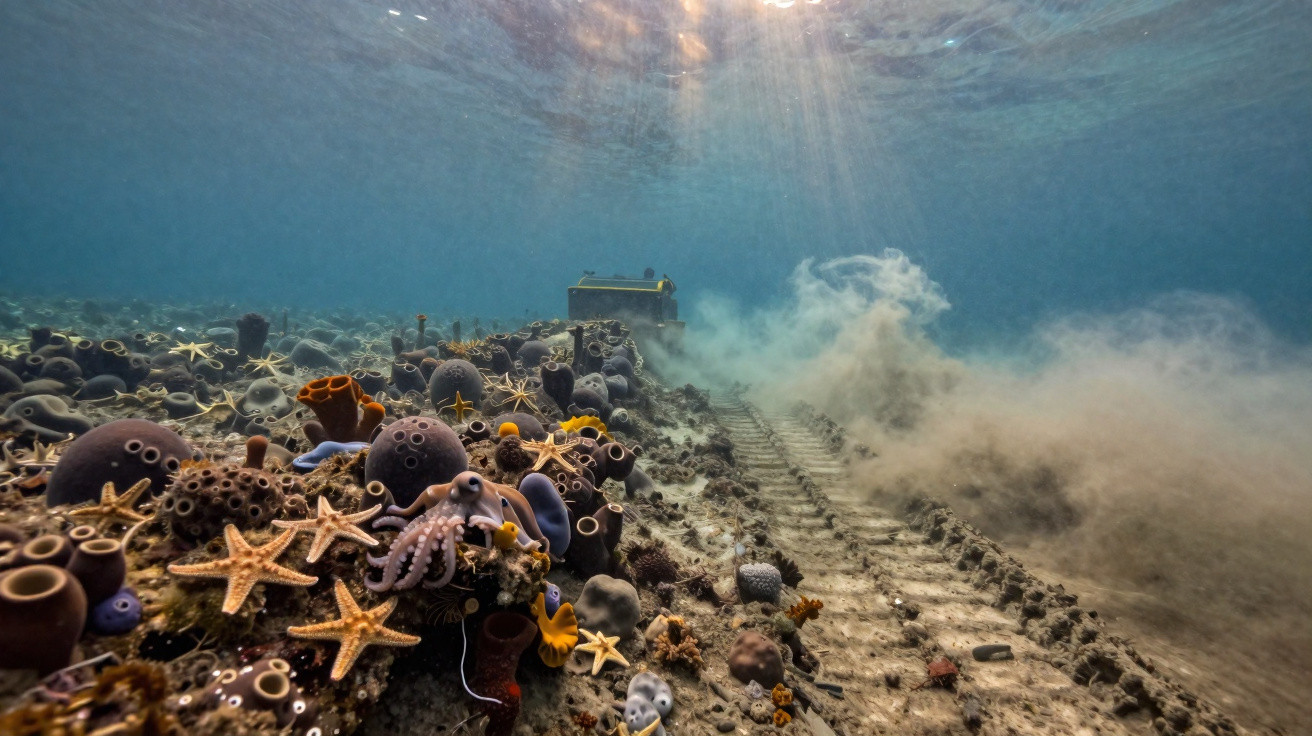
A new field experiment provides one of the strongest answers so far. Scientists found that one pass by a deep-sea mining collector physically eliminated more than one-third of the animals and species directly in its route.
The findings indicate that biological harm may happen at once, rather than only following years of large-scale extraction.
Investigating deep-sea mining collector tracks
The harm was recorded in newly made tracks cut into the abyssal seafloor during a 2022 trial, which lifted thousands of tonnes of mineral-rich nodules from deep Pacific sediments.
Eva C. D. Stewart and colleagues at London’s Natural History Museum (NHM) compared conditions before and after the trial, directly showing that animal communities became less numerous and less varied within the tracks.
The reduction was evident within months of the test and remained clear despite the substantial natural fluctuations that influence deep-sea life over time.
This difference between swift disruption and gradual background variation defines both what the evidence can currently demonstrate and what still needs to be learned about the wider seafloor response.
Polymetallic nodules sustain seafloor life
Mining firms are seeking polymetallic nodules – rock-like formations on the seafloor containing valuable metals including nickel, cobalt and copper – as worldwide demand for these resources keeps increasing.
Throughout much of the deep ocean, these nodules are dispersed across soft mud, providing rare areas of hard substrate. Numerous animals cling to them or rely on them for food, shelter and reproduction.
When mining equipment gathers nodules from the seafloor, it removes these habitats as well as the minerals.
As so many species rely on the nodules themselves, mining impacts must be assessed as habitat destruction – rather than simply by the volume of metal recovered.
Tracks produced the greatest decline
Within the new tracks, macrofauna – seafloor animals that can be seen without a microscope – declined markedly in just two months. The collector disturbed the top inch of sediment, where most organisms live, leaving behind an exposed strip.
Using samples collected before mining, the researchers found a 32 percent reduction in species richness within the tracks.
“Finally, we have good data on what the impacts of a modern commercial deep-sea mining machine might be,” said Stewart.
Sediment plumes reshaped the seafloor community
Away from the tracks, sediment plumes – drifting, settling clouds of disturbed mud – altered which species were most prevalent without reducing the total number of animals.
The researchers collected samples roughly 1,300 feet from the track and found that a light coating of sediment had settled over the nodules.
Animal abundance remained consistent in this area, yet several species became more dominant, reducing overall biodiversity in the plume zone.
Since plumes may extend beyond the mined tracks, monitoring must examine the balance of communities as well as simple animal totals across large areas.
Natural cycles can conceal damage
For two years before mining started, animal densities increased and decreased across the abyssal plain – a level expanse of deep seafloor covered with fine mud.
Shifts in surface winds and currents influenced the amount of food reaching the seabed, and seafloor communities responded accordingly. These natural changes lowered animal numbers at several sites before the trial, making reliable control sites essential.
Without repeated sampling, managers might interpret a climate-related decline as mining harm and set the wrong protection boundary.
From 80 mud cores, the team sorted 4,350 animals and recognised 788 species, although diversity was still under-sampled. Estimates indicated that around 15,000 individuals, or 400 cores, would be required to identify most species.
The scientists measured species richness – the number of distinct species in each core – which commonly declines when mining diminishes animal communities.
“We have also discovered many new species and shown how the abyssal ecosystem changes naturally over time,” said Stewart.
Deep-sea mining recovery could require decades
Findings from earlier trials indicate that recovery is likely to be slow and inconsistent. Another study following a 1979 mining test strip continued to detect major disruption 44 years later.
Deep-ocean sediments are mixed only gradually, while replacing removed nodules takes far longer than a human lifetime, meaning communities recover extremely slowly.
Some small, mobile organisms returned, but many larger animals remained less abundant in scraped areas. This record indicates that recent tracks could endure for decades, so the losses now documented may represent only an early warning.
Assessing such long-term change will demand more robust monitoring. Future surveys need sufficient sediment cores to account for natural variation, with at least five recommended at every site.
Collecting additional cores lowers the risk that one unusually species-rich or species-poor sample determines the outcome, particularly as animals occur in patches.
Surveys will also need specialists who can identify animals to species level. Without this precision, monitoring may fail to identify which species vanish first or overlook slower ecological changes beyond mined tracks.
Seafloor findings intensify the mining debate
The International Seabed Authority has granted 15-year exploration contracts to 22 contractors, while the industry continues pressing for regulations for commercial mining.
Regulators already demand baseline studies and environmental impact plans, and these findings underline why both should contain long-term time-series monitoring.
During the latest trial, Nauru Ocean Resources worked with Allseas to run the collector. The test showed that mining can cause immediate harm to the seafloor while also triggering wider, more subtle ecological changes over time.
Until longer-term follow-up information is available, policymakers must make a difficult choice over how much uncertainty they are prepared to tolerate.
Ongoing monitoring will establish whether affected communities are able to recover. The same rigorous sampling method could inform future permitting decisions or support pauses as governments balance economic demand with environmental risk.






Comments
No comments yet. Be the first to comment!
Leave a Comment