
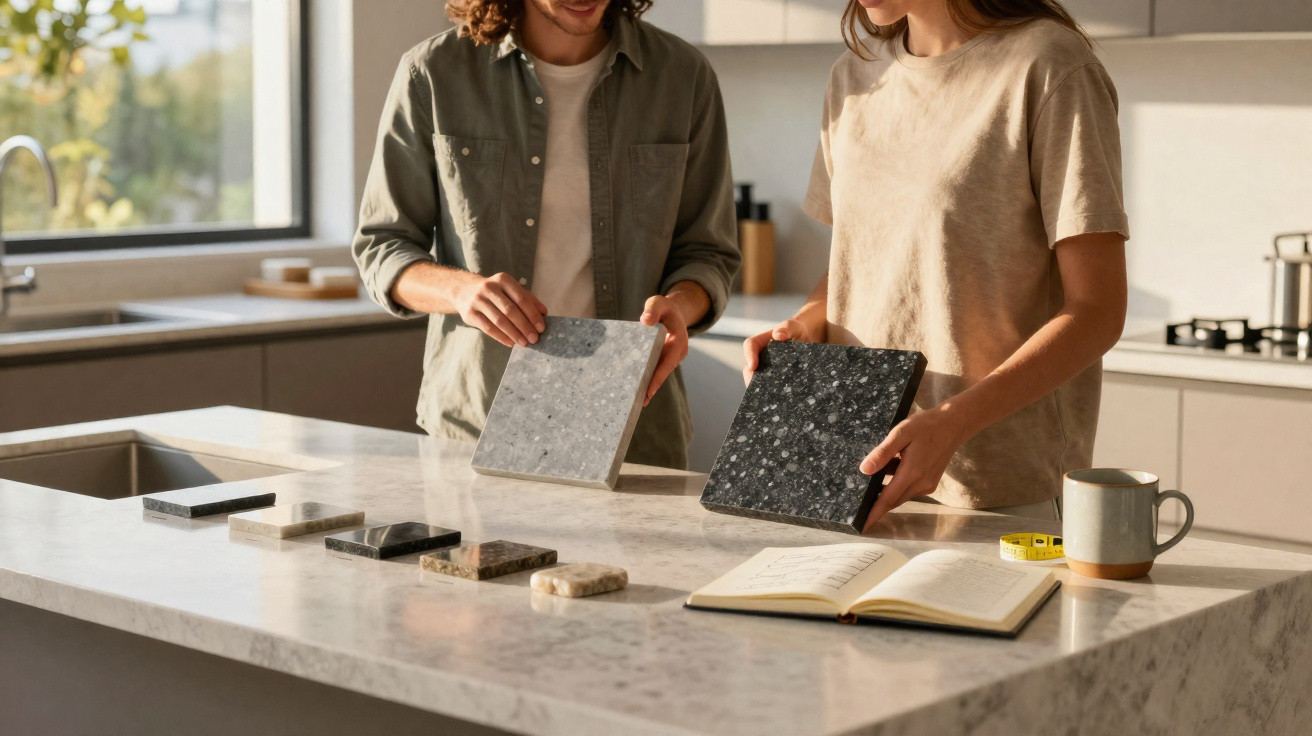
Engineered quartz has become a strong alternative to the traditional granite worktop because it combines low porosity, a consistent appearance and high resistance to coffee, wine and oil stains. Unlike many natural stones, its surface does not need sealing to prevent liquids from penetrating. There is, however, an important detail: this material is manufactured from mineral particles bound together with resins and pigments.
Why does quartz stain less than many natural stones?
The key difference is porosity. Manufactured quartz creates an almost non-porous surface, making it harder for liquids that commonly cause concern on a kitchen worktop to be absorbed. This makes prompt removal of spills easier and removes the need for the sealing used on certain natural stones to improve stain resistance.
- It has very low porosity.
- It does not require waterproofing with a sealant after installation.
- It withstands everyday spills from food and drinks well.
- It can usually be cleaned with water, a soft cloth and mild detergent.
- It offers more consistent patterns and colours than many natural slabs.
Does granite really need frequent sealing?
Not necessarily. Comparisons between granite and quartz often oversimplify this issue. The Natural Stone Institute states that many granite worktops do not need sealant at all, while others benefit from the use of a suitable product. Where sealing is needed and correctly applied, some sealants can have an expected service life of up to 10 or 15 years.
The benefit of quartz, therefore, is not that it necessarily eliminates annual maintenance that every granite surface would otherwise require. Instead, it avoids the need for that assessment and sealant application from the outset. With natural stone, the porosity, finish and specific slab type determine whether additional protection is needed, and sealing improves stain resistance without making the material entirely stain-proof.
Are quartz joints really easier to conceal?
The consistency of the colour and pattern can help an installer create a visually discreet joint, particularly with uniform designs. However, claiming that the material “does not need resin” is incorrect: the sections are joined using specialist adhesives, normally pigmented to match the slab. Joints still exist, and how they look depends on the cuts, the worktop design and the skill of the stone fabricator.
- The slab is cut to suit the kitchen measurements.
- The sections are fitted to minimise the gap between joints.
- A colour-matched adhesive is applied to the joint.
- The sections are aligned and kept level while the adhesive dries.
- Strongly veined designs require more planning to maintain visual continuity.
Engineered quartz and granite offer different everyday benefits
Its low absorption rate gives engineered quartz an advantage with liquids and makes maintenance simpler, but granite has an important benefit near the hob: it copes better with high temperatures. Quartz contains polymer resins that can discolour or develop permanent marks if very hot pans are placed directly on it, which is why manufacturers recommend using heat mats or trivets.
Granite also provides the natural pattern variation sought in many projects, whereas quartz offers greater control over shade and pattern repetition. In both materials, heavy impacts on edges can cause chips, while cut-outs for the sink and hob must be made properly to reduce stress points in the kitchen worktop.
How much does it cost to replace granite with quartz in the kitchen?
Price may be the very factor that keeps granite competitive. A Brazilian reference published in 2026 estimates installed worktops in common domestic granites at approximately R$ 550 to R$ 900 per m², although specialist varieties can exceed R$ 1.500 per m². Another market reference puts quartz worktops at around R$ 1.300 per m², with substantial variation according to brand, colour, thickness, cut-outs, edge finishing and installation. These figures are only an indication of scale: a quote from a local stone fabricator is what determines the actual cost.
Engineered quartz makes more sense for those who prioritise stain resistance, a controlled appearance and straightforward maintenance, while granite remains appealing because of the price of many domestic varieties, its heat resistance and the natural pattern of every slab. The decision is not simply about replacing an “old” stone with a “better” one: it means deciding which features matter most in that renovation and comparing the cost of the complete worktop, including the material, cut-outs, joints, sink, upstand, transport and installation.




Comments
No comments yet. Be the first to comment!
Leave a Comment