
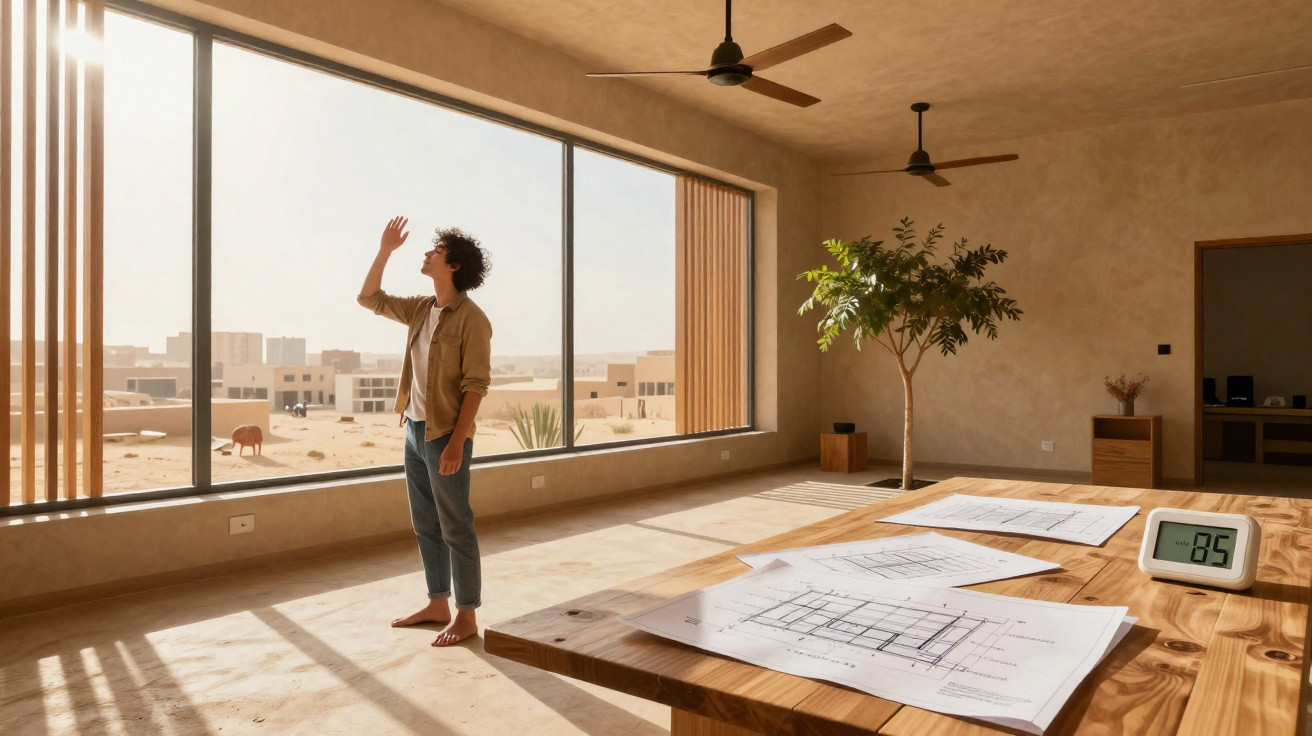
We rarely think of buildings as systems that sustain life. Yet that is precisely their role. We sleep, work and take refuge from storms within them, and we return to them when the outdoor air feels furnace-like.
People spend 90% of their lives inside buildings, where walls, roofs and windows provide a protective ‘third skin’ against the weather.
That ‘third skin’ is now coming under increasing pressure. Weather patterns are becoming more severe, while many homes and offices were never designed for the heatwaves and freezing storms occurring more frequently.
This matters because a building that cannot maintain a safe temperature is more than merely unpleasant: it can put people at risk.
When buildings no longer work
Many homes and workplaces have not been built to cope with the extreme shifts in weather that will become increasingly common in a warmer future.
This is evident in spaces that warm rapidly and remain hot long after sunset, or rooms that become bitterly cold as soon as a cold front arrives.
The writers of Adaptive Thermal Comfort: At the Extremes – Susan Roaf, Fergus Nicol and Michael Humphreys – offer an unequivocal assessment.
“In reality, many modern buildings, and particularly homes, are already failing in various ways. During extreme weather events, they overheat. During power outages, some buildings do not even remain habitable,” they noted.
Power cuts during heatwaves or winter storms are no longer unusual. Once the power fails, many contemporary buildings lose not only comfort but also their basic safety.
The cost of remaining comfortable
“Even many in the middle classes in developed economies are finding it increasingly hard to afford the energy needed to keep their homes thermally safe, let alone comfortable, even before the onset of the evermore extreme weather events we will all face in the future,” wrote the authors.
The issue extends beyond cost alone. It concerns the decisions people are compelled to make: should they keep the air conditioning running overnight and face the bill later, or endure the heat and risk becoming ill?
At this point, building design becomes deeply personal. It determines who can feel secure, who can sleep, and who must simply endure each season.
Why modern building design can worsen the problem
Many current design fashions photograph well but perform poorly in actual weather conditions. Frequent building design problems include the risk of overheating in poorly ventilated single-aspect flats, as well as buildings in dense urban areas that hold onto high temperatures throughout hot days and nights.
Large expanses of glass present another difficulty. Many modern homes feature open-plan layouts and extensive glazed walls without blinds or curtains.
Such designs allow heat to enter and escape with ease, meaning rooms can become excessively hot or cold very quickly, to the detriment of residents’ health and comfort.
The book suggests that this situation developed gradually over time.
During the twentieth century, the authors say, the Western world promoted an extremely narrow interpretation of “thermal comfort” in building design. This led to the spread of lightweight, glass-walled, air-conditioned buildings across the globe, often with windows that cannot be opened.
These buildings are not only highly energy-intensive to operate, with that demand set to grow as climates become harsher; many are also super-polluters and significant contributors to climate change.
In other words, the very building model that performs badly in extreme weather may also help intensify that weather. It is a feedback loop that is difficult to overlook.
Rethinking the way we design buildings
The authors contend that machines should no longer be viewed as the sole solution.
“The way we currently measure and design buildings for the climate is not working. It is leading us to a dead-end generation of unadaptable and thermally dangerous buildings that require so much energy to remain habitable, that only the very wealthiest will be able to afford to occupy them,” they warned.
The researchers describe a turning point. One path involves continuing to create buildings that are isolated from the surrounding climate and kept habitable by efficient machinery.
“The other direction points to the seemingly revolutionary idea that we urgently need to reconnect indoor climates to those outside them to create buildings in which people are enabled to use local, natural, renewable energy from sun, wind and planting to stay comfortable indoors for as much of the year as possible, free of cost to themselves and with minimal impacts on the planet.”
The notion of ‘reconnecting’ may seem unfamiliar to anyone raised to equate comfort with tightly sealed rooms and powerful cooled air. However, it reflects how people lived for centuries: in buildings that responded to local weather rather than constantly resisting it.
Making extreme climates liveable
The team observes that people have always adapted to their environments across an enormous range of climates, made liveable through buildings that evolved locally.
They maintain that we must now recover knowledge from traditional builders worldwide who already create for extreme climates.
The book draws on examples ranging from Mongolia’s traditional yurts to the Māori approach to human well-being.
It also looks to Sweden, where community support can help protect people during severe conditions, and to architects in South East Asia who create comfort from local, natural materials and resources rather than relying entirely on continuous air conditioning.
This change would also alter whose knowledge is valued. Rather than treating ‘Western’ design as the norm, the book argues that essential expertise already exists in regions that have managed heat, humidity and dramatic weather changes for generations.
What pioneering building designers do differently
Susan Roaf, professor of architectural engineering at Heriot Watt University, argues for a fundamental reset.
“We need radical new thinking. We need completely new thinking that enables buildings to run on local energy, using natural ventilation, solar gain in winter, and time cooling in summer, so profoundly reducing energy use in, and carbon emissions from buildings. More efficient machines are not the solution,” said Professor Roaf.
“What’s really exciting is the new generation of pioneering architects who design beautiful, comfortable, naturally-ventilated buildings that keep people cool.
“It’s time we in the North start listening to others. It’s time for architects in South East Asia, for instance, who are creating wonderful buildings, to export their wisdom back to teach the West how to design responsible climate-friendly homes and workplaces.”
“This is the message: we need hybrid or mixed-mode buildings that can be run for as much of the year as possible on local, free, natural energy, and only heated or cooled when necessary.”
This ‘hybrid’ model reflects the practical approach increasingly advocated by engineers. It favours buildings kept stable through careful orientation, shading, insulation, air flow and thermal mass, with mechanical heating or cooling used as a backup rather than the primary strategy.
The complete study appeared in the journal Adaptive Thermal Comfort.






Comments
No comments yet. Be the first to comment!
Leave a Comment