
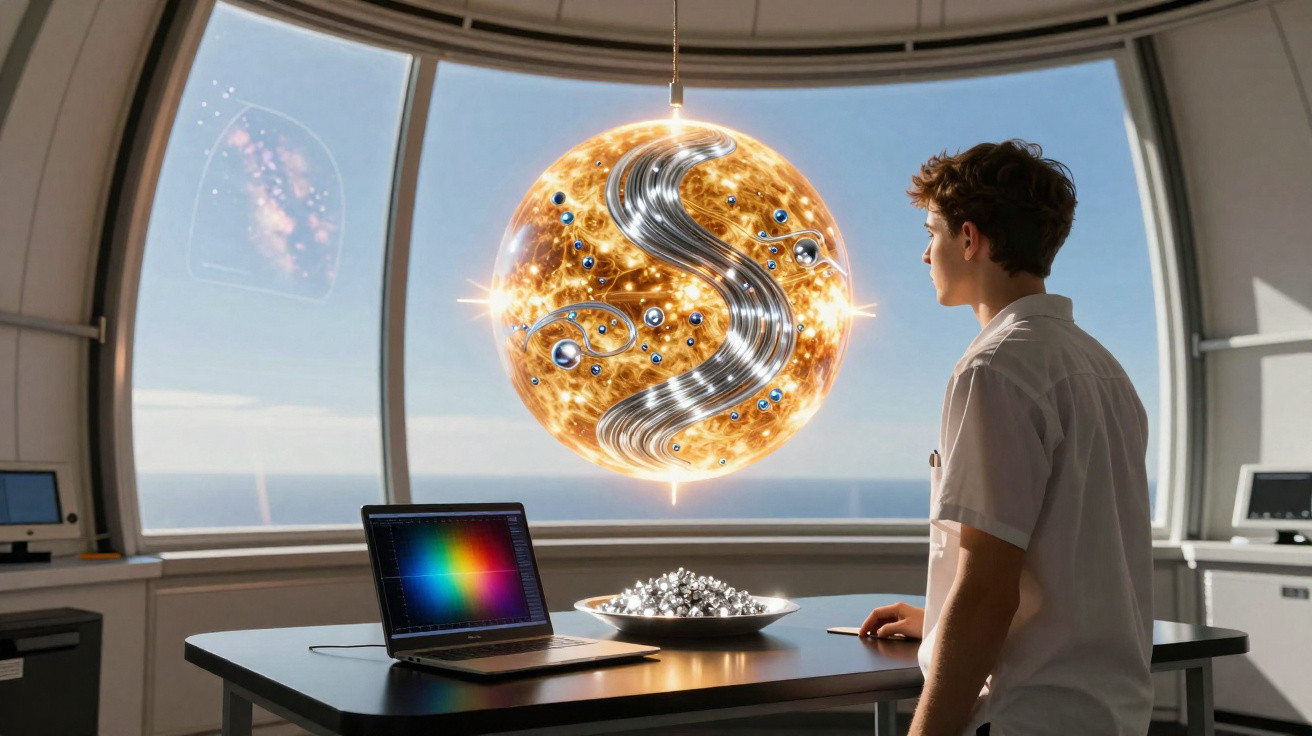
The Sun's missing silver
For years, scientists have puzzled over the Solar System's apparent shortage of silver.
Why do ancient meteorite fragments hold far more silver than the Sun when both formed about 4.6 billion years ago?
If they emerged simultaneously from the same rotating cloud of dust and gas, their ingredients ought to be similar. A new study by an international research team, published in Astronomy & Astrophysics, may now explain the discrepancy.
There is considerably more silver in the Sun than scientists had previously believed.
Silver still represents only a tiny proportion overall: hydrogen and helium account for 98.5 percent of the Sun's mass. Yet the latest calculations indicate that our star contains 55 percent more silver than earlier research suggested.
A clearer model of the Sun's light
This substantial revision stems from a far more advanced model for interpreting the light emitted by the Sun.
As sunlight travels through atoms in the Sun's outer atmosphere, some wavelengths are absorbed. This creates dark marks at particular wavelengths, called spectral lines, and their patterns reveal the atmosphere's composition. Every element produces a distinctive signature.
Using a supercomputer, the researchers applied a much more detailed three-dimensional model of the Sun and its light emissions. It enabled them to reassess how silver atoms may behave and interact with solar radiation.
"With our new model, we were able to interpret the spectral lines used to determine the solar silver abundance more accurately," says astrophysicist Sema Caliskan, from Uppsala University in Sweden.
The 55 percent increase brings the Sun's silver level almost entirely in line with meteorites of the same age. Unlike the Sun, meteorites can be directly sampled because they regularly arrive on Earth.
What the Sun's silver reveals about the Milky Way
The results do more than resolve a Solar System calculation mismatch. Establishing the Sun's silver content helps scientists follow the Milky Way's chemical evolution and assess how long other stars may have existed.
Because silver can be produced during a star's death, the element also offers a view into the Universe's earliest eras and the evolution of celestial bodies.
"The new knowledge about the Sun's composition is important for the understanding of other stars, planets and cosmic material, because the Sun is one of astronomy's key reference points," says Caliskan,
The updated model nevertheless retains some uncertainties. By examining how responsive the outcome was to varying inputs, the scientists found that the calculations were influenced most strongly by data describing interactions between silver and hydrogen.
Further observations and data collection should allow the model to be refined, the researchers say.
"We assessed modeling uncertainties via targeted sensitivity tests, finding the results to be most sensitive to the hydrogen-collision data," writes the team in their published paper.
For instance, the SUNRISE UV Spectropolarimeter and Imager - SUSI for short - has gathered detailed information on light travelling from the Sun to Earth. These measurements could help calibrate the model more precisely.
Having established how much silver the Sun contains, the team plans to use its improved model on other stars. Future research could use silver as a forensic clue to reveal more about the Milky Way and its expansion.
As ever, fresh data can test existing findings, giving astronomers a stronger and more dependable view of the Solar System and beyond.
"By studying the light of stars of different types and ages, we hope to understand where silver is formed in the Universe, and how it has been distributed throughout the Milky Way over time," says Caliskan.
The research was published in Astronomy & Astrophysics.
This article was fact-checked by Rachel Garner and edited by Rebecca Dyer. Although we take pride in our process, we are only human. If you notice an error, please let us know.






Comments
No comments yet. Be the first to comment!
Leave a Comment