
Plastic pollution may seem remote-until it appears where it clearly does not belong, including in human blood. Rather than disappearing, most plastics fragment into microplastics that travel through the oceans, enter the food chain and persist for decades.
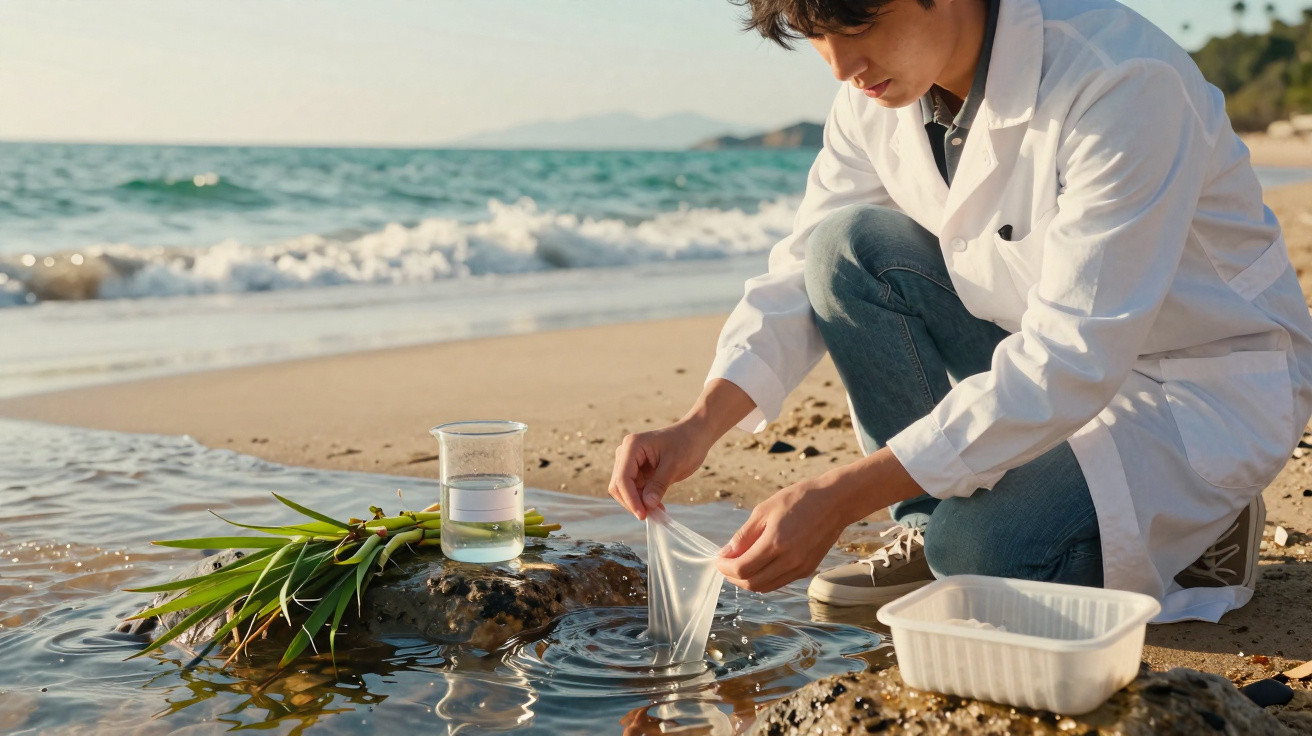
Researchers in Japan now report what could be a more promising alternative. They have developed a plant-based plastic that fully dissolves in seawater within hours, without leaving microplastic particles behind.
Made from cellulose, Earth’s most plentiful natural polymer, the material is intended for everyday packaging. It stays durable while in use, yet can safely disintegrate if it reaches the sea.
The research, led by Dr. Takuzo Aida at the RIKEN Center for Emergent Matter Science (CEMS), suggests a different approach to plastics-one centred on what happens to materials after they have been discarded.
From plastic to particles
Exposure to sunlight and the movement of waves can grind larger plastic objects into tiny pieces that become mixed with beach sand and surface water.
Fish and shellfish may ingest these particles, which can then be eaten by people unaware of what else may be present in their meal.
Microplastics are challenging to trace, as laboratories use methods including pyrolysis-where a sample is heated until it decomposes into simpler gases-alongside other analytical techniques.
Building plastic from plants
The researchers started with carboxymethyl cellulose, a chemically altered cellulose form that dissolves in water, thickens liquid blends and is already manufactured at industrial scale.
However, plant-derived raw materials do not automatically ensure harmless degradation, as certain chemical bonds can withstand microbes as well as demanding saltwater environments.
To convert this cellulose derivative into plastic, the CEMS team applied ionic polymerisation. In this method, charged chemical groups form chains in ordinary water at room temperature.
A second polymer, containing positively charged guanidinium ions, attached itself to acidic points along the cellulose chains, enabling the components to connect.
This produced a tightly cross-linked network-a mesh of joined chains-that provides the transparent film with its rigidity and strength.
Salt and CMCSP
CMCSP gains its strength from salt bridges, which are temporary connections between opposing electrical charges that support the polymer network.
As seawater penetrates the material, sodium and chloride ions crowd around these connections and disrupt them, causing the network to separate into water-soluble components.
To prevent premature degradation, the team applied a fine protective coating that slows the penetration of water and salts during ordinary use.
The first film versions were transparent and robust, but they were also brittle and readily cracked because the rigid cellulose chains could not slide past each other.
Researchers addressed this by introducing choline chloride as a plasticiser-small molecules that allow polymer chains to flex rather than break.
By varying the amount of this salt, the team was able to adjust the material from firm sheets to softer films with greater stretch.
Strong enough for packaging
In their paper, the researchers characterise CMCSP as mechanically strong and explain that its flexibility can be adjusted through the additive. When sufficient additive was used, CMCSP stretched to 130 percent of its original length before it broke during tensile testing.
The team also created a transparent, readily handled film measuring only 0.003 inches (0.07 mm) thick.
To demonstrate that the chemistry could be applied beyond small laboratory specimens, they made CMCSP into a lightweight bag for fruit and vegetables.
In a demonstration video, the bag held tomatoes successfully, offering a straightforward but useful test of practical packaging performance.
These very thin bags are particularly important because they can easily escape rubbish bins and landfill sites, and they are a frequent contributor to plastic pollution in waterways.
No microplastics left behind
The crucial process is dissociation-separation into individual molecules rather than increasingly small fragments-which prevents the usual formation of microplastics.
After entering solution, the ingredients expose their entire surfaces, enabling natural chemical reactions to occur more quickly than they would in solid materials.
The authors call the material closed-loop recyclable because its dissolved components can be retrieved and recombined into the same material without requiring fresh feedstocks.
Recycling dissolved plant-based plastic
The team recovered CMCSP by introducing an electrolyte, a salt that separates into charged particles in water, which drew the components together again.
This route is important because rapid breakdown in the ocean should serve as a safeguard, rather than as the primary means of dealing with most plastic waste.
In real-world use, recycling would require collection systems capable of stopping the dissolved mixture from dispersing and losing its value further downstream.
What makes it different
Many compostable products degrade effectively only in heated industrial facilities, meaning they can persist when they reach cold seawater.
Rather than depending on hydrolysis-bond breaking caused by water and enzymes-CMCSP disintegrates when salts interfere with its charged links.
As salts are also found in soil, disposal on land could prompt degradation as well, though actual soil conditions differ greatly in their moisture levels.
Limits of biodegradable plastics
A field study monitoring polylactic acid textiles in seawater recorded little visible alteration after 428 days, showing why “biodegradable” can mislead consumers when labels do not account for marine environments.
These findings underline the need for real-world testing that assesses not just whether materials degrade, but whether their breakdown products are safe for marine organisms. At the same time, any new packaging material must satisfy practical requirements.
Coatings and films must still prevent the passage of gases and water vapour. Food producers also need assurance that chemicals will not transfer into food or change its flavour.
Pricing must also stay competitive with paper, recycled plastic and other plant-based polymers already competing for space on shelves.
Future of CMCSP
Expanding CMCSP production will depend on reliable material supplies, consistent film properties and disposal guidance that matches the ways people actually throw packaging away.
“This study shows that our work is now at a more practical stage,” said Dr. Aida.
The water-based blending method eliminates many chemical solvents typically used in plastic production, although processing and drying in factories would still consume energy.
If it can be scaled successfully, CMCSP may provide packaging that is durable in normal use while breaking down faster after entering seawater.
Nevertheless, tackling plastic pollution will still require lower single-use consumption, better waste-collection systems and policies that encourage cleaner, more recyclable materials.




Comments
No comments yet. Be the first to comment!
Leave a Comment