
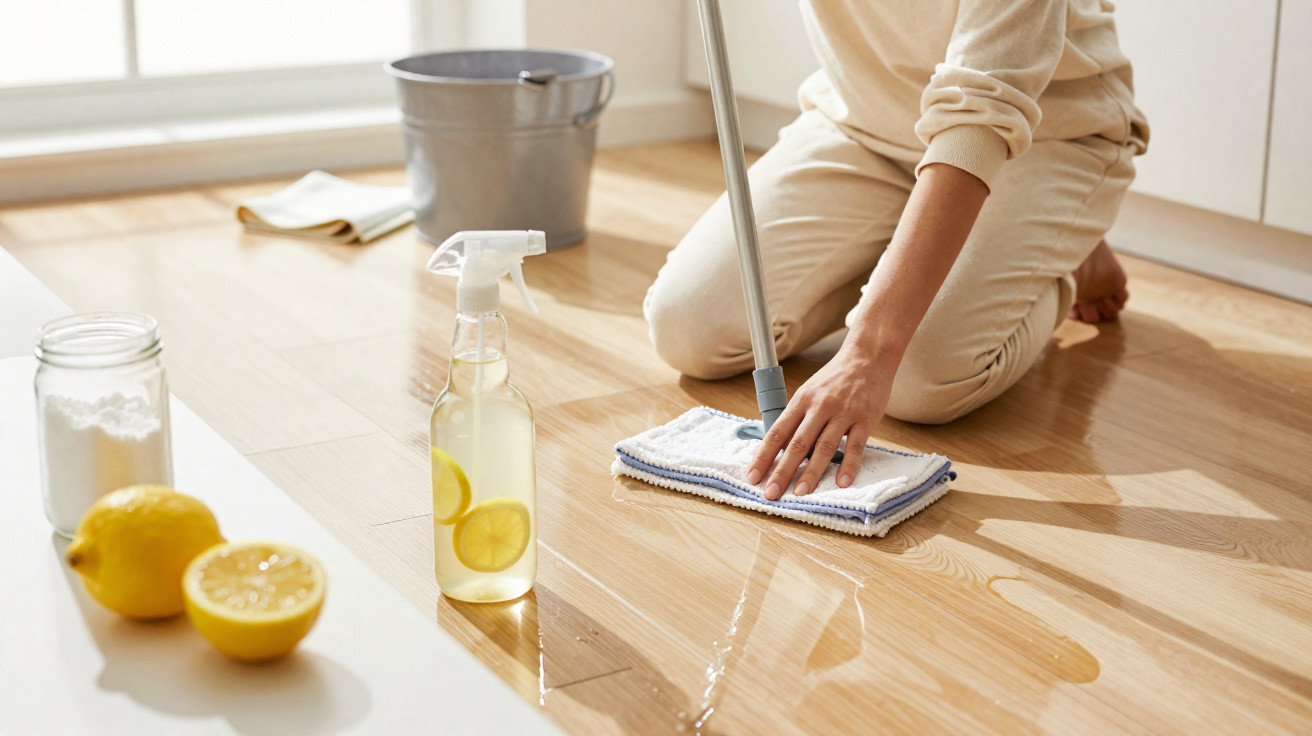
At 7 pm, dinner has just finished, and the faint sound beneath your socks gives it away: the kitchen floor is sticky. A drop of oil by the hob, a forgotten splash of sauce and constant trips around the table mean the tiles seem to have collected the whole day’s memories. Sometimes, you reluctantly reach for the mop, hoping hot water will do the job. Yet once the floor dries, marks show up again in the light. That does not necessarily mean the cleaning has been neglected; it is simply what happens in a busy kitchen. Fortunately, there is a simple, affordable and remarkably effective homemade mixture for dissolving grease without turning cleaning into an endless chore. The difference lies in getting the quantities right.
Why the kitchen floor becomes sticky, even after a quick clean
We all know the moment when a floor looks clean but feels slightly tacky underfoot. That feeling is often caused by an invisible film of tiny oil droplets, cooking steam, damp crumbs and poorly rinsed cleaning product. It is not merely one isolated stain: a thin layer builds up around the sink, hob and bin, where people are constantly walking.
In a family kitchen, the change can be noticeable after only a few days, especially when frying or oven cooking is a regular habit. An oil splash may seem insignificant at the time, but it attracts dust and combines with product residue, creating the dull, sometimes greasy floor that seems to require vigorous scrubbing. In fact, a degreaser that is too harsh or used in too large a quantity can leave behind its own film.
Grease does not react like dust: water alone often shifts it without properly lifting it away. You therefore need water that is hot enough, a mild alkaline agent to help dissolve greasy dirt, and a very small amount of washing-up liquid to hold it in the wash water. The right mixture is not the one that produces the most foam, but the one that nearly rinses away by itself and dries without a film.
The homemade mixture that degreases without leaving a film
Pour three litres of hot, but not scalding, water into a bucket. Add one level tablespoon of soda crystals and one teaspoon of washing-up liquid. Stir gently with the mop handle or a dedicated spoon until the crystals have dissolved. Soak a microfibre cloth or a thoroughly wrung-out mop in the solution: the floor should be damp rather than soaked, as too much water encourages marks as it dries.
The method matters almost as much as the recipe. Begin at the far end of the room and work towards the exit, calmly paying particular attention to greasy areas, without going over the same spot ten times with water that has become dirty. Let us be honest: hardly anyone truly does this every day. A targeted clean after particularly greasy meals, followed by a full clean once a week, is often enough to restore that pleasing feeling of a clean floor beneath your feet.
A common mistake is to pour vinegar into the same bucket, either out of habit or because it is recommended everywhere. However, soda crystals and vinegar largely neutralise each other: it foams and looks impressive, but the expected degreasing power is reduced. Keep vinegar for a light rinse, if your flooring can tolerate it, or simply use clean water with a fresh microfibre cloth.
“When a floor is still sticky after washing, it does not always mean it needs more product: it often means there is too much of it.”
- 3 litres of hot water to loosen everyday grease;
- 1 level tablespoon of soda crystals;
- 1 teaspoon of washing-up liquid, no more;
- a microfibre mop that has been very thoroughly wrung out;
- a second pass with clean water if the floor is heavily soiled.
Small details that prevent marks and keep the floor clean for longer
The first useful habit is to replace the water as soon as it turns grey or cloudy. Carrying on with a dirty bucket means spreading some of the residue back over the floor, particularly into grout lines and corners. In open-plan kitchens, where late-afternoon sunshine reveals everything, finish by quickly running a dry microfibre cloth in the direction of the boards or grout lines. This takes two minutes and prevents the dull appearance that is sometimes wrongly blamed on the tiles.
Soda crystals work particularly well on tiles, porcelain stoneware and some PVC floors, but they are not suitable for every surface. Avoid using them on oiled parquet, untreated wood, natural stone such as marble or travertine, and delicate surfaces with an unknown finish. If in doubt, always test the mixture behind a door or beneath a piece of furniture: it may not be glamorous, but it prevents a lasting and unpleasant surprise.
A more relaxed approach also starts before the floor becomes sticky. Wiping up oil immediately, putting a washable mat in front of the sink and not leaving a splash of sauce to sit are small habits, yet they make a visible difference. A less greasy floor needs fewer products, less rinsing and less effort on a Saturday morning. This is not about pursuing perfection; it is simply about having a kitchen where it feels pleasant to walk barefoot.
| Key point | Detail | Benefit for the reader |
|---|---|---|
| The right quantity | 3 litres of hot water, 1 tablespoon of soda crystals and 1 teaspoon of washing-up liquid. | Effective degreasing without excessive foam or sticky residue. |
| The wrung-out mop | The fabric should stay damp, never saturated with water. | Faster drying and far fewer visible marks. |
| The choice of flooring | The mixture is mainly suitable for tiles, porcelain stoneware and certain PVC floors. | Protects delicate materials while helping you adopt an appropriate routine. |
A clean kitchen floor should not be the result of a battle involving three bottles, an overpowering smell and an hour spent scrubbing. This homemade mixture is a reminder of something rather simple: accuracy is better than excess. Hot water, sensible quantities, a clean microfibre cloth and a little regularity are often enough to remove that unpleasant sticky-floor feeling. What remains is a lived-in kitchen, where vegetables are chopped, children rush through too quickly and coffee occasionally spills. Everyone may have their own little recipe handed down by a mother, neighbour or grandparent, but the most effective ones are often the simplest. It is up to you whether your floor needs a thorough clean this weekend or just one well-judged step this evening.





Comments
No comments yet. Be the first to comment!
Leave a Comment