
Add us to your favourites on Google.
Why add us?
Get the latest from Zona Militar in your Google feed.
SSN(X): the US Navy’s future nuclear attack submarine
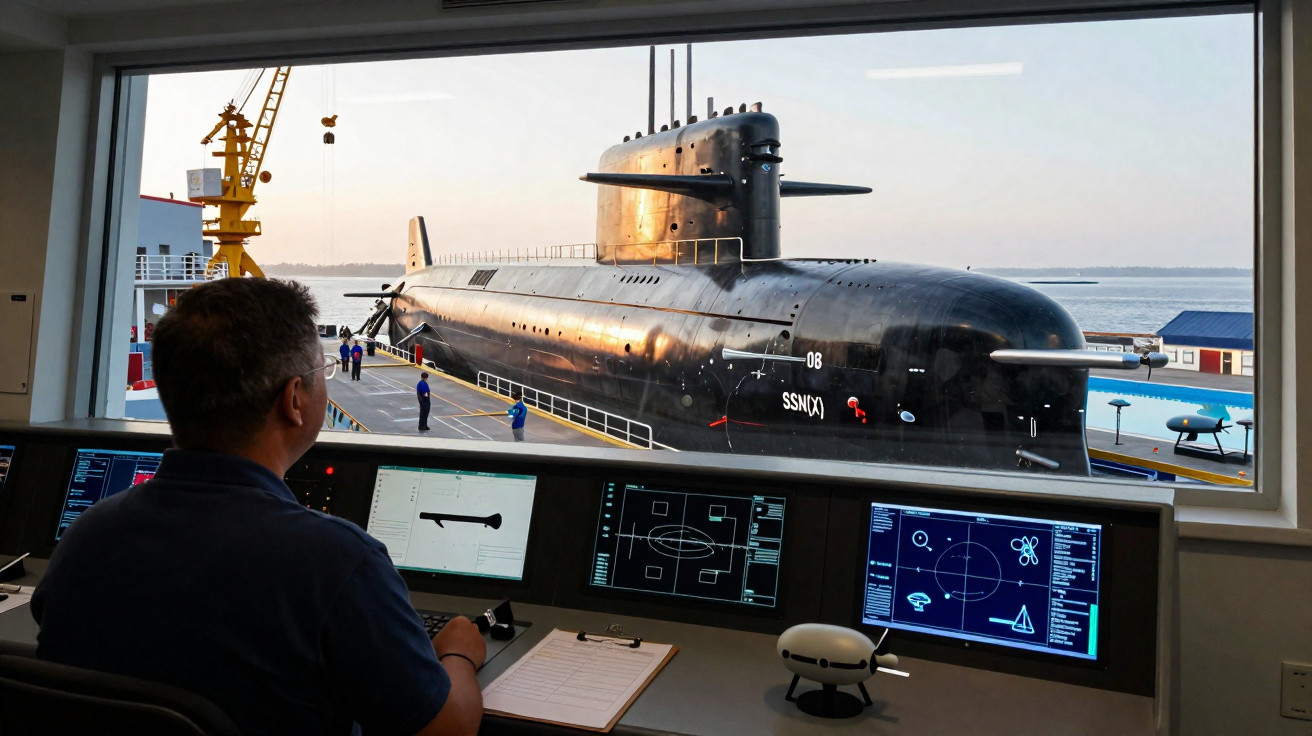
As part of its recently released Navy Shipbuilding Plan, the US Navy has revealed the first details of the SSN(X), its next generation of nuclear-powered attack submarines. The design will focus on the ability to deploy advanced drones across a range of operational environments. Contrary to earlier expectations, these submarines will initially serve alongside the Virginia class currently in service, with entry into service now anticipated in the mid-2040s.
Addressing this capability, the official US Navy document states: “Beginning in the mid-2040s, it will complement the Virginia class to create a mixed attack submarine force designed to penetrate and dominate heavily defended enemy areas. With greater payload volume, enhanced survivability, and the ability to seamlessly host unmanned systems and robotic and autonomous systems (RAS), SSN(X) will ensure persistent access to denied areas and eliminate enemy sanctuaries.”
Naval industrial investment and SSN(X) construction
The US Navy expects construction of the new submarines to benefit from the substantial investments currently being made in the country’s naval industrial base. This would make it possible to incorporate new technologies and shape processes around lessons learned from earlier programmes. The service is also committing significant resources to sustain the Virginia class and bring the new Columbia class into service. The first Columbia-class boat is expected to be available at the start of the next decade, beginning the replacement of the Ohio class.
Naval officials do not regard this as a minor consideration, as the future SSN(X) boats will be the first submarines of their kind to be developed entirely from scratch and introduced by the US Navy in more than three decades. As the aforementioned document notes: “We cannot repeat the mistakes of the 1990s, when a false sense of security led leaders to allow the SIB (Editor’s note: Submarine Industrial Base) to atrophy. We must ensure that the investments being made today translate into sustained long-term growth to guarantee continued dominance.”
Beyond the SSN(X) class itself, the US Navy intends to allocate more than USD 124.9 billion to its submarine programmes during the 2027–2031 fiscal period, split equally between construction of the Virginia and Columbia classes. In addition, the industrial base would receive a further USD 6.2 billion to strengthen its workforce and associated supply chains, with the aim of enabling it to build around three submarines per year. A further USD 7.2 billion would be assigned to various projects intended to improve the production capacity of each shipyard.
Seawolf-class retirement plans
Finally, while work progresses on a new generation of nuclear-powered submarines, plans are also being drawn up for the retirement of the Seawolf class. Introduced during the 1990s, the class was affected by major budgetary constraints that considerably reduced the number of boats acquired. Under current plans, USS Connecticut (SSN-22) would be the first of the class to leave active service, which is expected to occur at the beginning of the next decade.
Images used for illustrative purposes






Comments
No comments yet. Be the first to comment!
Leave a Comment