
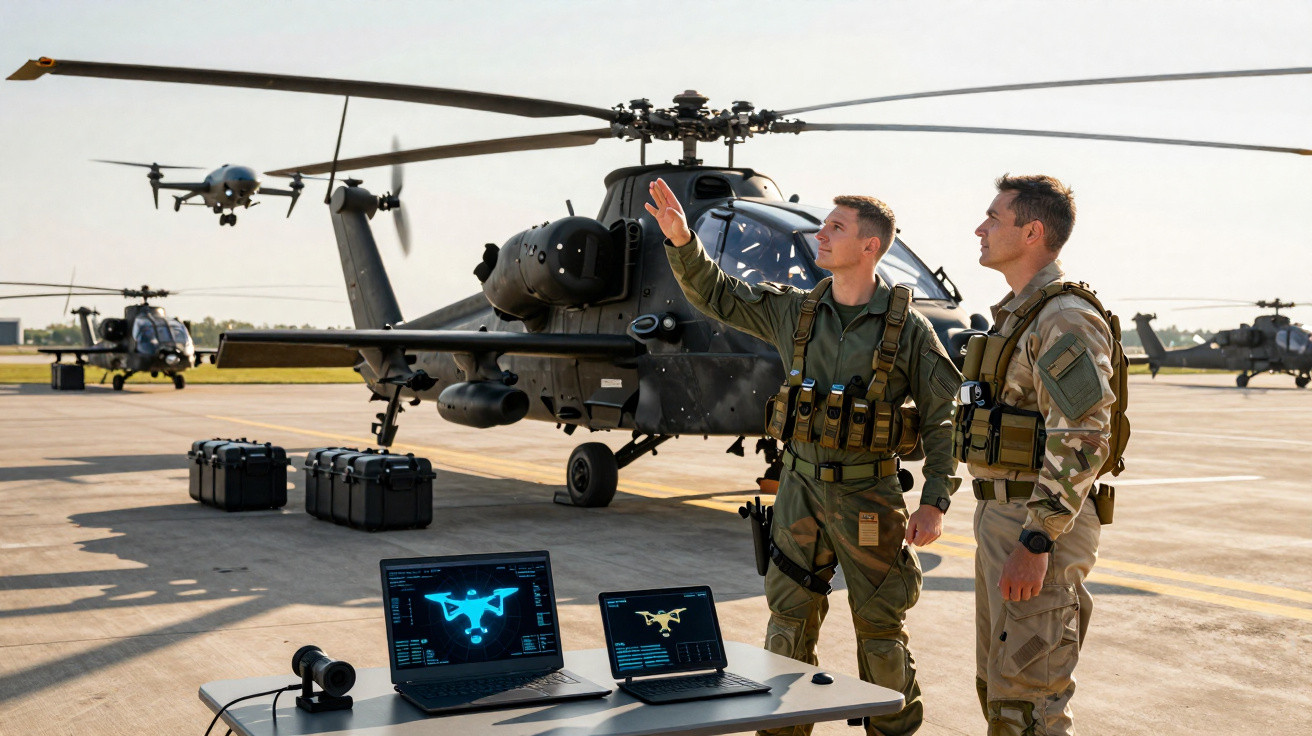
The UK Ministry of Defence confirmed in an official statement issued on 24 January that seven companies will compete to develop and manufacture new collaborative combat drones for operation alongside the British Army’s AH-64E helicopters. Known as Project NYX, the programme is primarily intended to deliver an uncrewed platform able to support attack helicopters in reconnaissance and surveillance, target acquisition, and electronic warfare missions.
Project NYX collaborative combat drones
Defence Readiness and Industry Minister Luke Pollard said: “These drones of the future will make the British Army more effective and lethal by enhancing our ability to strike, survive and win on the battlefield. Project NYX represents the cutting edge of the Defence Industrial Strategy and is working with leading British industry partners to ensure the UK remains at the forefront of autonomous military technology.”
The tender process follows the completion of an earlier pre-qualification stage, which concluded last year with the following shortlist of domestic companies: Anduril Industries (through its UK headquarters), BAE Systems, Leonardo MW, Lockheed Martin UK, Syos Aerospace UK, Tekever and Thales UK.
From this group, the British Government intends to select only four candidates to progress to the next phase of the project in March this year. Those selected will have the chance to produce a concept demonstrator, with the aim of achieving Initial Operating Capability in 2030.
Artificial intelligence and operational autonomy
The new drones are expected to feature advanced artificial intelligence systems, intended to give them the ability to make decisions independently and adapt flexibly to conditions in the operational environment in which they are deployed. According to the British Government, this is designed to lessen the burden on pilots operating in highly hostile environments, while also reducing the number of personnel required for each mission. “Commanded, not controlled” is the term used by British authorities to describe this approach.
London has also stated that this work forms part of a wider effort to provide the British Armed Forces with a greater number of uncrewed systems, enhancing current capabilities both in variety and scale. The planned adoption of these new technologies is among the next steps outlined in the latest Strategic Defence Review, which established that the country will need these developments to maintain the lethality of its forces in the future.
AH-64E Apache helicopters in the British Army
It is also worth recalling that, since last year, the British Army has operated a fleet of 50 Boeing-built AH-64E Apache helicopters. These aircraft have been based mainly at Wattisham Station in Suffolk, while some units allocated to crew training have been sent to the Army Aviation Centre at Middle Wallop in Hampshire.
Even without the collaborative combat drones mentioned above, the AH-64Es represent an improvement over the Mk.1 helicopters previously used by the service, incorporating upgrades to their engines, optical and detection systems, as well as their armament.
Images used for illustrative purposes




Comments
No comments yet. Be the first to comment!
Leave a Comment