
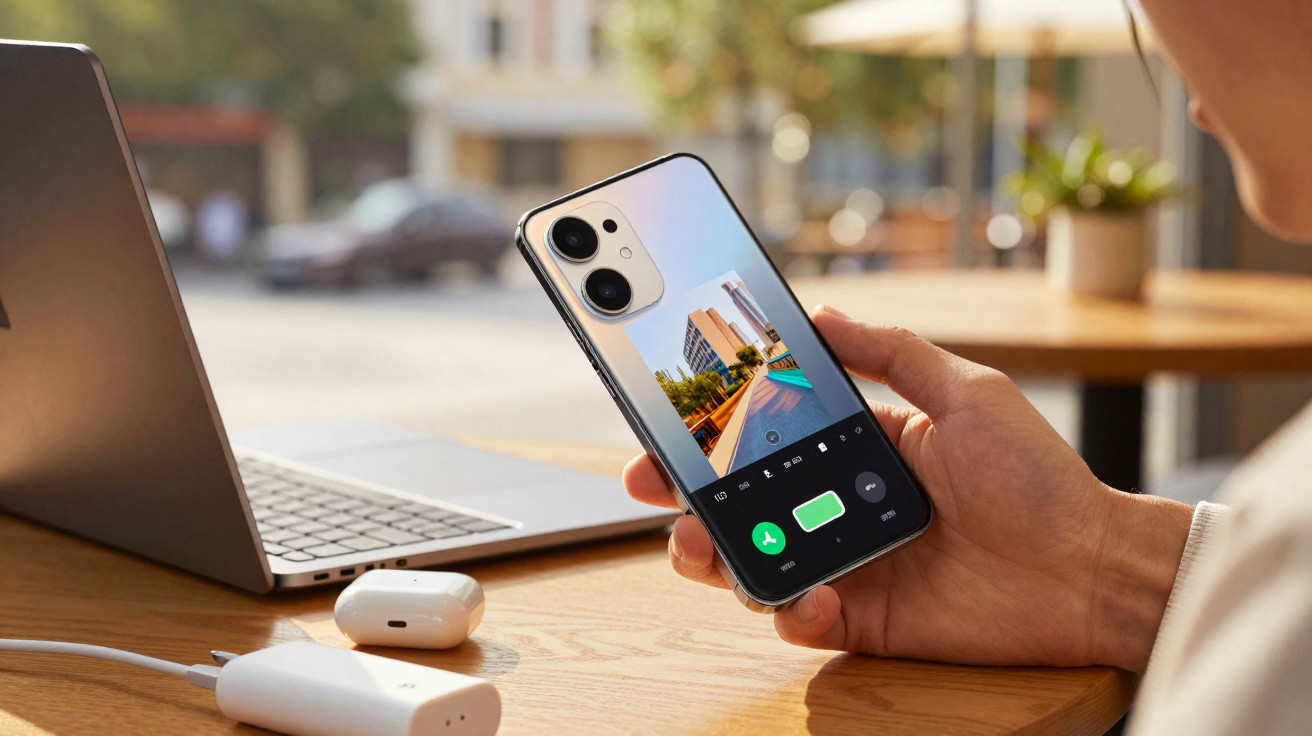
The Honor 600 makes no secret of its numerous, rather pointed nods to the iPhone 17 Pro, to the extent that it can initially look like a mere imitation. Yet beneath that obvious influence, this smartphone has some compelling strengths of its own: a 6,400 mAh battery, an AI-packed photography experience and a considerably more accessible price than its lookalike.
During the First World War, shortages left the German population struggling to obtain everyday goods and forced people to devise replacements for almost everything. Bread was made with rye and potato flour, coffee was extended with chicory, and margarine stood in for butter.
One word has endured from these necessity-driven copies: the German expression for a replacement product. It later entered French while retaining its negative connotations. An ersatz is an inferior substitute, chosen only because there is no better option.
That was one of the first words that came to mind when we took the Honor 600 out of its box. Its resemblance to the iPhone 17 Pro Max is striking, and it is even closer to the iPhone 17 Pro. The rectangular camera module, the extra side button and the orange finish introduced by Apple last autumn make the comparison unavoidable.
Over three weeks of testing, however, we wanted to look beyond that first impression. Could the Honor 600 offer more, particularly in AI, photography and battery life thanks to its 6,400 mAh battery? Its price also changes the equation considerably. So, is the Honor 600 simply an iPhone 17 Pro ersatz, or is it a genuine alternative?
Price and availability
The Honor 600 will be available from 23 April in orange, as well as white and black, starting at €549.90 for the 8GB/128GB model.
A launch offer will apply to its other two configurations from 23 April to 6 May inclusive:
- The 8GB/256GB version, normally priced at €649.90, will cost €499.90 with a €150 discount voucher.
- The 8GB/512GB model, exclusive to the brand's website and normally priced at €699.90, will be available for €499.90 with a €200 voucher. It also includes 12 months of additional screen insurance.
Design: an iPhone 17 Pro from Wish?
At least Honor is open about it. During the Honor 600 presentation, the Chinese company summed up its inspiration in two words: “Sameness and difference”. In other words, it reproduces a shared aesthetic while asserting its own distinct identity.
Honor's first argument is handling. The iPhone 17 Pro measures 8.5 mm thick, weighs 199 g and has a 6.3-inch screen, whereas the Honor 600 is 7.8 mm thick and 185 g with a larger 6.57-inch display. It is thinner and lighter despite offering more screen area, all while fitting a 6,400 mAh battery into its chassis. That is an engineering achievement worth recognising, and the phone is genuinely enjoyable to use with one or two hands.
At the rear, the family resemblance is around 80% apparent, with the Honor 600 on the left and the iPhone 17 Pro on the right. There is a slightly raised rectangular plateau, to use Apple's preferred terminology. Inside sit two vertically aligned sensors, each surrounded by an orange metal ring.
To the right, a pill-shaped section contains the LED flash and colour-temperature sensor. The iPhone 17 Pro, meanwhile, has three sensors arranged differently, enough to rule out outright plagiarism.
Honor has also stopped short of copying Apple's unibody frame and glass back, most likely for cost reasons. Instead, it uses composite fibre, essentially premium plastic. The difference is faintly noticeable to the touch, but the finish is convincing and does not readily collect fingerprints.
Another cost-saving compromise concerns connectivity, as USB-C is restricted to 2.0 speeds. Fortunately, Wi-Fi 6E and Bluetooth 5.4 are supported, while the SIM tray accepts two 5G nano-SIMs, with the second slot able to be replaced by an eSIM.
Lastly, IP68, IP69 and IP69K certifications make the Honor 600 a genuinely rugged handset, able to withstand immersion, high-pressure water jets and dust. It can therefore survive both a drop into the toilet and a heavy shower.
Display: bright, with no meaningful compromises
With its 6.57-inch panel, the Honor 600 occupies the middle ground that should suit most buyers. It is neither too compact for fans of larger screens nor so large that it feels like holding a brick. The 2,728 x 1,264-pixel AMOLED display delivers a density of 458 ppi, while 0.98 mm bezels, unusually slim at this price, enhance immersion.
To keep costs under control, the phone does not use LTPO technology. Its refresh rate can therefore adjust automatically between 60 Hz and 120 Hz, or be fixed at either of those two levels. That omission is not a deal-breaker, as its two most serious rivals, the Nothing Phone (4a) Pro and Pixel 10a, are in the same position.
As usual, Honor makes an extravagant brightness claim, announcing an extraordinary 8,000-nit peak. Real-world use is clearly nowhere near that figure, but the panel nevertheless remains perfectly readable outdoors, even in direct midday sunshine.
Three colour modes are available: Vivid, Normal and Professional. We recommend the first; the second is slightly too warm, while the last is a little too cool. The latter two settings do less to flatter content viewed on social media and YouTube.
There is also good news for anyone who loses themselves in TikTok before going to sleep: the display uses 3,840 Hz PWM dimming, as previously seen on the Magic 8 Pro. In practical terms, this reduces eye strain during extended scrolling sessions.
Performance: the sensible choice
Inside, Honor has made a pragmatic choice with Qualcomm's Snapdragon 7 Gen 4. This mid-range SoC, also found in the Nothing Phone 4a Pro, is paired here with 8GB of RAM and 256GB of storage.
In our benchmark testing, the Honor 600 posted respectable results that translate into consistently smooth everyday operation, including intensive multitasking and launching the most demanding apps.
Browsing, social networks, multitasking and streaming pose no real difficulty for the Honor 600. Only the most demanding games in the Play Store expose its limits, requiring some graphical compromises to retain acceptable fluidity. That is no surprise at this price, and serious gamers are not the Honor 600's core audience anyway.
The chip's stability is more impressive. Its 99.4% result in the 3DMark Wild Life Extreme stress test shows that performance does not fade over time. There is no throttling or excessive heat, with Honor successfully avoiding two issues that remain fairly common on many mid-range and high-end smartphones.
Software: MagicOS 10, AI everywhere
The Honor 600 runs Android 16 with MagicOS 10. It is a clean interface whose visual language has clear echoes of iOS. The same applies to the Magic Capsule, still present and inspired by Apple's Dynamic Island, but with one significant and welcome difference: Honor's version vanishes completely when it has nothing to show, or when you choose not to give it anything to display.
The connection to a certain Californian company remains evident in the button arrangement, too. Beneath the volume and lock controls sits a third button. Already seen on the Magic 8 Pro, it can launch the camera or access MagicOS smart features through short, double or long presses. Unlike Apple's Action button, it cannot be freely customised and is limited to photography or AI.
The rest of MagicOS 10 develops without being transformed. AI Suggestions and Magic Portal remain. The genuinely notable addition is AI Memories, Honor's answer of sorts to Microsoft's Recall and Nothing's Essential Space. Web pages, videos and documents are saved and sorted for later browsing, functioning as a record of what you have viewed.
For software support, Honor promises 6 years of Android updates and security patches, which is excellent. The only downside is the handful of pre-installed applications that spoil the initial set-up. A quick spring clean is unavoidable, but it will not take long.
Photography: a capable portrait phone and serious night shooter
Last month, the Nothing Phone 3a Pro made a major statement by including a 3.5x telephoto lens, a rarity for a smartphone at around €500. The Honor 600, like the Google Pixel 10a before it, does not go that far.
Across our three weeks of use, the 200 MP main sensor (f/1.9, 1/1.4-inch format) fully impressed us at 1x, 2x and 4x, both indoors and outdoors. Images have warm, well-contrasted colours and well-managed dynamic range. The rendering is flattering, but only enough to please the eye and attract Instagram likes. There is, however, somewhat heavy software processing on fine textures, along with occasionally unpredictable results against the light.
The 12 MP ultra-wide camera (f/2.2) maintains colour consistency with the main sensor, which is not always the case at this price. However, some optical distortion can be seen at the edges in perspective shots. Noise also becomes apparent quickly as light levels fall or when a scene is in shadow.
Honor has a strong pedigree for portraits. In 2024, the Honor 200 Pro stood out in this area, particularly thanks to its partnership with Harcourt studio. The 600 does not benefit from that collaboration, but the brand's signature remains recognisable. Subject separation is clean, bokeh is balanced and skin tones are handled naturally.
At night, Honor adopts a clear approach that is closer to Samsung than Google. While the Pixel attempts to reproduce what the eye actually sees, Honor prefers to enhance the scene.
Night shots come out bright without necessarily turning a pitch-black night into early evening. Supporters of natural-looking images will undoubtedly appreciate this more than Samsung's and Xiaomi's approach.
In the AI video race, Honor takes the lead
Rather than trimming the rest of its specification sheet to fit in a telephoto lens, Honor focuses on AI for its photography and video experience. Its flagship feature for doing so is Image to Video 2.0. This is not entirely new, as the Honor 400 already offered it, but Honor takes the execution further here.
Where the previous version animated one photograph in a 5-second loop, the Honor 600 can now combine up to three photos to create a 3- to 8-second sequence guided by a natural-language prompt.
In use, the result delivers on its promise, provided the photos share visual and narrative coherence and the prompt is sufficiently precise. Otherwise, it becomes something else: at best, a rewritten or enhanced memory; at worst, something entirely fabricated.
This kind of AI video generation is not exclusive to Honor. Google introduced it on YouTube Shorts as early as 2023, before professional tools such as Runway and Pika gained traction among creatives. Nevertheless, Honor is among the first to put it genuinely into the pocket of the everyday user. According to rumours, Samsung is also working on a comparable feature for its Galaxy AI ecosystem.
Although the technology is technically impressive, it also raises a legitimate concern. In the age of deepfakes, making the creation of entirely fabricated memories accessible to everyone is troubling.
There is also an important caveat: the feature will be free for 76 days, with 10 attempts a day. Beyond that, a subscription will probably be required. Content creators and younger users may see value in it, but one question remains: are we really prepared to pay to reinvent our memories?
Battery life: leading endurance
A 6,400 mAh battery in a 7.8 mm chassis on a 185 g smartphone is the kind of equation we would expect from a €1,000 premium handset.
For comparison, the iPhone 17 Pro fits 4,252 mAh into 8.8 mm, while the Nothing Phone (4a) Pro houses 5,080 mAh in 7.95 mm. Beyond this engineering feat, the secret has two words: silicon-carbon. This technology increases battery energy density without taking up additional room. Honor has adopted it, like Xiaomi and Oppo, while Apple, Samsung, Google and Nothing have not yet made the move.
With this hardware, the Honor 600 lasts through a demanding full day and into the following morning. With more restrained use, it can even approach late afternoon on the second day. When it is time to recharge, 80W SuperCharge completes the process in 57 minutes according to our testing.
The first few percentage points naturally rise particularly quickly: the phone reaches 30% in just 16 minutes. While 27W wired reverse charging is useful, wireless charging is absent. That compromise will be minor for most people, although the Pixel 10a does offer it.
Conclusion
At first sight, everything suggested that the Honor 600 would be an ersatz: in other words, a pale copy of the iPhone 17 Pro. Its orange colour, camera block, extra button on the side and Magic Capsule all point in that direction, as does a software overlay that leans more towards iOS styling than Android. None of these elements is new on its own, but together they begin to add up.
Spend more time with it, though, and it reveals some personality. It delivers stable performance without major missteps, a 6,400 mAh silicon-carbon battery that provides comfortable endurance, and a balanced camera system. It does not claim to surpass Google's and Samsung's best mid-range models, but it comes close, especially for portraits and night photography. There are naturally some limits at this price: no wireless charging, no LTPO, USB-C limited to 2.0 and a few pieces of bloatware to remove.
Its aggressive pricing ultimately prevents any meaningful direct comparison with an iPhone 17 Pro. Its real challengers are the Nothing Phone 4a Pro, Samsung Galaxy A57 and Pixel 10a. Against those phones, the word ersatz no longer really holds up. And even if some wish to take the iPhone 17 Pro comparison to its conclusion, chicory is no longer mixed with coffee out of necessity. It is now enjoyed on its own merits.
Honor 600
€549
8.2
| Category | Score |
|---|---|
| ### Design and display | 8.0/10 |
| ### Performance and AI | 8.0/10 |
| ### Photography and video | 8.5/10 |
| ### Battery life and charging | 8.5/10 |
| ### Technology-to-price ratio | 8.0/10 |
What we like
- Polished design and bright AMOLED display
- Solid, stable performance and interesting AI features
- Good 200 MP main sensor and successful portraits
- Highly enduring 6,400 mAh battery
- Fair value for money
What we like less
- Very heavy inspiration from the iPhone 17 Pro
- USB-C 2.0, no LTPO technology and no wireless charging
- Demanding games require graphical compromises
- Ultra-wide camera is less convincing


Comments
No comments yet. Be the first to comment!
Leave a Comment