
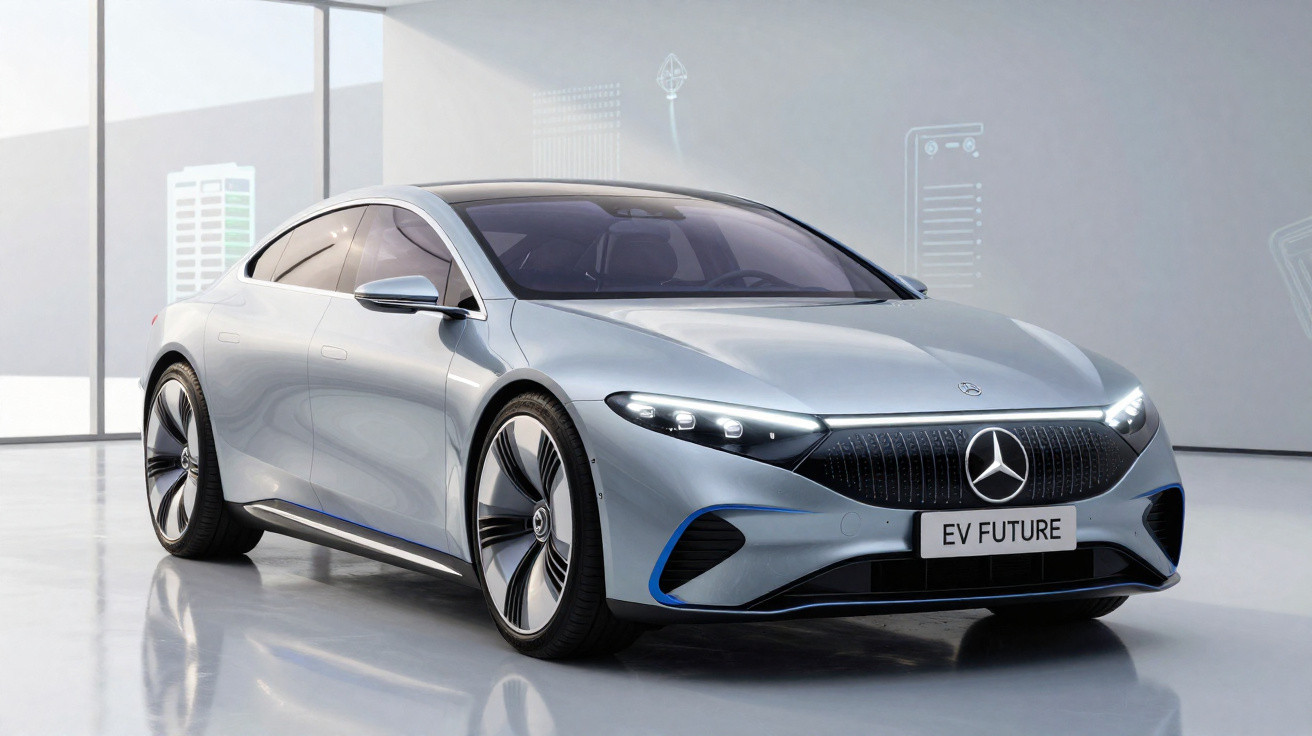
The interview was brief, yet revealing. Markus Schäfer, Mercedes-Benz’s chief technology officer, spoke candidly about the major issues confronting Europe’s automotive industry, from battery development to the European production chain.
“Europe truly needs a European battery industry, with local cell production and access to raw materials. We must free ourselves from this dependency and quickly introduce long-term measures to end this vulnerability,” the executive told Razão Automóvel exclusively.
The raw-materials threat
Schäfer also warned that, while the balance between raw-material supply and demand is currently relatively stable, there is no certainty that this will continue: “there will be periods of raw-material shortages and rising prices, during which we could become highly dependent on regions outside Europe”.
European institutions are already aware of this dependence. In an effort to strengthen Europe’s strategic autonomy, the Action Plan set out by the European Commission (EC) includes €1.8 billion in investment to support local manufacturing and limit exposure to external suppliers. By the end of 2024, the EC had already allocated grants totalling €1 billion to European battery manufacturers.
More than a production challenge
In Schäfer’s view, the issue extends beyond merely manufacturing batteries locally: research must also be strengthened. “We need to intensify research to find substitutes for rare earths and possibly develop magnets that do not rely on these elements. To achieve that, we have to invest in our own refineries in Europe and avoid sourcing everything that matters most from outside our continent,” he said.
“We need to intensify research into battery cells to find alternatives.”
- Markus Schäfer, Mercedes-Benz chief technology officer
This process is already under way. One of Europe’s largest lithium deposits is in Serbia, where a joint European initiative for its extraction already exists. Meanwhile, Mercedes-Benz has a battery-cell factory operating in France through ACC, its joint venture with Stellantis Group and TotalEnergies.
Even so, Schäfer acknowledges that the challenge is not limited to production capacity: “There are many projects under way, but that only shows how difficult it is to master cell production. We lack the necessary know-how”. To illustrate his point, the executive referred to China: “they have refined this entire process over a decade and a half, thanks to intensive collaboration between all stakeholders”.
“Everyone in the European industry must come together and be willing to invest in this area, otherwise nothing will happen. The automotive industry, suppliers, associations, Member States and the European Union must work side by side. But that requires patience,” he concluded.
The future of solid-state batteries
Despite the current limitations in Europe’s production chain, Mercedes-Benz continues to invest in the future of battery technology. In September last year, the German manufacturer announced the development of a solid-state battery with Factorial. Named Solstice, it promises a significant leap in electric-car range.
However, Markus Schäfer remains cautious about the technology’s maturity: “I think solid-state batteries are still at a very early stage. They work well in test cycles, in a laboratory environment, but it is very different when we are talking about thousands and thousands of kilometres driven by real customers, with rapid charging and the need for maximum reliability”.
Nevertheless, the executive insists that the brand is not behind in the race: “We will be ready to compete with any brand globally in this field”.
Mercedes-Benz’s focus is not confined to solid-state batteries, however. The company is also developing a new generation of lithium-ion batteries with a higher silicon content, a technology that will make it possible to increase energy density significantly.
“We will achieve an increase in energy density and, ultimately, have lighter batteries,” Schäfer said.
A pragmatic future
When it comes to the electric transition, Mercedes-Benz retains its ambitious message while recognising market realities. The new MMA platform, debuting with the next-generation CLA, was designed for electric power but can also accommodate combustion engines. The reason is flexibility. “The market and customers have to be ready,” Schäfer admitted, without committing to a definitive end for combustion engines, which, according to industry sources, could remain in production into the 2040s.
In higher segments, such as the E-Class, the strategy will be clearer: electric and combustion platforms will be separated to avoid technical compromises and retain product excellence.
“Our long-term goal is to be 100% electric, but the market and customers have to be ready,” Markus Schäfer said, stressing that Mercedes-Benz fears no scenario and is ready “to compete with any brand”. Whatever the future brings, the principle of “the best or nothing” remains embedded in the mindset of the German brand’s executives.



Comments
No comments yet. Be the first to comment!
Leave a Comment