
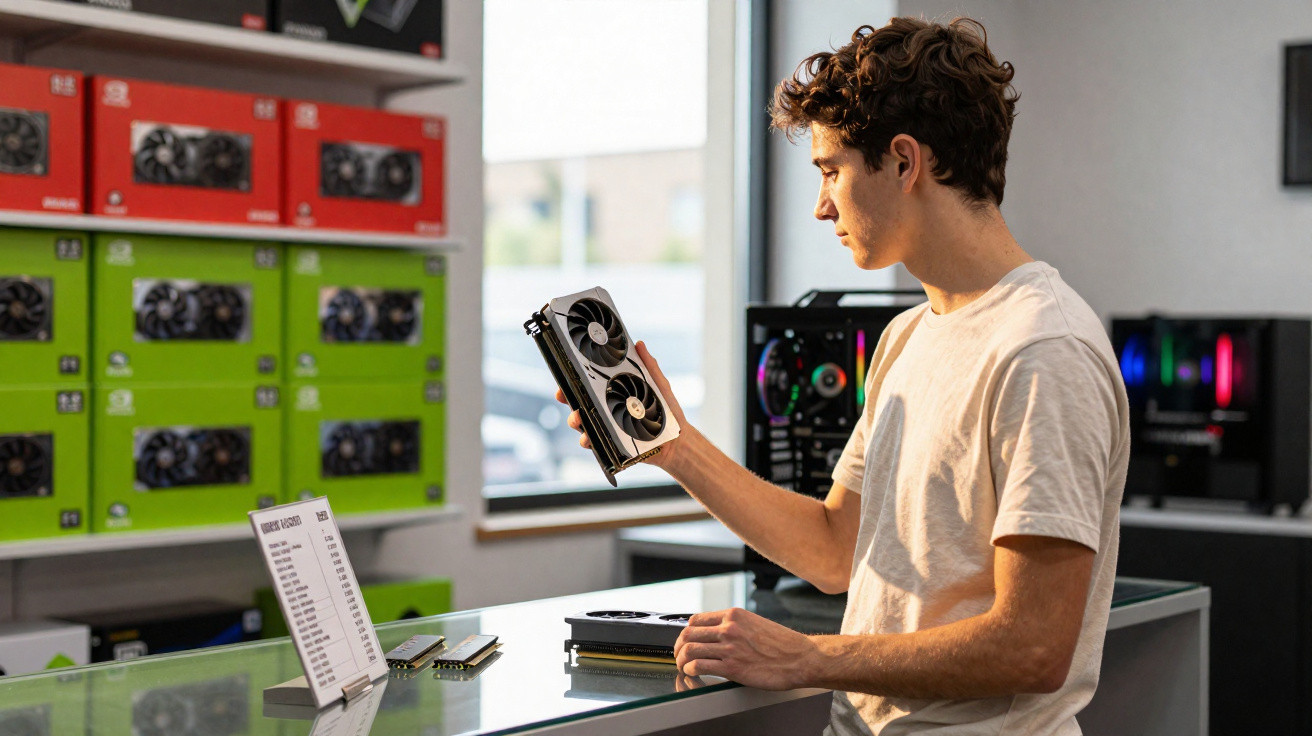
The start of 2026 had looked set to offer some relief for anyone hoping to build or upgrade a gaming PC.
Then a low-key notice from NVIDIA completely changed that outlook.
The GPU manufacturer has contacted its partners and confirmed what the hardware industry had feared: another round of price increases will affect graphics cards, driven by the sharp rise in the cost of the memory used in these components. The impact falls directly on ASUS, MSI, Gigabyte and other brands, which must now decide how to pass those costs on to buyers.
An internal notice that changes the market
According to behind-the-scenes information published by specialist Asian hardware outlets, NVIDIA told its board-manufacturing partners - known as AICs, including ASUS, MSI and Gigabyte - that prices for GDDR6 and GDDR7 memory kits will rise when supply contracts are renewed in January 2026.
The crucial detail is that the company is not changing the recommended price of its GPUs themselves. Instead, it is charging more for the memory supplied with those chips.
“NVIDIA is keeping the official price of the graphics chip unchanged, but raising the cost of dedicated memory, pushing the increase into the board-assembly stage.”
The distinction may appear minor, yet it has major implications across the supply chain. Video memory, or VRAM, is among the costliest parts of a modern graphics card, particularly on models carrying 12 GB, 16 GB or more. Once memory costs surge, partner manufacturers have far less room to manoeuvre.
There is also a parallel strategic move under consideration: NVIDIA may expand shipments of ‘bare’ GPUs, meaning chips supplied without memory, leaving partner brands to purchase VRAM modules directly from DRAM makers. In that situation, the risk of price fluctuations would shift almost entirely to ASUS, MSI, Gigabyte and their peers.
Memory pressure: why everything is getting more expensive
The semiconductor market is facing a fresh wave of cost pressure, with memory once again at the centre of the storm. Standard RAM modules used in PCs and laptops have already risen sharply in price in recent months, affecting the cost of many laptops by up to 20%.
The same trend is now reaching GPU-specific memory such as GDDR6 and GDDR7, which requires advanced manufacturing processes and competes for production capacity with data centres, artificial intelligence and consoles.
- Greater demand for AI and server GPUs is intensifying competition for fast memory chips.
- Restricted production capacity makes every new manufacturing batch more expensive.
- Earlier contracts with lower prices are now expiring, pushing costs upwards across the market.
As inventories purchased at older prices run out, graphics-card makers are being forced to recalculate the total cost of every model. With margins already under pressure, passing at least part of the increase on to the end customer becomes almost unavoidable.
MSI moved first, with ASUS and Gigabyte likely to follow
Reports from the Asian market suggest MSI was the first to revise its price list, beginning with newer models, including cards in the GeForce RTX 50 range. The move is said to have started in December, ahead of the memory-contract rollover.
Sources connected to European retailers indicate that ASUS and Gigabyte are heading in the same direction, raising prices on both NVIDIA and AMD graphics cards. In other words, the effect is not confined to GeForce products: Radeon cards are being caught up as well.
“In practice, models with 16 GB of VRAM or more are already seeing increases of between 15% and 20% at European retailers, with variations by manufacturer and product line.”
AMD’s new Radeon RX 9000 cards have appeared at some retailers with rises of between 10% and 18% over the same period, pointing to a broad upward trend. Gamers who had closely tracked year-end offers are already beginning to see prices climb in January.
Different approaches from NVIDIA and AMD
As memory costs increase, the two major rivals are taking different routes in an effort to maintain public interest and protect their margins.
NVIDIA: emphasis on 8 GB models
NVIDIA partners are reportedly steering production towards graphics cards with 8 GB of VRAM, such as the forthcoming RTX 5060 and 5060 Ti 8 GB. The rationale is to reduce the amount of memory fitted to each card and contain the final cost.
Less VRAM makes a card cheaper to manufacture, allowing brands to hold closer to the recommended price and keep competing in the mid-range segment, where most gaming sales are concentrated.
AMD: retaining 16 GB and prioritising performance
AMD, meanwhile, is expected to maintain its focus on 16 GB models, especially XT versions of the Radeon RX 9000. The company is seeking to highlight raw performance and a stronger ability to handle 4K gaming, high-resolution textures and heavier workloads.
That approach carries a risk, however. With memory now so expensive, every 16 GB card weighs much more heavily on the buyer’s budget, and its technical advantage may not be enough to justify a large price jump when household budgets are tight.
How graphics card price increases reach consumers
Price changes do not appear in the same way at every retailer. Each country, distributor and shop responds differently. Even so, a few recurring patterns are beginning to emerge:
| Card type | Typical VRAM | Expected increase |
|---|---|---|
| Current entry-level (for example, forthcoming RTX 5050, RX 9500) | 6–8 GB | Smaller rise, with an emphasis on volume |
| Mid-range (for example, RTX 5060, RX 9600) | 8–12 GB | Moderate increase, with greater variation by brand |
| High performance (for example, RTX 5070+ and RX 9700+) | 16 GB or more | Rises of between 15% and 20% in some markets |
For anyone building a PC in 2026, the message is clear: 16 GB cards are likely to be the most price-sensitive category, while 8 GB models are becoming the ‘safe haven’ for those seeking immediate value for money.
What this means when building or upgrading a PC
The impact of these developments translates into practical choices for buyers. A few scenarios make the situation clearer:
- Anyone still using an older entry-level card, such as a GTX 1650 or RX 570, may feel compelled to move straight to mid-range 8 GB models, accepting a shorter useful lifespan in future games in exchange for spending less now.
- Players aiming for a 16 GB card for 1440p or 4K gaming may reconsider, choosing 8–12 GB instead and using more aggressive graphics-quality settings.
- Enthusiasts who always wait for the ‘next generation’ may extend the life of their current GPU through smaller upgrades, such as additional system RAM or a faster SSD, delaying a graphics-card purchase.
There is a psychological factor too. After a prolonged period of inflated prices during the pandemic, many consumers spent 2024 and 2025 waiting for a return to ‘normality’. Confirmation of fresh increases may undermine the confidence of people who had hoped to find the ideal time to replace their GPU.
Concepts that explain the situation
Two technical terms help explain why the situation has become so delicate:
VRAM (Video RAM): this is the dedicated memory on a graphics card, used to store textures, frames and the data required to render an image. Modern games, especially at 1440p and 4K, consume large amounts of VRAM. When it runs short, stuttering, freezes and sharp FPS drops can occur.
MSRP (recommended retail price): this is the benchmark price announced by the manufacturer for each model. By keeping the GPU chip MSRP unchanged while altering only memory costs, NVIDIA shifts the pressure to its partners. They must choose between reducing margins, raising the final price or cutting features such as VRAM capacity or the cooling system.
Possible outcomes and risks ahead
If memory prices continue rising, the market could follow several worrying paths. Models with less VRAM are likely to dominate the mid-range, shortening their useful lifespan as more demanding games arrive. This creates a kind of ‘accelerated replacement cycle’, putting further pressure on consumer budgets.
Another possibility is a growing number of versions with only small differences: the same GPU offered with 8 GB, 12 GB and 16 GB, each at a substantially different price. Without close attention to the specifications, many people could pay a high price for a seemingly powerful model that is actually constrained by limited memory.
On the other hand, the situation creates room for more rational choices. Carefully considering monitor resolution, preferred game types and how long the card is expected to be kept can help determine whether paying extra for 16 GB makes sense now, or whether an 8–12 GB model is better suited to the short term.





Comments
No comments yet. Be the first to comment!
Leave a Comment