
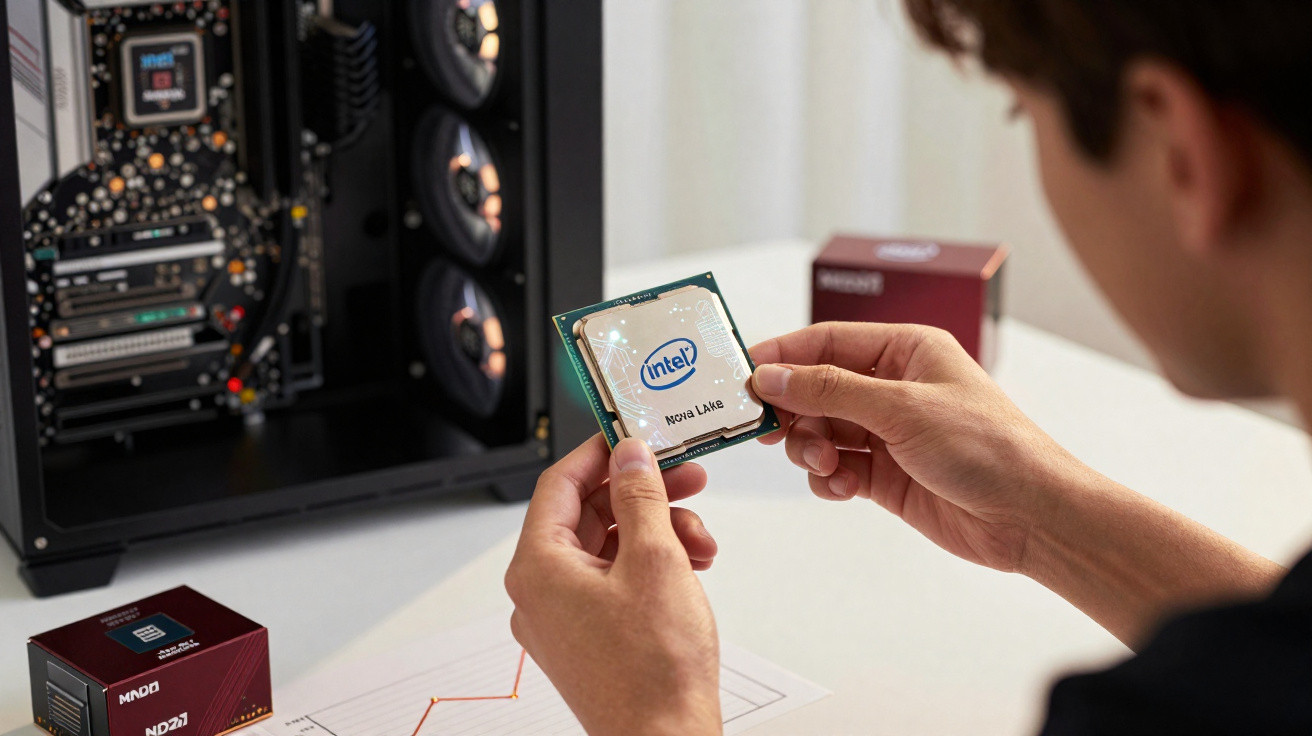
The high-performance processor segment is preparing for another major shake-up, with bold promises and tight timelines.
Intel has started to reveal details of Nova Lake, its next major PC architecture, which is aimed squarely at AMD's advances and seeks to return the brand to the top of gaming and productivity from 2026.
Nova Lake signals the end of Intel's transition period
After several generations that enthusiasts considered underwhelming, Intel is betting that Nova Lake will be the turning point. Rather than delivering incremental refinements, the company is discussing a far-reaching overhaul of its desktop and high-end range.
The Nova Lake-based Core Ultra 400 family is expected to arrive late in 2026 and introduce a new technological foundation. The architecture features two main core types:
- Coyote Cove P-Cores – designed for maximum per-core performance;
- Arctic Wolf E-Cores – focused on power efficiency and parallel workloads.
The aim is straightforward: increase IPC (instructions per cycle) while cutting energy waste, an area in which Intel has faced pressure from the Ryzen ecosystem, particularly in mixed workloads.
Nova Lake is being treated internally as a generational shift, rather than a simple “refresh” of the current line.
This shift is also intended to end the impression that Intel had been “holding back” innovation and relying too heavily on frequency improvements without truly changing the architectural foundation.
Up to 52 cores and exceptional L3 cache
Early specifications point to a substantial push in core counts. At the top of the range, future Core Ultra 400 processors could offer up to 52 cores, combining P-Cores, E-Cores and low-power efficiency (LPE) cores for background tasks.
Intel is also preparing a direct answer to AMD's Ryzen X3D chips, which are known for their generous cache capacity that benefits gaming. The new L3 cache, called bLLC (Big Last Level Cache), is emerging as one of Nova Lake's central features.
| Core Ultra 400 (Ultra 9) | Core Ultra 400 (top of the range) | Core Ultra 400 (mid-range) | |
|---|---|---|---|
| Total cores | 52 (48 + 4 LPE) | 42 (38 + 4 LPE) | 28 (24 + 4 LPE) |
| Core breakdown | 16 P-Cores / 32 E-Cores | 14 P-Cores / 24 E-Cores | 8 P-Cores / 16 E-Cores |
| L3 cache (bLLC) | 288 MB | 288 MB | 144 MB |
| Socket | New dedicated socket | New dedicated socket | New dedicated socket |
The bLLC increase could reach 288 MB in the most expensive models, a figure well beyond what the desktop market is used to seeing. The intention is to directly address memory-access latency and keep more data readily available to the CPU during every cycle.
For gamers, a massive L3 cache tends to deliver tangible FPS gains in demanding titles with extensive real-time data exchanges.
This design also suits professional workloads such as 4K/8K video editing, scientific simulations and 3D rendering, where keeping data close to the cores reduces bottlenecks and improves performance consistency.
Hybrid design, with fewer tricks and more physical cores
One change in direction stands out: every indication suggests Intel will drop Hyper-Threading in this generation. Instead of two logical threads per core, the company is relying on more physical cores and optimising each cycle.
This decision has a direct impact in three areas:
- Simplified architecture, with fewer virtual execution paths;
- Potential thermal improvements, as each core is placed under less pressure from simultaneous threads;
- Scalability in modern software, which is increasingly better equipped to handle dozens of real cores.
The inclusion of LPE cores, intended for background jobs and system maintenance, also indicates an effort to reduce power consumption during standby, silent updates and cloud processes that continually run in the background.
Intel's major bet on AI in the PC
Another area in which Intel intends to stand apart is on-chip AI acceleration. Nova Lake is expected to feature a sixth-generation NPU (Neural Processing Unit), capable of providing around 74 TOPS (trillion operations per second) for inference workloads.
The goal is to comfortably exceed the minimum requirements for PCs labelled for native AI experiences, such as Copilot+ devices.
At present, certification for this category generally sits in the 40 to 45 TOPS range for the NPU. By doubling that capability, Intel is seeking to provide headroom for running:
- local AI assistants, with less reliance on the cloud;
- generative image and video creation tools;
- real-time translation, subtitles and transcription;
- security routines based on behavioural detection.
In professional environments, this could reduce GPU and CPU load in projects using smaller models integrated into the operating system itself or productivity suites.
The contest with AMD and the 2026 launch window
Core Ultra 400 processors with Nova Lake are set to take on AMD's Zen 6 architecture, which is expected during the same period. The timing suggests the two giants are preparing for a head-to-head contest in gaming, content creation applications and local AI alike.
AMD has enjoyed a positive run with Ryzen 7000, 8000 and the X3D variants, which use stacked cache to achieve strong gaming results. Intel's answer through expansive bLLC demonstrates that the focus is not merely on winning synthetic benchmarks, but on affecting the real-world use cases that matter most to enthusiasts.
If the promises are fulfilled, 2026 could be the generation in which the concept of an “AI-ready PC” stops being marketing and becomes a basic requirement.
What this means in practice for users
For those building or upgrading PCs, Nova Lake carries several indirect messages. First is the new dedicated socket, which will effectively require a motherboard replacement. Such a transition is usually accompanied by support for new interfaces, including faster memory and storage standards.
It is reasonable to expect:
- next-generation DDR memory with higher clock speeds;
- more PCIe lanes for GPUs and high-performance NVMe SSDs;
- improved integrated connectivity, including Wi-Fi and high-speed USB ports.
Another likely consequence concerns thermal requirements and the need for capable cooling systems. With as many as 52 cores operating, heat dissipation becomes a sensitive issue. Even with an emphasis on efficiency, transistor density continues to rise, requiring more demanding users to give serious consideration to robust coolers and well-ventilated cases.
Technical terms worth another look
Several concepts gain prominence with Nova Lake and help clarify the technical discussion:
- IPC (Instructions per cycle) – indicates how much “real work” a processor completes with each clock cycle. A chip with high IPC can be faster than another with a higher frequency, depending on the task.
- L3 cache / bLLC – ultra-fast memory within the processor, used as a “premium parking space” for data that will be accessed repeatedly. The larger and better organised it is, the less idle time the cores experience.
- NPU – a dedicated AI unit, optimised for matrix and vector operations that consume considerable power on conventional CPUs and GPUs.
In practical terms, a competitive game with large maps and many players is likely to benefit from additional cache and more high-performance cores, reducing sharp FPS drops during intense action. Meanwhile, a content creator working with AI-based filters may see faster previews and less time-consuming exports when the NPU comes into play.
There is also an element of risk: if software does not keep pace with this hardware leap, some of that capacity will remain idle. Developers will have a strong incentive to adapt game engines, video editors and office suites for an environment featuring dozens of physical cores and integrated AI acceleration.
On the other hand, the combination of many cores, generous cache and a powerful NPU is likely to extend the machine's useful life. In theory, anyone investing in a Nova Lake-based system could move through several generations of software without becoming outdated too soon, provided the rest of the system – memory, storage and cooling – keeps pace with Intel's proposed leap.




Comments
No comments yet. Be the first to comment!
Leave a Comment