
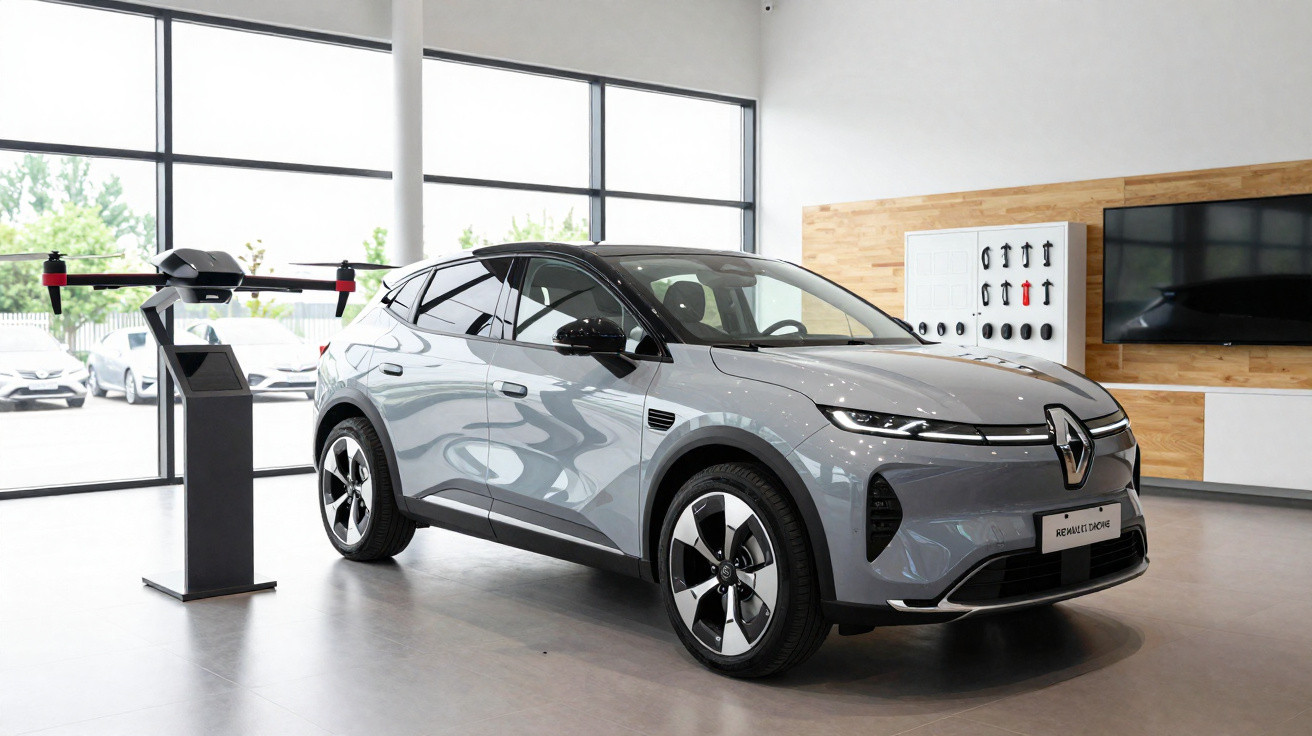
What began as an industrial collaboration could shortly transform a historic Renault factory into a high-volume drone assembly operation, blurring the line between civilian manufacturing and military requirements during a period of geopolitical tension.
Renault’s Le Mans plant moves into defence production
Renault and France’s Defence Procurement Agency (DGA) have confirmed that the group’s Le Mans site is being considered for the assembly of military drones. Under the current contract designation, “Chorus”, the plant could manufacture as many as 600 aerial drones each month once it reaches full capacity.
The initiative involves French defence specialist Turgis & Gaillard, which focuses on advanced military systems. Renault contributes large-scale industrial capability and manufacturing expertise, while Turgis & Gaillard supplies defence technology, systems-integration expertise and access to military clients.
French authorities want to use the car industry’s efficiency and scale to rapidly boost domestic drone production.
For the government, the rationale is straightforward. Although cars and drones appear very different, their production relies on similar fundamentals: highly precise assembly processes, rigorous quality checks, and the capacity to scale output quickly while keeping costs under control.
What types of drones will Renault build?
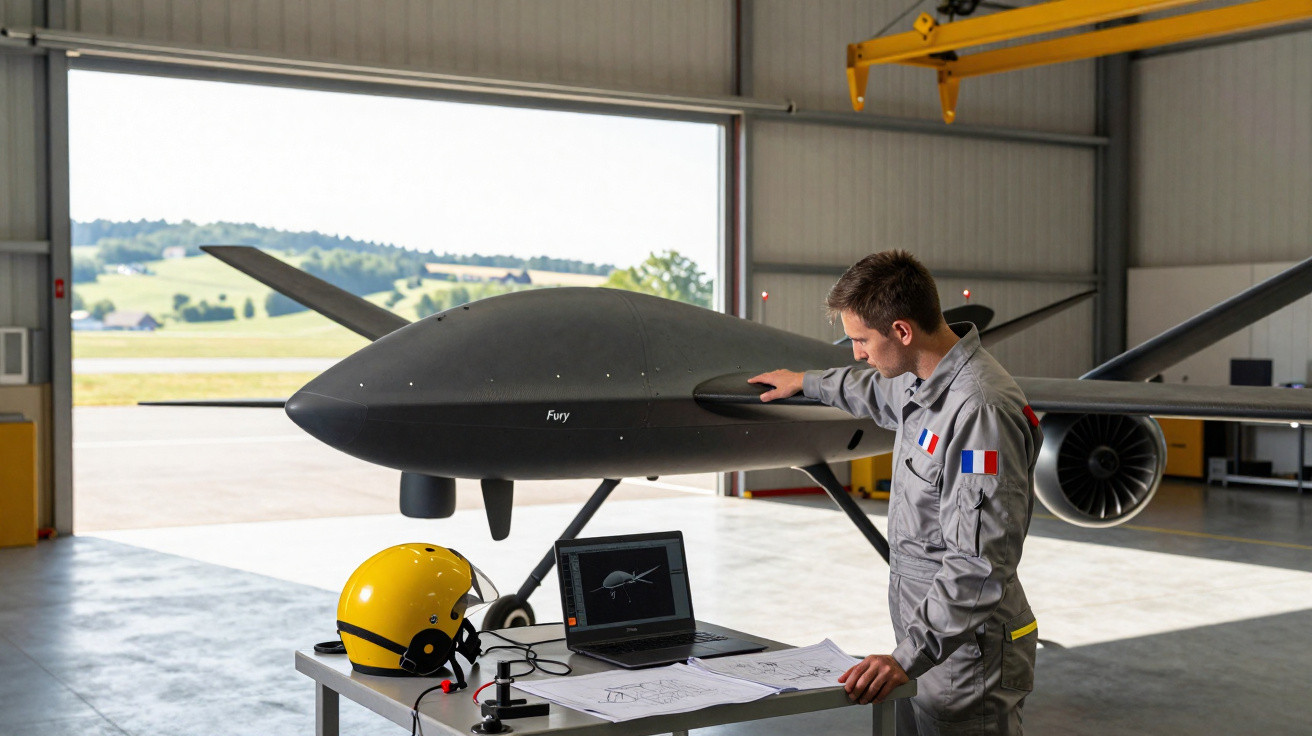
The drones included in the Chorus contract are not small, readily available quadcopters. Instead, they are aerial systems described this month by France’s senior armaments official as “long-range remotely operated munitions,”.
In practical terms, this generally means drones able to cover tens or hundreds of kilometres, carry sensors or explosive loads, and undertake reconnaissance or strike operations. Fighting in Ukraine, the Middle East and the South Caucasus has demonstrated how these systems can alter the battlefield at a comparatively modest cost against conventional aircraft or missiles.
Renault is taking care to define the limits of its participation, insisting that it will not manufacture complete weapons.
The group’s role is strictly limited to manufacturing the drone’s structure; any military payload will be added later by specialised defence operators.
This separation of responsibilities is intended to confine Renault’s role to industrial manufacturing rather than the direct handling of weapon systems. Frames, fuselages, wings and other structural parts would be stamped, machined and assembled in a setting more akin to an automotive factory than an ammunition plant.
A phased ramp-up during the next year
The Le Mans facility is not expected to switch immediately from vehicle components to producing hundreds of drones. Output should rise in stages, with full-rate production expected in around a year.
- Initial phase: dedicated production lines and tooling installed, employees trained, and early-series prototypes produced
- Intermediate phase: small-batch manufacturing, quality approval, and coordination with Turgis & Gaillard and the DGA
- Full-rate phase: capacity of up to 600 drone structures a month, subject to military orders
For Renault, the arrangement represents both an experiment and a potential opportunity. It offers the company a way to show that it can industrialise sophisticated, technology-heavy products beyond its established car-making activities, while continuing to meet its commitments to its main car and van operations.
The company maintains that this does not amount to a strategic shift towards defence. Its managers present the work instead as an application of existing capabilities: supply-chain management, production-cost control, strict delivery planning and compliance with demanding quality requirements.
Volunteers only: recruiting workers for Renault’s drone project
Moving from components for civilian vehicles to structures for military drones inevitably raises ethical concerns among workers at the factory. Both Renault and the trade unions recognise the sensitivity of the matter.
All employees assigned to the drone project at Le Mans will be volunteers, following discussions with staff representatives.
The CFDT union, one of the principal voices at the site, sought explicit safeguards. It requested accredited training schemes to ensure workers moving into the new activity acquire the right skills, alongside rigorous adherence to workplace safety requirements and wider ethical principles.
This model is designed to ensure that staff are not compelled to undertake work with which they may be uneasy, particularly if they object to a direct connection with the defence industry. Renault will have to handle internal redeployment carefully, both to prevent friction between teams and to avoid any suggestion that employees who decline to volunteer are treated unfairly.
Ethical issues on the production line
Defence contracts entering a conventional industrial factory bring back memories of more troubling moments in European history, when car plants were converted to wartime output. The present circumstances are different, but the ethical discussion remains highly relevant.
Some employees may regard the project as a contribution to national security and Europe’s strategic autonomy. Others may be concerned about assisting with the production of systems that could serve as loitering munitions or precision-strike platforms.
For unions, transparency is a central issue. Workers want clarity on precisely what they are making and on the potential use of those systems. There is also concern that the boundary between civilian and military activity could gradually become less distinct without explicit consent.
Why France is involving carmakers in its drone strategy
France has sought to reinforce its defence industrial base, particularly in drones, an area in which it has at times fallen behind the US, Israel and Turkey. The war in Ukraine has further revealed the speed at which armed forces consume drones and munitions during high-intensity warfare.
Dependence on specialist defence companies alone can constrain production. Their plants tend to be smaller, while their supply chains are set up for restricted runs rather than mass manufacturing.
Automotive groups like Renault have large plants, seasoned logistics and a culture of high-volume, cost-controlled production that the defence sector now badly needs.
Employing car factories to make drone structures enables the state to increase capacity without constructing entirely new sites. It also creates an industrial buffer for periods of exceptional demand, such as a significant crisis or a sharp rise in exports to allied nations.
A wider industrial movement
Renault is not the only company being approached for work connected to defence. Across Europe, governments are discreetly looking to major civilian businesses in automotive, rail and electronics to produce military items that can be standardised or modularised.
Comparable discussions are under way in Germany and Italy concerning artillery shells, armoured-vehicle components and communications equipment. The aim is to divide production between specialist defence businesses and larger groups able to activate thousands of employees and extensive supplier networks when necessary.
Key terms and practical implications
Several technical terms associated with the Renault project require explanation for readers who are unfamiliar with defence language.
| Term | Meaning |
|---|---|
| Remotely operated munitions | Human-guided drones carrying explosive charges that can hit targets from a distance. |
| Drone structure | The drone’s physical form - its frame, wings and fuselage - excluding electronics and weapons. |
| Industrial ramp-up | A gradual progression from prototype output to high-volume production. |
| Defence procurement agency | A government organisation responsible for ordering, testing and accepting military equipment for the armed forces. |
In practical terms, the Le Mans scheme has implications well beyond one French city. It provides a precedent for the mobilisation of civilian industries in a period of strategic strain. Other European carmakers, including groups with UK and US operations, will be monitoring it closely.
One possible outcome is a growth in similar alliances: car plants producing structures and subassemblies, electronics companies fitting sensors and communications systems, and leading defence contractors carrying out the final weaponisation. Such a distributed arrangement could accelerate deliveries, but it could also make the public debate over who belongs to the arms industry more complex.
Risks, benefits and questions ahead
For Renault, potential advantages include additional sources of revenue, more effective use of factory capacity and a strengthened reputation as a high-technology industrial business. The project could also deepen its relationship with the French state, which is both a major shareholder and a long-standing partner.
The risks are varied. Reputation is one concern: a marque associated with family cars and compact city vehicles is now featuring in defence-related news. Labour relations are another: should outside tensions intensify, or a particular conflict lose support among the French public, volunteers at Le Mans could face difficult questions.
A larger political issue also confronts Europe: to what extent should civilian economies move towards defence manufacturing when international tensions increase? The Renault example indicates that public authorities are prepared to move further than many expected, using familiar consumer brands to pursue strategic aims well beyond the showroom.





Comments
No comments yet. Be the first to comment!
Leave a Comment