
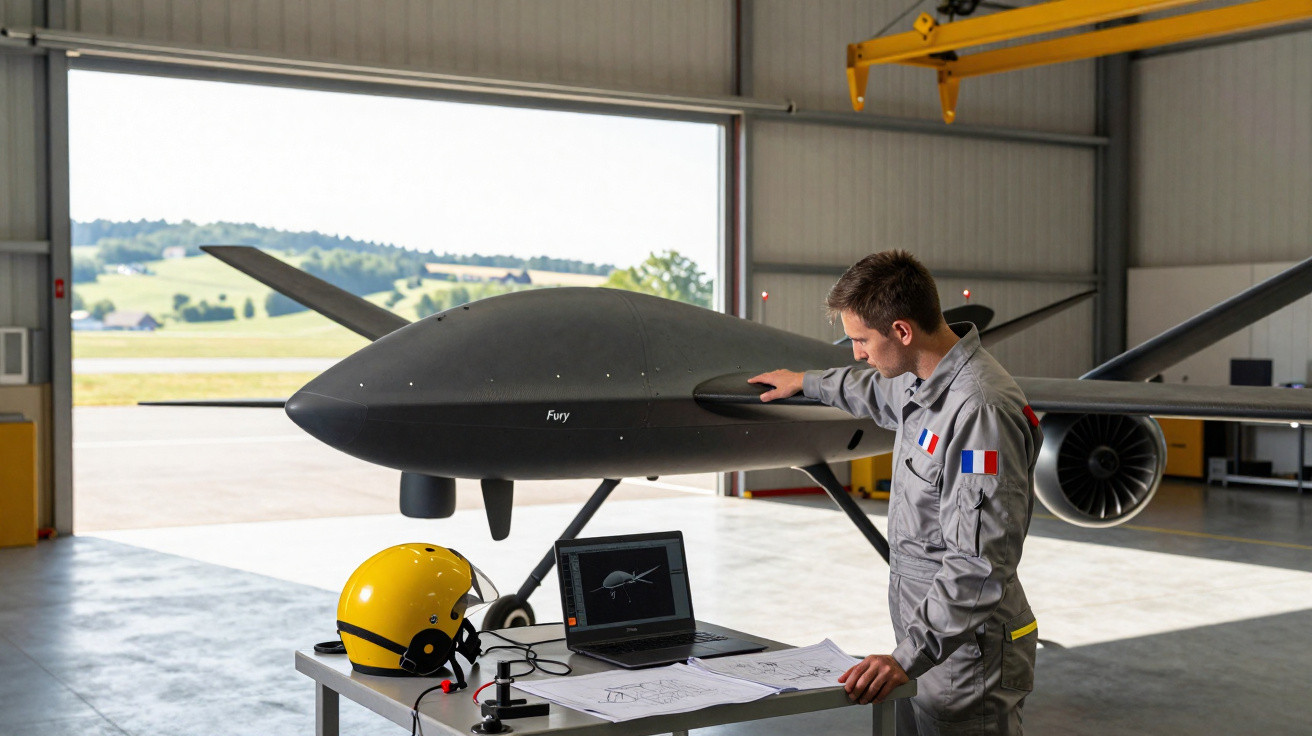
A discreet precision-engineering workshop in eastern France has just disrupted Europe’s defence landscape with an exceptionally fast new interceptor.
Based far from Paris and the major defence groups, ALM Meca, a 17-strong firm in Alsace, has created Fury: a compact, highly agile drone intended to pursue hostile drones at speeds previously associated with fighter aircraft and missiles.
A small Alsace workshop challenges defence giants
ALM Meca, the business responsible for Fury, was not founded as a high-profile defence start-up. For many years, it focused on ultra-precise machining for the aerospace and defence sectors, manufacturing components in which even one defect could prove disastrous. This industrial heritage, rooted in traditional workshop skills, gave its team deep expertise in mechanics and metalworking rather than software-driven hype.
The company eventually chose to move beyond supplying components for other systems. Its management took the ambitious decision to develop a complete drone, covering everything from the airframe to propulsion, without first securing a major state contract or industrial backer.
Fury was developed on the company’s own money, without a dedicated government programme, in a sector usually dominated by heavily subsidised giants.
Within Europe’s defence sector, where multi-billion-euro programmes generally run for years and involve extensive lists of contractors, this is unusual. A small employer funding a high-performance interceptor largely by itself represents something closer to start-up risk-taking than conventional defence procurement.
From the workshop floor to the high-speed sky
Why interception drones are needed now
Fury sits in a category still largely absent from European arsenals: affordable drone interceptors. On modern battlefields, low-cost quadcopters and small fixed-wing drones are deployed in vast numbers. They operate at low altitude, travel slowly and may arrive in swarms. Their uses include spotting for artillery and carrying out kamikaze attacks against vehicles or infrastructure.
Using conventional surface-to-air missiles to counter such threats is economically illogical. A basic drone derived from civilian equipment may cost only a few hundred pounds, while the missile used to destroy it can cost hundreds of thousands. As wars in Ukraine and the Middle East have demonstrated, that disparity rapidly becomes untenable.
ALM Meca developed Fury specifically to address this shortfall. Rather than launching a missile, the concept is to deploy a small but extremely fast drone capable of intercepting and neutralising the intruder. It resembles Anduril’s American Roadrunner interceptor in principle, although Fury is presented as Europe’s first aircraft in this performance category.
Using a £500,000 missile against a £500 drone is a losing game; Fury aims to reset that equation.
Fury: a compact “monster” designed for speed
Fury is relatively small, measuring around 1.1 metres long, with a wingspan marginally wider than its fuselage. Its defining figures lie elsewhere: it can reach approximately 700 km/h, about three times faster than many of the small drones it is designed to pursue.
To deliver that performance, ALM Meca selected a challenging approach: a kerosene-powered micro-jet engine rather than electric motors or compact piston engines. Microturbines are famously difficult to engineer and produce, demanding exacting tolerances, controlled heat management and durable materials within an exceptionally small structure.
In return, they provide substantial thrust for their size, swift acceleration and sustained high-speed flight.
- Top speed: around 700 km/h
- Length: ~1.1 m
- Manoeuvre load: up to 20 G
- Propulsion: kerosene micro-jet engine
- Primary mission: interception of hostile drones
People familiar with the programme say Fury can climb almost straight upwards after launch. It accelerates fiercely and can endure manoeuvres reaching 20 times the force of gravity. This manoeuvrability is vital for a compact interceptor chasing slower, unpredictable targets that could alter course at the last moment.
There is currently no direct European equivalent to Fury’s performance level; its closest peer is the US-built Roadrunner interceptor.
From prototype to production: the greatest challenge
A convincing demonstrator meets an industrial barrier
Fury’s demonstrator has already flown, persuading military observers that its core technology is genuine. The next obstacle is converting a small number of hand-built prototypes into a dependable product capable of leaving an assembly line in batches of dozens or hundreds.
Large-scale production introduces separate demands: secure supply chains, consistent quality, stringent certification, and dependable operator training and support. For a small company, these requirements may be as formidable as the original aerodynamic and propulsion challenges.
Without a capable industrial partner, ALM Meca risks being trapped in a “demo valley”: respected for its innovation but unable to expand quickly enough to satisfy military requirements.
Interest grows in Paris and elsewhere
The French government has begun to take notice. Fury and ALM Meca were formally mentioned in the National Assembly in 2025. The company is regarded as one of the rare French firms capable of designing and manufacturing drone microturbines in this performance class, an expertise genuinely mastered by only a small number of organisations worldwide.
ALM Meca is already involved in defence programmes supported by the French procurement agency, including the Veloce 330 initiative. It has also encountered financial pressure, underlining that a technological advantage does not necessarily ensure commercial stability.
The French defence ministry has placed an initial order for drones using ALM Meca turbines and has alerted major industrial players such as Safran and Dassault to the company’s potential.
This combination of political interest, initial orders and prospective partnerships may give Fury the route it needs to progress from demonstration flights to operational squadrons. International interest is also beginning to emerge as European countries seek credible counter-drone capabilities.
Why Fury matters to Europe’s defence industry
A message for major groups and small workshops
Fury’s significance extends beyond its technical achievements. Its development indicates that important innovation need not come solely from vast programmes with long schedules and complicated governance. It can also come from a small workshop with several machines, a micro-jet engine and a determined team of engineers.
ALM Meca is not displacing Europe’s dominant defence groups. Rather, it demonstrates that agile, high-risk projects can still find a place within a closely regulated and cautious sector.
In certain respects, Fury recalls aviation’s early 20th-century pioneers, when figures such as Blériot and Farman began with modest workshops and experimental aircraft, developing expertise that later supported major industries.
How a Fury interception mission might unfold
During a typical operation, Fury would form part of a wider air-defence network. Radar, acoustic sensors or optical tracking systems would identify a suspicious drone approaching a base, vessel or critical location such as a power station. Once it has been confirmed as a threat, the system would launch Fury, potentially from a rail or compact launcher.
The interceptor would quickly accelerate to high speed under guidance from ground control or onboard systems. Its task would be to approach the target from a favourable direction before neutralising it. Depending on the final configurations selected by customers, this might involve direct impact, fragmentation charges or another method. The essential aim is to respond rapidly enough to stop the hostile drone before it reaches its target, while remaining less expensive than firing a volley of missiles.
| Element | Fury’s role |
|---|---|
| Sensors (radar, cameras, acoustic) | Detect and track hostile drones |
| Command system | Decide when and where to launch Fury |
| Fury interceptor | Physically engage and neutralise the target |
| Traditional missiles | Reserve for larger or high-value aerial threats |
Key concepts and future risks
For those less familiar with the terminology, several concepts merit explanation. A microturbine is a miniature jet engine comprising a compressor, combustion chamber and turbine, like those of a passenger aircraft but reduced in scale to fit inside a small drone. G-load describes the acceleration force experienced by an aircraft or its structure: 20 G equals twenty times the acceleration of gravity, placing materials and engineering under extreme strain.
The increasing use of interceptors such as Fury will create further questions. Highly manoeuvrable drones travelling at 700 km/h near urban areas raise issues surrounding debris, collateral damage and airspace management. There is also a strategic concern: as interception systems improve, operators of offensive drones will attempt to adapt by flying lower, adopting stealthier designs or overwhelming defences with larger swarms.
European countries are now testing combinations of jamming, lasers, conventional guns and interceptors. Fury belongs within this layered-defence model, occupying the space between inexpensive jammers and high-end missiles. The coming years will determine whether a small Alsatian company can preserve its lead as larger competitors enter the same niche.




Comments
No comments yet. Be the first to comment!
Leave a Comment