
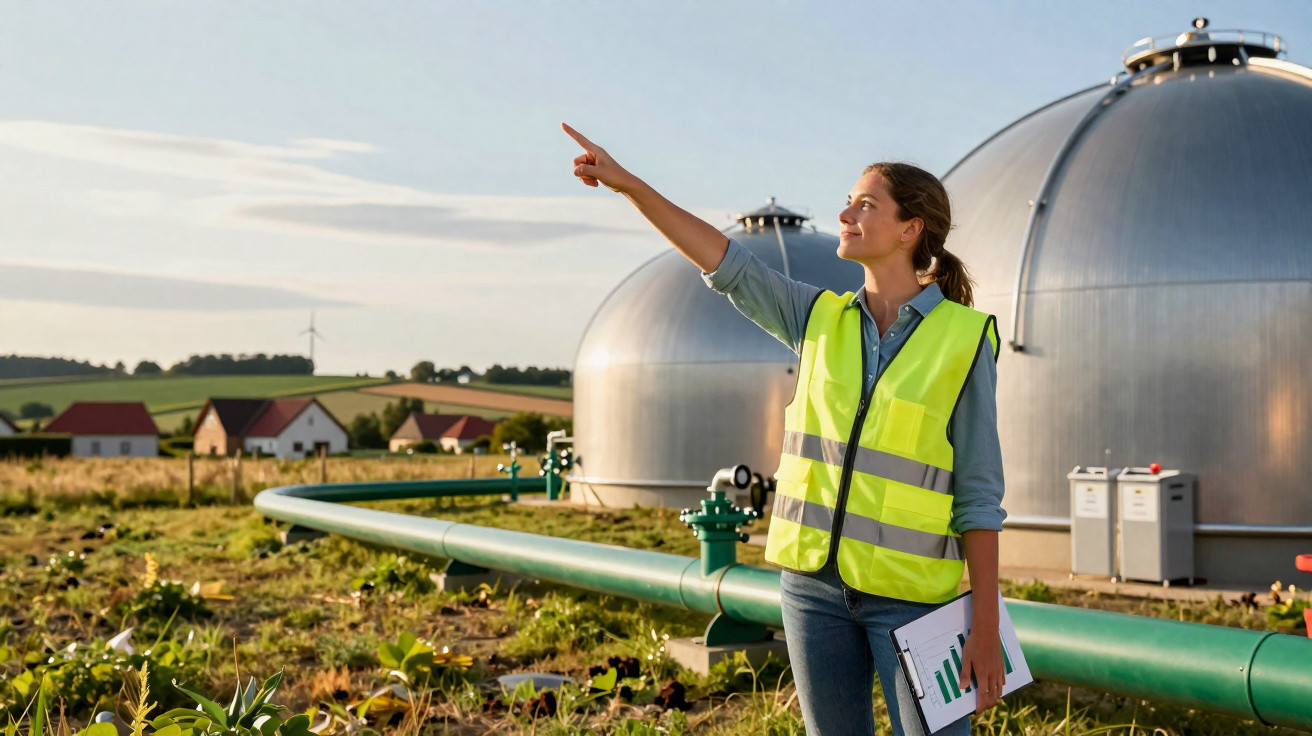
Amid the energy crisis, one country has unexpectedly moved into the lead – casting Germany’s gas transition into the shade.
While Berlin continues to debate heating legislation, LNG terminals and hydrogen corridors, Paris has secured a quiet yet decisive win: France is producing enough green gas to lead Europe for the first time in 2025, overtaking Germany of all countries in renewable gases.
France’s rise: 803 plants and 13.6 TWh of green gas
In 2025, France expanded its renewable gas capacity by around 13 per cent. One figure is particularly significant: 13.6 terawatt hours of biomethane were injected into the gas grid. This is equivalent to the annual energy supply of roughly one million households.
There are now 803 injection plants connected to the grid across the country. Together, they have an installed capacity of 15.5 terawatt hours, with 13.6 terawatt hours actually produced. As a result, biomethane accounts for around 3.9 per cent of France’s national gas consumption.
France is Europe’s number one for biomethane injection in 2025, pushing Germany and Denmark into the following places.
This puts the country in a new position within European energy policy: no longer viewed as a latecomer, but as a pace-setter in green gas.
How biomethane is made: energy from manure, waste and sewage sludge
Most of France’s green gas comes from fermenting organic residual materials. The principal feedstocks are:
- agricultural and food organic waste
- sewage sludge from municipal wastewater treatment plants
- organic municipal waste from towns and local authorities
These materials ferment in airtight containers known as fermenters or digesters. This produces raw biogas, initially made up of methane, CO₂ and impurities. Processing facilities then clean the gas, increase its methane content and upgrade it into biomethane. Only then is it fed into the standard gas grid.
The benefits extend far beyond energy generation alone. Residual materials are given a new purpose rather than ending up in landfill or being expensively incinerated. The remaining fermentation residue, known as digestate, is applied to fields as fertiliser and can replace some synthetic mineral fertilisers.
This creates a circular chain: waste generates energy, while the resulting residues improve soils. For many farms, anaerobic digestion therefore becomes both an additional source of income and a way to manage stricter environmental requirements more effectively.
Industry and grid operators: why France is now ahead
France’s lead did not emerge by chance. Over many years, the country has built up its own sector in which grid operators, project developers and farmers work closely together. Companies such as GRDF and Teréga have specifically invested in connecting new plants and creating flexible grid structures.
Rather than constructing new pipelines everywhere, operators have technically upgraded existing gas networks. Metering and control stations have been adapted, reverse-flow injection points installed, and pressure conditions optimised. This practical approach saves both time and money while still enabling large injection volumes.
At the same time, the state has established predictable conditions for project developers: feed-in tariffs, support schemes and technical guidance have helped turn individual developments into a scalable industry. Consequently, France is now among the countries where biomethane is developing economically at the fastest pace.
The 2030 target: 44 TWh or more
Paris is already looking further ahead. Its official energy strategy targets biomethane production of 44 terawatt hours by 2030. That would be more than three times today’s volume. The government is relying on three main levers:
- a substantial increase in the number of anaerobic digestion plants
- technical process improvements to achieve higher yields
- financial incentives through so-called biogas production certificates
These certificates require gas suppliers to include a minimum share of biomethane in their portfolios. By 2028, that share is expected to reach four per cent. Energy suppliers must therefore either participate in projects or purchase the relevant volumes on the market.
Planning certainty remains a crucial issue. Plants often operate for 15 to 20 years, while approvals can take several years. Industry representatives are therefore calling for the certificate scheme to be extended beyond 2028. Without a clear roadmap, investment pauses could follow, slowing growth.
Europe turns to e-methane and power-to-gas
While France is chiefly scaling up conventional biomethane plants, the next wave of technology is approaching across Europe. Two terms dominate the discussion: e-methane and power-to-gas.
- e-methane: synthetic methane produced from renewable hydrogen and CO₂
- power-to-gas: processes that convert surplus renewable electricity into gaseous forms of energy, such as hydrogen or synthetic methane
An example from northern Europe indicates the direction of travel: in Finland, Ren-Gas’s eNRG Kotka project has received an EU grant worth tens of millions to produce e-methane on an industrial scale. The key advantage is that the gas is fully compatible with existing gas grids and can be transported in exactly the same way as fossil natural gas.
The EU’s strategy is clear: surplus wind and solar power should no longer be curtailed, but stored chemically instead. Gas storage facilities and networks can then serve as vast energy stores. This could supply climate-friendly gas to industries and heavy transport that are difficult to electrify.
Global biomethane boom: Europe as a heavyweight
The trend does not stop at the EU’s borders. The biomethane market is growing markedly around the world. Market researchers expect a value of around US$6.95 billion in 2025 and almost US$10.74 billion in 2034. This represents annual growth of just under five per cent.
| Indicator | Value |
|---|---|
| Market volume 2025 | ≈ US$6.95 billion |
| Forecast for 2034 | ≈ US$10.74 billion |
| Average annual growth | around 4.97 % |
| Europe’s market share | approximately 61 % |
Globally, well over 70 per cent of biomethane production comes from organic waste. More than 80 per cent of plants use conventional anaerobic digestion. On the demand side, electricity generation and heating markets dominate, with transport increasingly important as well, including lorry fleets powered by compressed or liquefied biomethane.
Large markets for Renewable Natural Gas, meaning upgraded biogas that replaces fossil natural gas in pipelines, are also expanding in North America. Europe may lead in terms of market share, but competition is not standing still.
A lead with risks: how secure is France’s new top position?
France leads in injected biomethane, but its advantage is not set in stone. Germany is responding with new support programmes and is seeking to refocus its biogas sector more strongly on grid injection and flexible electricity production. Scandinavian countries are almost routinely deploying power-to-gas alongside large wind farms.
Pressure is also increasing beyond Europe. The US is seeing a growing number of RNG projects, driven by state climate targets and companies seeking to decarbonise their supply chains. For France, this means that only a combination of technological expertise, stable rules and export capability can secure a lasting lead.
The real race is not solely about volumes, but about a robust, internationally competitive value chain built around green gas.
What biomethane means in practice for citizens and local authorities
For consumers, biomethane is initially invisible because it flows through the same gas grid as its fossil counterpart. Its impact is felt elsewhere: municipal waste operators can make productive use of waste, farmers gain additional income, and regional value creation increases.
Several practical developments are likely to become more relevant in the coming years:
- gas contracts with a declared share of renewable gas
- municipal bus fleets running on biomethane or e-methane
- heat networks where gas boilers increasingly use green gas
- industrial facilities gradually replacing natural gas with biomethane-based gas
There are risks too. Poorly designed incentives could result in energy crops being grown on a large scale, competing with food production. France is attempting to ease this conflict by prioritising residual materials and waste. Over the longer term, synthetic gases made from renewable electricity are expected to take on an ever larger role.
For Germany, France’s rise is a wake-up call. The country’s energy-transition debate focuses heavily on electricity and hydrogen. Biomethane and e-methane are often treated as niche subjects, despite their ability to use existing infrastructure and deliver substantial CO₂ savings in the short term. Anyone seeking room for manoeuvre over the coming years cannot ignore green gas.





Comments
No comments yet. Be the first to comment!
Leave a Comment