
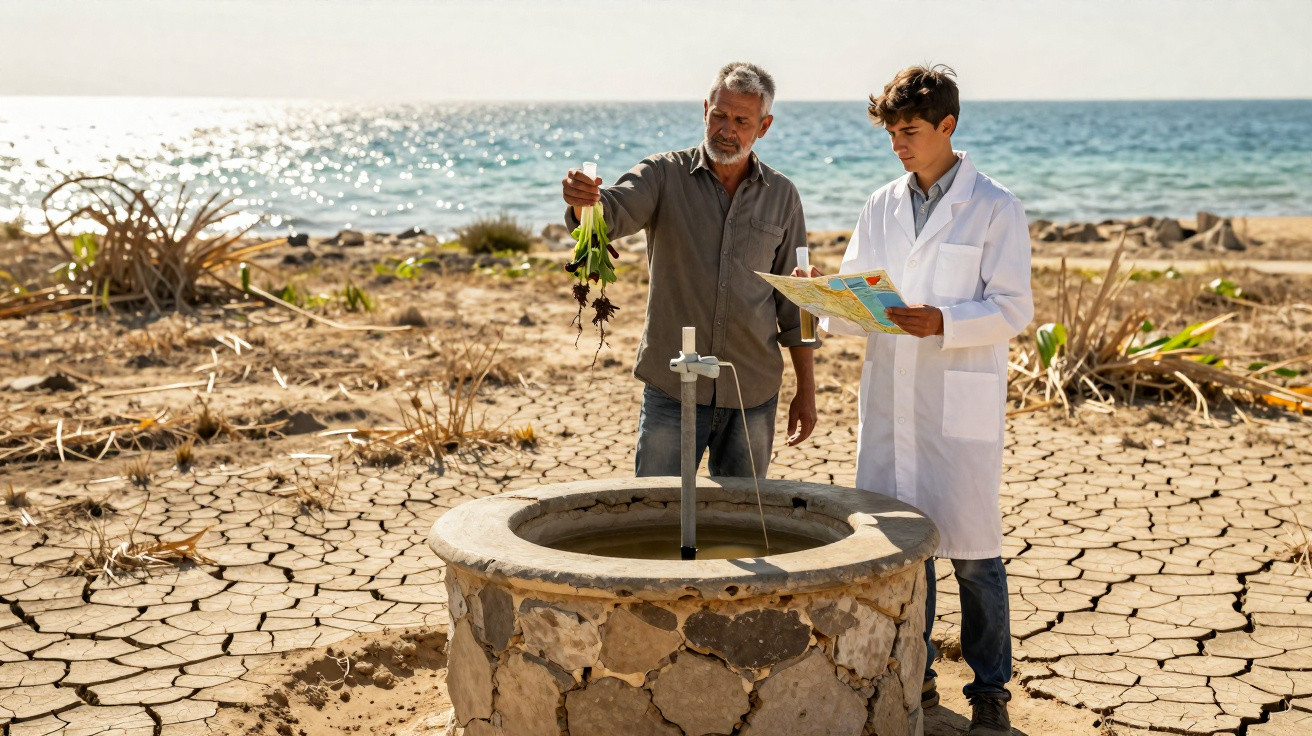
Groundwater held beneath the world’s coastal areas provides drinking water for vast populations, but new research indicates that this vital resource faces mounting pressure.
Across numerous coastal regions, substantial changes in groundwater levels may enable seawater to push inland and pollute freshwater stores.
The research was conducted by a team headed by Professor Robert Reinecke of the Institute of Geography at Johannes Gutenberg University Mainz and Annika Nolte of the Climate Service Center Germany in Hamburg.
The scientists say that intensive groundwater pumping combined with sea-level rise is producing a hazardous situation in coastal areas worldwide.
“Between 1990 and 2024, more than 20 percent of the coastal areas we studied showed significant changes in groundwater levels. In some cases, levels have dropped by more than 50 centimeters (about 20 inches) per year,” Reinecke said.
“This points to over-abstraction and, consequently, the potential intrusion of seawater and associated salinization.”
Worldwide mapping of coastal groundwater
What distinguishes the study is the scale of its underlying information. The team compiled data from roughly 480,000 wells across a range of countries.
It represents the largest global dataset of coastal groundwater measurements brought together to date. Its extensive coverage enabled the researchers to assess groundwater conditions in highly varied regions using a consistent approach.
Rather than relying solely on separate local investigations, the researchers could create a broader view of developments along coastlines around the world.
“Our study makes three key contributions,” Reinecke said. “First, it translates available measurement data from different locations into globally comparable metrics, enabling large-scale assessment for the first time.
“Second, it identifies areas at particular risk and highlights the changes occurring there. Third, it provides indicators that can be used to model developments along previously unmonitored coastlines.”
Groundwater declines are increasingly widespread
The findings reveal that groundwater levels are not changing in the same direction in every location. They have risen in certain places but fallen elsewhere.
However, the general pattern has grown more concerning in recent years. Since 2016, the researchers found that falling groundwater levels have become more common.
This development is important because lower freshwater levels can leave coastal aquifers more susceptible to seawater intrusion.
The research further indicates that changes are not necessarily uniform within a single region. Nearby locations can display sharply contrasting patterns.
“The extent of groundwater-level change varies significantly, even on a small scale within many regions,” Reinecke said.
Consequently, large-scale regional averages can conceal local areas of concern. A coastline may seem broadly stable initially, even though particular sections are already experiencing severe pressure.
Coastal groundwater loss hotspots
The steepest falls were recorded principally along the coasts of the United States and Central America, around the Mediterranean, and in South Africa, India and southern Australia.
In these locations, the warning signs are already particularly pronounced. The issue is not merely that groundwater levels are shifting, but also what those shifts may cause.
As freshwater levels drop too far, the equilibrium between groundwater on land and the sea is more readily disturbed. Saltwater can then start entering freshwater reserves below ground.
The study characterises this relationship as particularly severe because two pressures are acting simultaneously.
High levels of groundwater extraction undermine the system from one direction, while climate change and rising sea levels add pressure from the other.
High-risk coastal zones
The researchers also examined the coastal zones most vulnerable to saltwater intrusion. Their assessment identified two principal risk factors.
The first is a groundwater table already situated near sea level. In these areas, even modest changes can disrupt the balance and allow seawater to travel farther inland.
The second is a heavy reliance on groundwater in dry regions. Communities in arid areas frequently depend strongly on underground water where alternative freshwater sources are scarce, so any deterioration in groundwater quality becomes a considerably more serious issue.
“Coastal areas where the groundwater table is close to sea level are especially at risk, as are arid regions where populations rely heavily on groundwater,” Reinecke said.
“Our study provides global evidence that coastal groundwater is threatened by salinization and must be prioritized for monitoring and management.”
Risks to food supplies and ecosystems
The concern reaches well beyond the wells themselves. Should coastal groundwater become excessively salty, the consequences may affect everyday life, agriculture and natural habitats.
Over the coming decades, the risk could extend to every coastal region. This is a notable warning given that more than 30 percent of the global population lives in coastal areas.
Lasting harm to these water reserves could influence household water supplies as well as food production and coastal ecosystems reliant on dependable freshwater conditions.
Coastal groundwater is an essential resource, yet it is facing increasing strain. In the absence of more rigorous monitoring and improved management, many areas could see one of their most important freshwater supplies become progressively less dependable.





Comments
No comments yet. Be the first to comment!
Leave a Comment