
High heating bills, yet rooms still feel merely lukewarm? Many systems push heat around the home diligently without properly releasing it. One quick check reveals whether your heating is delivering warmth – or simply running.
We all know the moment: you place a hand on the radiator and wonder whether it is actually doing its job. The bill suggests it is; the room says otherwise. This is not a luxury concern but an everyday issue, especially while energy prices remain volatile and every degree matters. You do not need an engineering qualification – just an understanding of the unit mounted on your wall. That is exactly what this simple test provides. No app and no tools: two minutes, two touches and a fairly honest verdict. The test takes two minutes.
What the 2-minute test actually shows
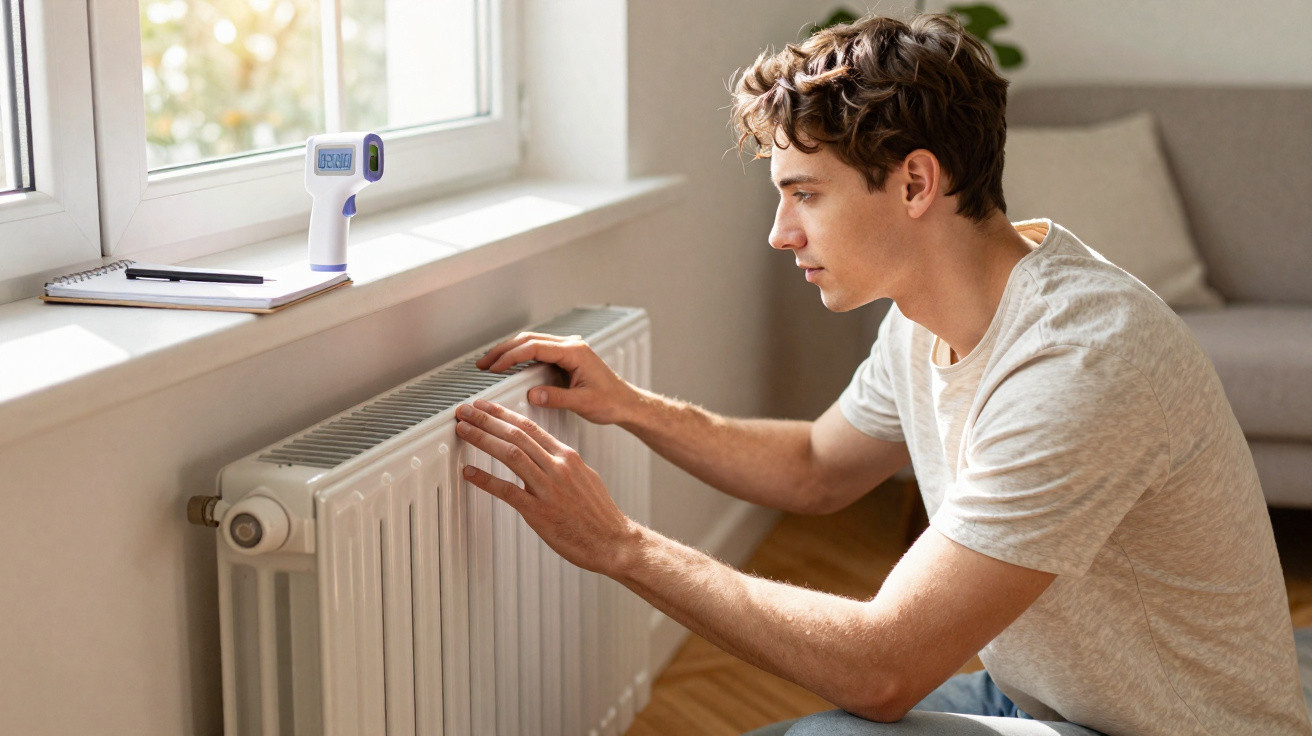
The test could hardly be clearer: open the thermostat briefly, feel the top of the radiator with your hand, then the bottom, listen, and you are done. It sounds basic because it is – and that is precisely why it is so reliable. The flow enters at the top and the return leaves at the bottom. Hot water comes in, cooler water goes out. The gap between them is your efficiency fingerprint. If the top and bottom feel the same, the radiator is not really working – water is simply rushing through it. This is not an obscure trick; it is hydraulics you can feel. A radiator that is distinctly hot at the top and noticeably cooler at the bottom is transferring plenty of heat into the room. The water is losing energy, which is exactly the aim.
Take Julia in Leipzig as an example: an older property, high ceilings and new thermostats. She briefly turns up the living-room valve, waits a minute and feels the top right: hot. Bottom left: lukewarm. There is no rushing or whistling, only a gentle gurgle that disappears shortly afterwards. The room warms more quickly, while the gas meter does not race away. That is how it should be. Good efficiency feels imperfect: hot at the top, considerably cooler at the bottom.
Now for the reverse situation. Is the radiator equally hot from top to bottom? That points to an excessively high flow rate, often caused by an overpowered pump or a missing hydraulic balancing adjustment. Water races through without enough time to give up its heat. The result is that the boiler works hard, the room warms too slowly, a condensing boiler condenses less effectively and the bill rises. Estimates from the German Energy Agency indicate that up to two thirds of heating systems in existing buildings are not properly adjusted, with hydraulic balancing often absent. That can easily cost 5 to 15 per cent in efficiency. Lowering the flow temperature to suit the building can also deliver a noticeable further improvement in many systems.
Here is a figure worth remembering: lowering room temperature by one degree saves around six per cent of heating energy on average. It is not magic, just physics and routine. It is also worth checking the display on many boilers: condensing appliances benefit from low return temperatures – the more lukewarm the return, the more latent heat the heat exchanger can recover. Put simply, if the return is not markedly cooler than the flow, you are giving away potential. The 2-minute test makes this visible without having to navigate through menus.
Step by step: the test, what it means and quick fixes
The process is quick. In the room you use most, turn one thermostat fully up, wait 60 to 90 seconds, feel the top right of the radiator and then the bottom left. Listen for sounds too: a steady hum is fine, but whistling or heavy rushing is not. If it feels hot at the top and clearly cooler at the bottom, you are on the right track. If it feels the same all over, the flow is too high. Is only the top lukewarm, or even cold? Then there is often air inside, or sludge in the radiator. Let us be honest: nobody does this every day.
“If the return is almost as warm as the flow, you are burning through efficiency – reduce the flow first, and it will become cheaper,” says heating engineer Martin B., who has worked in existing properties for 22 years.
What can you do straight away? Bleed the radiator if it gurgles. Turn the thermostat valve fully down, use a radiator key, place a cloth underneath, let the air hiss out until water appears, then close the valve again. Afterwards, check the pressure gauge and top up the system if necessary. Next, review the heating curve: on many boilers, the flow temperature is set far too high. Reduce it in small increments and monitor comfort. For condensing boilers, the target is a return below 55 °C – preferably below 45 °C.
The pump also deserves attention. Modern high-efficiency pumps have a variable characteristic curve: set yours to a lower mode and check whether the rooms still warm up. Operating noise often becomes quieter immediately, the return cools down and efficiency improves. Does the burner start in short cycles every few minutes? This is cycling, and it wastes efficiency. Open larger heating surfaces, run the pump more gently and lower the flow temperature slightly to make the cycle steadier.
Your everyday basic toolkit:
- Turn the thermostat fully up briefly, feel the top, then the bottom: a temperature difference is good.
- Gurgling? Release the air and check the pressure afterwards.
- Set the pump to a lower level; rushing reduces and the return cools.
- Lower the heating curve gradually, check comfort and keep an eye on the return.
- Keep several radiators slightly open at the same time to avoid cycling.
If you have a condensing appliance, look at its display: many show flow and return temperatures. A difference of 10 to 20 K is often a good operating range. No display? The hand test remains useful. If the test repeatedly indicates “equally warm”, it is worth arranging hydraulic balancing by a qualified heating engineer – once correctly set up, it can remain settled for years.
Why these two minutes are worthwhile
No two homes are alike, and no two radiators behave in exactly the same way. That is why a reference point you can physically feel is so useful. The 2-minute test makes the invisible side of your heating system tangible, moving you away from guesswork. It does not replace maintenance, but it shows whether you are heading in the right direction or merely sending valuable heat through the system.
It is quiet, quick and costs nothing but curiosity. It is also remarkably universal: older homes, new builds, gas, oil, district heating or a heat pump with radiators – the principle is similar in every case: heat goes in, cooler water comes out. What you feel tells a story about flow, heat transfer and balance. Share it with the person you live with, and you may both suddenly understand why a small pump adjustment or one degree less is not a sacrifice, but planned comfort. And if one simple touch of the radiator could change your winter evenings, what is stopping you from trying it today?
And, honestly, what if everything begins with a hand on metal?
| Key point | Detail | Why it matters to the reader |
|---|---|---|
| Temperature difference | Hot at the top and noticeably cooler at the bottom = good heat transfer | A quick self-check without tools |
| Noise pattern | Whistling/rushing suggests excessive flow or air | Clues to simple immediate actions |
| Return temperature | Below 55 °C for condensing boilers, ideally lower | Better efficiency, lower costs |
FAQ:
- How exactly should I feel it properly? After 60–90 seconds of operation, briefly touch the upper flow area of the radiator (take care: it may be hot), then the lower return area. Do not merely brush it; keep your hand there for 2–3 seconds and notice the difference.
- What if the bottom of the radiator stays cold? There is often air trapped inside, or the flow is too low. Bleed it, fully open the valves and check the pump. If it remains this way, sludge may be present – in that case, call a qualified heating engineer.
- How often should I carry out the test? Once at the start of the heating season and after every change, such as adjusting the heating curve or pump setting. After that, only check occasionally.
- Does this also apply to underfloor heating? The principle does, but not the hand test. Here, flow indicators and the flow/return temperatures at the manifold show the picture. Differences of 5–10 K are common, while whistling indicates pressure that is too high.
- Will this genuinely save me money? Yes, if you act on the results: bleed radiators, adjust the pump setting, lower the heating curve and arrange hydraulic balancing. Savings of 5–15 per cent are typical, and can be higher depending on the starting point.


Comments
No comments yet. Be the first to comment!
Leave a Comment