
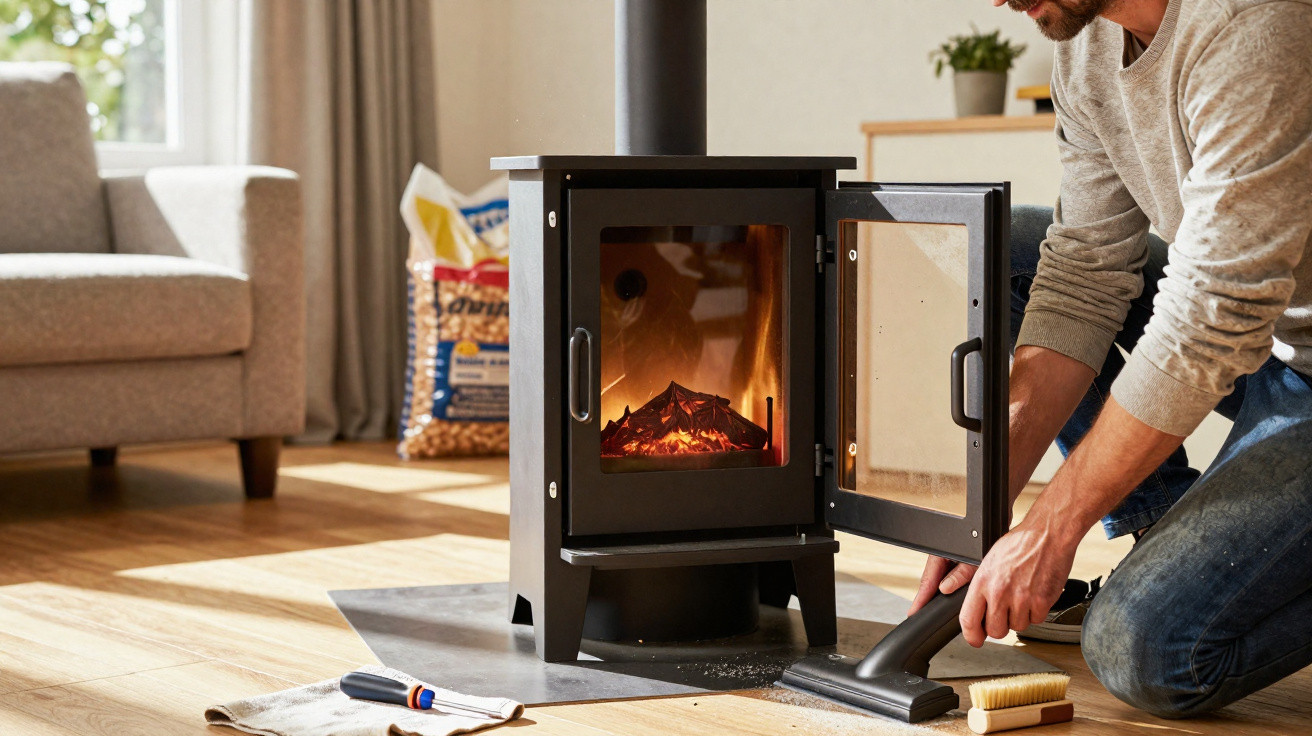
The winter was mild and the stove ran less, so I thought I could skip the spring service.
A few months later, I regretted that decision.
Anyone who owns a pellet stove will know the pattern: as temperatures rise, the appliance is put on standby, everyday life carries on and maintenance slips down the list of priorities. That is exactly what happened to me. Then the apparent convenience came back to bite me: poor draught, error messages, unpleasant smells and engineer call-out costs. What seemed insignificant turned out to be a classic spring maintenance mistake.
Why a spring check for your pellet stove is essential
Even if the pellet stove is used only occasionally in April or May, it still operates normally every time it is started. It burns pellets and produces ash, fine particulate matter and soot. These residues collect in the combustion chamber, air passages and flue pipe. Although the appliance may appear clean from the outside, a dense layer of deposits can build up inside.
Without regular spring cleaning, efficiency falls, pellets are used up faster, heating becomes more expensive – and the risk of faults rises significantly.
Blocked air channels and restricted flue routes mean that the stove needs more pellets to maintain the same room temperature. At the same time, flue-gas temperatures increase, components wear out more quickly and, in the worst case, there is a dangerous risk of carbon monoxide exposure.
The key steps in spring maintenance
1. Empty the burn pot and ash drawer thoroughly
The burn pot, also often called the burner insert or crucible, is the heart of the stove. This is where poor maintenance first becomes obvious: baked-on clinker, blocked holes in the burn pot and an unstable flame. If this area is not cleaned properly, ignition problems or incomplete combustion may follow later.
- Allow the stove to cool completely, then unplug it.
- Remove the burn pot and scrape clear every opening.
- Empty the ash drawer fully, sweeping out the corners as well.
- Clean with an ash vacuum fitted with a HEPA filter; do not use an ordinary household vacuum cleaner.
Daily or at least weekly cleaning during the heating season is not enough. Spring calls for an especially careful inspection because the stove may then remain unused for several months. Any ash left inside attracts moisture, may cause corrosion and becomes even more firmly stuck by the next heating season.
2. Check seals rather than overlooking them
The door and glass seals determine whether the pellet stove draws air in a controlled way or pulls in uncontrolled secondary air. Once a seal becomes porous, misshapen or brittle, the combustion balance is disrupted. The result can be a sooty glass pane, a dark flame or, in some cases, the smell of smoke in the room.
A simple finger test can help: press the seal gently. If it feels hard or splits in one place, it should be replaced. Many manufacturers recommend renewing the door seal every two to three years, or sooner where the stove is used heavily.
3. Clean the glass pane for more than appearance
Clean stove glass is not simply an aesthetic matter. A dark pane streaked with black deposits is nearly always an indication of poor combustion, incorrect airflow or damp pellets. During the spring clean, it is worth inspecting it closely:
- Clean it only when it is cold.
- Use a soft cloth, never abrasive scouring pads.
- Use a specialist cleaner for fireplace or stove glass, or a household method: a damp cloth, a little fine ash and gentle rubbing.
If the glass needs cleaning more often than usual, investigate the cause: unsuitable pellet quality, dirty air passages or damaged seals.
4. Clear the air and flue passages
The internal workings and pipework are a typical trouble spot when maintenance has been neglected. Ash dust settles everywhere, especially:
- in the appliance’s internal air channels;
- around the flue-gas inlet area;
- in bends and horizontal sections of the flue pipe.
Failing to clean these areas in time can lead to faults such as soot deposits in the flue pipe, low-pressure error messages or even a flue-gas back-up. In many cases, the flue pipe and chimney must be dealt with by a qualified specialist – your own spring check does not replace this work, but complements it.
Annual servicing: more than a recommendation
In many European countries, annual servicing is compulsory for appliances burning solid fuels. German-speaking countries also require by law that these heating appliances are checked regularly by a qualified professional and that the chimney is swept. Ignoring this can result not only in damage to the appliance, but also in problems with your insurance if the worst happens.
Without proof of maintenance, an insurer may reduce its payout in the event of a claim. And that is where “a minor job” can quickly become a very costly mistake.
The professional checks more than cleanliness; they also examine safety-critical elements:
| Inspection point | Work carried out |
|---|---|
| Burner and ignition | Cleaning, test run and, where necessary, adjustment of parameters |
| Flue route | Inspection of the flue pipe and chimney, with soot removal |
| Seals | Visual inspection and replacement where worn |
| Electronics | Visual inspection of wiring, sensors and fans |
Once the work is complete, the specialist issues a certificate. Owners should file this document carefully, as every detail can matter in the event of a fire or carbon monoxide poisoning.
Why spring is the best time
1. Identify faults early instead of being cold in January
Those who postpone the inspection until autumn may find themselves caught in the scheduling chaos of the heating season. Spare parts can be difficult to obtain, engineers are overstretched and the living room stays cold. A comprehensive spring service can reveal defects that would otherwise have caused a complete breakdown months later.
2. Faster appointments and often better prices
Many heating firms have more availability in spring. Appointments can be arranged sooner, without waiting for weeks. Some companies even offer reduced fixed rates for maintenance at this time of year. It saves both money and stress.
3. Lower consumption and fewer emissions
A clean, properly operating pellet stove gets more energy from every bag of pellets. Removing deposits, keeping air routes clear and having settings checked by a professional noticeably reduces consumption. This cuts heating costs and lowers fine particulate pollution and CO₂ emissions.
Common mistakes made by many owners
- Cleaning “by appearance”: Emptying only the ash drawer is not enough. Hidden areas, corners and air channels remain blocked.
- Cheap pellets: A low price often means more dust, ash and clinker. This clogs the appliance more quickly.
- Leaving the hopper full over summer: Pellets absorb moisture from the air, swell and break apart. Feed problems are likely by the next start-up at the latest.
- Putting off maintenance: “It will be fine this year” often ends in a breakdown precisely when the heating is urgently needed.
How to protect your pellet stove over the long term
Anyone wanting to avoid trouble should establish a straightforward routine: a quick weekly look during the heating season, a small cleaning session based on the amount of ash, and a firmly scheduled appointment for major spring maintenance. Many manufacturers set out specific intervals in their manuals – following them can considerably extend the appliance’s lifespan.
Keeping a small maintenance log is also useful. This may be a note or a file recording the date of the last clean, seal replacements and servicing by a specialist company. If a problem occurs, it makes it easier to see what has already been done and where cause and effect might lie.
Important terms explained briefly
Pellets: Small cylinders of compressed wood, often made from sawdust. They are considered a comparatively climate-friendly fuel when they are dry and high quality.
HEPA filter: An especially fine filter that traps even the smallest dust particles. In an ash vacuum, it prevents fine ash clouds from escaping into the room.
Carbon monoxide: A colourless, odourless gas produced by incomplete combustion. It is highly toxic in enclosed spaces, which is why a correctly functioning flue system is so important.
What I learned from my mistake
The engineer’s bill, a blocked flue pipe and a faulty seal made it very clear to me just how expensive convenience can become. Rather than spending two hours on cleaning and checks in spring, I paid a great deal in autumn for repairs, an urgent appointment and replacement parts – as well as spending a weekend in a jumper because the stove was out of action.
Anyone with a pellet stove has a comfortable and usually economical source of heating. The condition is that it is not treated as an “appliance you switch on and forget”, but as a small heating system that needs care. The crucial time for that is not the first frost, but spring, when the flame gradually takes its break.





Comments
No comments yet. Be the first to comment!
Leave a Comment