
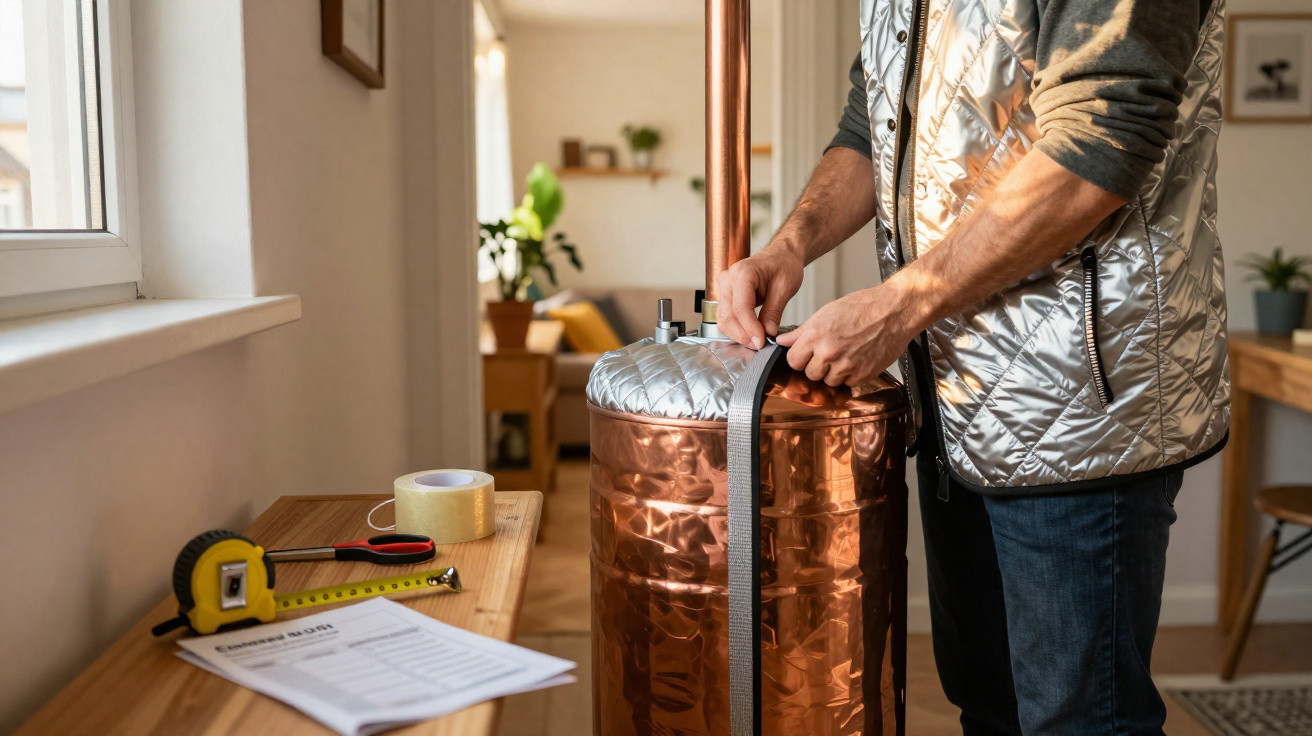
Among the household appliances quietly working in the background, the hot water tank is easy to overlook. Because it continually holds water at temperature, it can make a steady dent in your energy budget, particularly during winter. A straightforward insulating “jacket”, however, can reduce this heat loss and take a noticeable sum off your bills.
Why your hot water tank is costing you more than you think
In many UK and European homes, the hot water cylinder is among the largest individual consumers of household energy. It heats water and keeps it warm around the clock, whether somebody is showering or the household is away for the weekend.
A cylinder positioned in a chilly location - such as a garage, loft, basement or unheated utility room - loses warmth more quickly. Heat radiates from its metal casing into the surrounding air, requiring the boiler or heating element to bring the water back to temperature again.
Without extra insulation, a hot water cylinder can lose around 20% of its energy through simple heat escape into the room.
This lost warmth is, in effect, money disappearing into the air. Even newer cylinders with factory-fitted insulation may gain from another insulating layer, especially where the surrounding part of the home is draughty or unheated.
How an insulating “jacket” cuts those losses
An insulating jacket is simply a padded cover fitted around the tank to limit heat escaping from it. It is much like giving your hot water cylinder a winter coat.
Creating a layer between the hot metal tank and the colder air slows the speed at which warmth is lost. As a result:
- water in the cylinder remains hot for longer
- the boiler or heating element needs to come on less frequently
- temperatures inside the tank stay more consistent
A basic jacket and insulated pipe sleeves can trim hot water energy use by 15–20%, often saving around £50–£60 a year.
The benefit can be greater when you insulate the first few metres of hot water pipe leaving the cylinder as well. Uncovered pipes behave like radiators, continuously giving off warmth into the room.
What does a cylinder jacket cost – and how hard is it to fit?
For most households, this is an inexpensive, straightforward and low-risk improvement. Ready-made cylinder jackets generally cost roughly £15 to £50, depending on tank dimensions and insulation thickness.
Installation in three simple steps
Standard jackets sold by DIY retailers do not normally require an electrician or plumber to install.
- Clean the surface: Remove dust and dirt from the cylinder exterior so that straps and adhesive parts can grip securely.
- Wrap the jacket: Fit the panels, or the single wraparound piece, around the tank and line up the openings with pipes, valves and access panels.
- Secure it: Fasten the ties, straps or adhesive bands until the jacket sits closely against the cylinder, without squeezing the insulation excessively.
For an ordinary domestic cylinder, the task usually takes between 10 and 20 minutes. Drilling is not required and, in most situations, there is no need to turn off the water supply because the internal plumbing is left untouched.
The best materials for hot water tank insulation
Jackets do not all perform equally. Both the insulation material and its thickness have a meaningful effect on results.
- Polyurethane foam: A light, highly insulating material that is easy to form into shape. It is commonly found in pre-insulated cylinders and certain retrofit kits.
- Mineral wool (glass wool or rock wool): Provides effective thermal insulation along with reasonable noise reduction, which can be helpful if sounds from the tank are an irritation.
- Reflective foil layers: Frequently used alongside foam or wool. Their shiny finish reflects radiant heat back towards the cylinder and can be particularly useful in cold lofts or garages.
Check the stated thickness and thermal resistance, often shown as an R-value. Jackets with greater thickness and higher R-values are better at cutting heat loss, although they can cost a little more.
How much can you realistically save?
Household energy consumption differs, but the following broad figures show the possible savings.
| Scenario | Annual hot water use | Potential saving with jacket + pipe insulation |
|---|---|---|
| Small flat, one or two people | Up to ~1,200 kWh | £25–£40 per year |
| Typical family home | ~1,600–1,800 kWh | £40–£60 per year |
| Large household, high hot water use | 2,000 kWh and above | £60+ per year |
At today’s energy prices, the outlay can often be recovered within a single heating season. For example, a £30 jacket that cuts £50 from annual bills has effectively covered its cost after only a few winter months of use.
Extra perks: comfort, noise and appliance lifespan
The advantages are not limited to financial figures. A properly insulated cylinder loses heat more gradually, which helps keep water temperatures steadier and makes an unexpectedly lukewarm late-evening shower less likely.
Jackets made with mineral wool can also dampen the clicking and creaking sometimes produced as tanks warm up and cool down. This may make a noticeable difference at night in a small flat or where the cylinder is close to a bedroom.
By reducing the number of reheating cycles, insulation can ease wear on elements, thermostats and valves, extending the tank’s useful life.
Fewer heating cycles also produce fewer abrupt temperature changes within the cylinder. This places less strain on internal parts and may postpone the need for a costly replacement.
Simple precautions before you start
Carry out a few basic checks before fitting insulation around your tank.
- Ensure safety valves, thermostats and inspection hatches will remain accessible once the jacket is installed.
- Do not hide operating instructions or warning labels.
- Keep insulation clear of flues and very hot surfaces on gas or oil systems, observing the manufacturer’s required clearances.
- If the cylinder is already badly corroded or damp, consult a professional first, as repairs or replacement may be necessary.
Some older cylinders and immersion heaters operate at very high temperatures. Setting the thermostat to a sensible temperature - generally around 60 °C, to guard against bacteria without overheating - may deliver further energy savings when used alongside insulation.
Combining a jacket with other small-scale upgrades
A jacket is most effective as one part of several modest upgrades, rather than as an isolated measure. Covering the first two to three metres of hot water pipe with foam sleeves cuts heat loss on the route from the tank to the taps. Low-flow shower heads also reduce the amount of hot water used while maintaining comfort.
Where you have a timer or smart control, setting the cylinder to heat during off-peak tariffs, if these are available, can increase the savings. The more effectively insulated the tank is, the longer it can retain that lower-cost heat for use later in the day.
Making sense of the numbers on your bill
For those unfamiliar with the terminology, a kilowatt-hour (kWh) is a unit of energy. Your supplier bills you at a fixed rate for each kWh used. If your cylinder consumes 1,800 kWh a year for hot water and the unit price is, for example, 30p per kWh, this portion of the bill totals £540.
Reducing that consumption by 15–20% through insulation means using 270 to 360 fewer kWh. At the same unit rate, this leaves £80–£110 in your bank account. Actual savings depend on tariffs and patterns of use, but the idea remains unchanged: every kWh that is not wasted is a kWh you do not have to pay for.
This modest practical measure will not resolve the energy crisis by itself. Nevertheless, for renters, homeowners and people reluctant to undertake major work, fitting a simple insulating jacket around a hot water tank remains one of the simplest ways to counter rising winter bills.




Comments
No comments yet. Be the first to comment!
Leave a Comment