
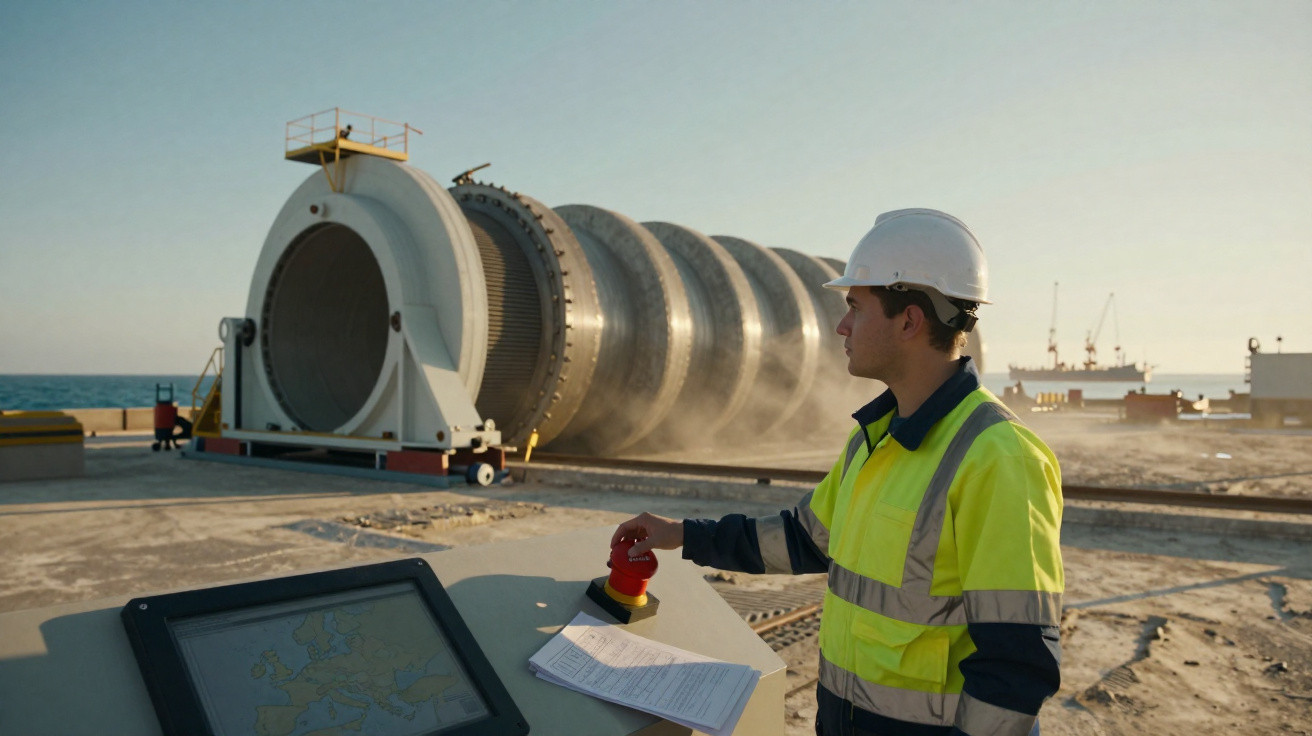
In the Baltic Sea, a bold European transport connection has been left in limbo - not by political disputes or a lack of funding, but by machinery.
Engineers, investors and governments are waiting for an enormous, yet-to-be-proven machine before construction can properly advance on what is expected to be the world’s largest immersed tunnel.
A record-breaking tunnel held up by a huge pause
At the centre of the impasse is the Fehmarnbelt fixed link, an underwater road and railway connection planned between Denmark and Germany. When finished, it is set to be the longest immersed tunnel in the world, running for roughly 18 kilometres beneath the Baltic Sea.
The project is expected to reshape travel across northern Europe. Rail journeys from Copenhagen to Hamburg should fall from nearly five hours to around three, while motorists would replace a ferry voyage lasting up to 45 minutes with a tunnel journey of about ten minutes.
The tunnel is designed as a series of immense concrete sections, each the size of a city block, laid on the seabed like a chain of Lego bricks.
Although it has political approval, major contracts are in place and work has begun on approach roads and railway lines, progress has been severely restricted by one vital factor: the specialist machinery required to produce and manage the enormous tunnel sections.
The mastodon machine on which the Fehmarnbelt link relies
The source of the delay is a gigantic bespoke industrial installation. Rather than being a conventional tunnel-boring machine that cuts through rock, it is a vast manufacturing and handling system intended to cast and transport the concrete sections that will ultimately sit on the seabed.
Every concrete section weighs tens of thousands of tonnes. Producing them calls for a facility of exceptional capacity, including casting halls, curing areas and gantry cranes on a scale seldom encountered in civil engineering.
Testing continues before full production begins
This “mastodon” remains in its testing stages. Its mechanical equipment, control software and safety processes all need to be verified. Even minor misalignment or vibration could harm the sections or create further delays later in the process.
Project managers are reluctant to accelerate the programme until engineers are confident that the production chain can operate dependably around the clock. The possibility of faults affecting one or more tunnel sections is considered simply too great.
The entire calendar for the tunnel now hinges on a single industrial complex proving it can operate smoothly at an unprecedented scale.
Bringing a system like this into service requires time. Workers need training, trial operations must be carried out repeatedly and emergency arrangements have to be practised. While these measures are expensive, omitting them could cause far more serious difficulties once hundreds of workers and vessels have been deployed offshore.
Why the Fehmarnbelt link is so important to Europe
The Fehmarnbelt tunnel is not simply a prestige scheme. It forms a major part of Europe’s north–south transport corridor and is intended to strengthen trade while moving more freight onto railways.
By providing trains with a direct permanent connection between Scandinavia and central Europe, the scheme is designed to reduce lorry emissions and shorten shipping routes. Passengers should also be less reliant on ferry schedules, which can be unpredictable.
- Approximate length: 18 km (about 11 miles)
- Type: immersed tunnel (road and rail)
- Location: between Rødby (Denmark) and Puttgarden (Germany)
- Main users: long-distance trains, freight, and cars
- Planned travel time in tunnel: around 10 minutes by car
Denmark and Germany both regard the connection as a strategic shortcut linking the Nordic countries with the rest of the European Union. Railway operators also anticipate new direct freight services without the need to put lorries onto ferries.
Building an immersed tunnel beneath the sea
In contrast with bored tunnels, which wind through rock, an immersed tunnel is made from individual sections constructed on land before being floated out and lowered into a dredged trench on the seabed.
The Fehmarnbelt sections are huge concrete box structures, each measuring several hundred metres in length. After being placed precisely, they are connected, sealed and protected beneath layers of sand and stone.
The project relies on a rhythm: cast an element, move it, float it out, sink it, then repeat - again and again for years.
This sequence requires a production facility to function like a car factory, except that it makes immense individual units. The “mastodon” manufacturing system must provide an almost uninterrupted supply of faultless sections, each produced to strict tolerances.
Why testing delays affect the whole timetable
Each additional week needed to fine-tune the machinery can postpone marine work. Dredging ships, tugboats and specialist teams are frequently reserved months or even years ahead, meaning factory delays make offshore logistics harder to coordinate.
The funding arrangements also rely on anticipated opening dates for the tunnel. The longer the postponement lasts, the later toll income will start, requiring planners to revise financial projections and renegotiate schedules with contractors.
Technical and environmental challenges for engineers
Engineers must meet two demanding requirements: delivering a highly complex design while complying with strict environmental restrictions in the Baltic Sea. Noise, sediment clouds and effects on marine life are all subject to close examination.
A failure during production or installation that requires offshore rework could expand the construction footprint, bringing added pressure from regulators and nearby communities.
This explains the caution surrounding the huge production machine. One cracked section or incorrectly cast element would be costly, but it could also lead to new environmental reviews or temporary suspension of work.
Lessons drawn from other megaprojects
Other large tunnel schemes, including the Channel Tunnel between the UK and France, encountered their own machinery problems. There, enormous tunnel-boring machines had to contend with unforeseen ground conditions and water inflows.
The Fehmarnbelt project uses different technology, but shares the same reliance on equipment working beyond the limits of what is normally routine in civil engineering. Every delay provides engineers with experience, while increasing political and financial pressure.
What immersed means in comparison with bored tunnels
For people more familiar with Alpine rail tunnels or urban Underground lines, “immersed tunnel” may be an unfamiliar term. It describes a construction approach in which:
| Immersed tunnel | Bored tunnel |
|---|---|
| Elements are built on land and sunk into a trench in water | Tunnel is drilled directly through rock or soil |
| Requires heavy marine works and precise seabed preparation | Relies on long tunnel-boring machines advancing underground |
| Suited to shallow water crossings | Suited to long land crossings or deep passages |
The Fehmarnbelt link clearly belongs to the first category. Its outcome depends less on boring through geological formations than on coordinating an enormous marine and industrial operation without serious errors.
Risks, possible outcomes and prolonged testing
Should the mastodon machine continue to encounter difficulties during testing, engineers have several options. They could alter parts of the installation, operate at a slower production pace or add parallel casting lines to divide the workload.
A reduced output rate could push back the opening date, perhaps by years, but might lower the chance of expensive failures. Major redesigns, however, create risks of their own, such as new approvals, further procurement and additional operator training.
Safety is another concern. When sections are this large, there is little margin for error in lifting, moving and aligning them. An incident in the construction yard or offshore could put workers at risk and damage equipment valued at hundreds of millions of euros.
For businesses and residents on both the Danish and German sides, the delay brings mixed consequences. Building noise and traffic disruption may continue for longer than expected. However, the extended testing period could also result in a more dependable tunnel when it finally opens, with fewer later closures for repairs or remedial work.
Megaprojects on this scale typically reshape transport patterns for decades. Should the Fehmarnbelt tunnel meet its objectives, northern European freight corridors will change, ferry operators will adapt their fleets and airlines may experience shifts in short-haul demand between regional hubs. Today’s unusual situation - a major European project halted by one enormous industrial system still undergoing tests - illustrates how strongly 21st-century infrastructure depends on ultra-specialised machinery.





Comments
No comments yet. Be the first to comment!
Leave a Comment