
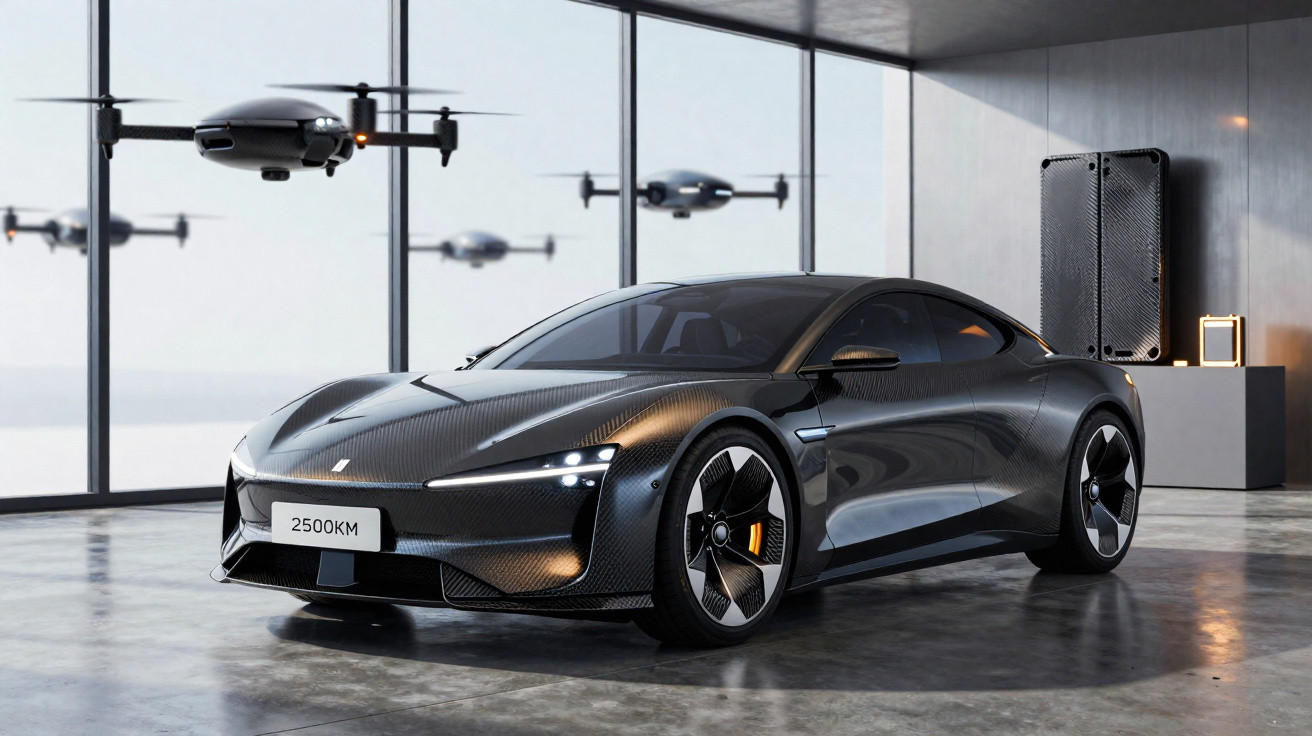
Engineers are transforming carbon fibre from a purely structural material into a source of energy. The principle is straightforward: a vehicle’s body should store electricity as well as withstand potholes and torque. Delivering this in reality, however, requires advanced materials, more intelligent interfaces and a careful compromise between strength and charge capacity. The potential reward is vehicles capable of journeys lasting days and drones that can remain airborne for hours.
What structural carbon batteries are
Structural batteries serve two purposes simultaneously: they bear mechanical loads and retain energy. In cars, drones and aircraft, this means the battery is no longer a separate, heavy box. Instead, it forms part of the body shell, floor or wing. Rather than carrying dead weight, the vehicle can gain additional range.
The battery becomes part of the chassis, so weight you used to carry now does double duty: support the vehicle and power it.
Carbon fibre is central to this development. It is lightweight, rigid and electrically conductive. Used both as reinforcement and a current collector, it can take the place of metal components and wiring while supporting active energy-storage materials. The crucial factor is the interface between the fibre, binder and electrolyte, where performance is often determined.
Two approaches to lighter power
Decoupled designs
Decoupled structural batteries place established commercial cells within a carbon laminate. This delivers packaging benefits and adds some rigidity, although dedicated battery cells must still be carried. While the mass savings are useful, the structural contribution remains limited.
Coupled designs
In coupled designs, battery elements are incorporated directly into the load-bearing composite. The carbon fibres act as the electrodes, while the electrolyte forms part of the matrix. This reduces the amount of hardware required and cuts mass further, creating a larger potential range benefit. The approach requires robust electrodes that retain capacity under mechanical stress, alongside solid or quasi-solid electrolytes able to conduct ions while resisting cracking.
Interface engineering is the quiet hero
Electrodes have to meet two competing demands: they must deliver high capacity without breaking down under bending, vibration and thermal cycling. Researchers are strengthening carbon-fibre electrodes using epoxy-based binders. Traditional PVDF binders may shift as components flex, whereas epoxy can secure active material to the fibres, improving cohesion while preserving routes for electrons and ions.
Better adhesion at the fiber–binder–electrolyte interface lifts mechanical strength without suffocating charge transport.
Electrolytes present a further challenge. Matrices rich in epoxy can be durable but may restrict ion movement. Liquid plasticisers improve conductivity, yet can leak when a network is excessively rigid or develops microcracks. Emerging hybrid matrices are designed to strike a balance: elastic enough for ion transport, stiff enough to bear loads, and reliable through changing temperatures.
Why zinc-ion is attracting attention
Zinc-ion chemistry provides a practical route towards structural batteries. Zinc is plentiful and inexpensive, while storing a respectable amount of charge by mass. Aqueous and gel electrolytes lower fire risk, and production can take place in ambient air, helping to reduce costs. A common configuration combines a zinc-powder anode with a manganese dioxide cathode featuring nano-structured elements for increased activity.
By combining zinc-ion cells with carbon-fibre composites, developers are seeking safer structures that still provide useful energy density. The overall package matters more than headline peak figures. Where a structural battery replaces floor panels and crash members, total vehicle mass can fall even when cell-level energy density remains behind leading lithium-ion technology.
| Attribute | Lithium-ion | Zinc-ion | Structural carbon + zinc-ion |
|---|---|---|---|
| Material availability | Moderate | High | High |
| Fire risk | Elevated | Low | Low |
| Energy density | High | Moderate | Moderate (offset by weight removal) |
| Cost trajectory | Volatile | Favorable | Favorable at scale |
| Structural role | External to structure | External or semi-structural | Primary load-bearing |
What 2,500 km could look like in practice
The headline number draws attention, but achieving it relies on several measures working together. Structural batteries reduce mass by integrating energy storage into the vehicle body. Aerodynamic refinements lower drag, while efficient motors and heat pumps reduce losses. In comparable vehicles, structural batteries alone could realistically provide a double-digit range improvement in the near term. Combined with lighter wiring, fewer fasteners and smarter packaging, they make long-distance EVs increasingly plausible.
- Mass reduction: replace floor, roof or sill panels with structural cells.
- Volume efficiency: recover space previously taken by large modules and enclosures.
- Thermal efficiency: build cooling channels directly into the laminate.
- Wiring cuts: carbon fibres can conduct current locally, reducing copper use.
Multi-thousand-kilometre journeys without a stop will still require leading aerodynamics and substantial energy capacity. Trucks, buses and long-range saloons are likely to benefit first. In city cars, the greater value may lie in lower costs and improved use of space rather than exceptional range.
Drones may benefit first from structural batteries
For small aircraft, mass fraction is decisive: every gram removed translates directly into more flight time. A drone wing or fuselage that also serves as a battery eliminates housings and brackets, increasing endurance and broadening payload options. Fixed-wing drones could conduct longer patrols with the same pack energy. Multirotors could accommodate improved sensors or operate in hotter conditions without reaching thermal limits.
What still stands in the way
Creating a load-bearing battery is only part of the task. It must also withstand crashes, potholes, bird strikes and rain. Repairs must be quick and localised, while recycling should allow fibres, metals and polymers to be separated without aggressive chemistry.
- Electrolyte durability through repeated flexing and temperature cycles.
- Lasting adhesion between fibre, binder and active material.
- Self-healing resins that restrict microcracks and preserve conductivity.
- Moisture barriers that do not prevent ion transport.
- Standardised testing for both crashworthiness and cell ageing.
To move from demos to driveways, structural batteries must pass both battery tests and crash tests, then prove they can be repaired.
Near-term signals to watch
Automakers are testing composite floors with integrated energy storage in prototypes and niche models. Drone manufacturers are piloting structural packs in lower-risk airframes where endurance is especially valuable. Universities and start-ups are publishing research into epoxy-based electrolytes and fibre-compatible binders with enhanced ionic pathways. Early commercial successes are expected in drones, robotics and lightweight vehicles operating at moderate voltages.
Helpful context for buyers and builders
Structural batteries will alter servicing models. A damaged body panel could also mean a damaged battery. Insurers will require repair procedures and isolation methods, while first responders need clearly identified cut points and shut-off processes. Regulators will seek dual certification: one route for energy systems and another for structures. These frameworks are now taking shape.
Consider a straightforward sizing example. If a midsize EV reduces its mass by 12% by adopting structural cells while retaining the same energy content, the efficiency gain on motorway cycles can reach a similar percentage. Add a modest aerodynamic package and intelligent thermal routing within the laminate, and the resulting range improvements begin to make cross-country travel feel effortless. Applied to delivery drones, the same calculation produces extra minutes of flying time, potentially reducing fleet size for a given route density.
A few useful terms to remember include decoupled versus coupled structural batteries; binder cohesion versus ionic conductivity; aqueous zinc-ion versus non-aqueous systems; and failure modes such as delamination, dendrite growth and electrolyte drying. Each relates to practical issues: How straightforward is repair? How safe is the system when abused? How does it age in winter?
Risks remain, but the advantages are equally clear. Carbon fibres combine high stiffness and conductivity in a single material. Zinc-ion chemistries offer the prospect of safer production and simpler recycling. If interface engineering continues to progress, the most significant improvement may be an unobtrusive one: lighter vehicles, longer journeys and energy storage concealed in plain sight.






Comments
No comments yet. Be the first to comment!
Leave a Comment