
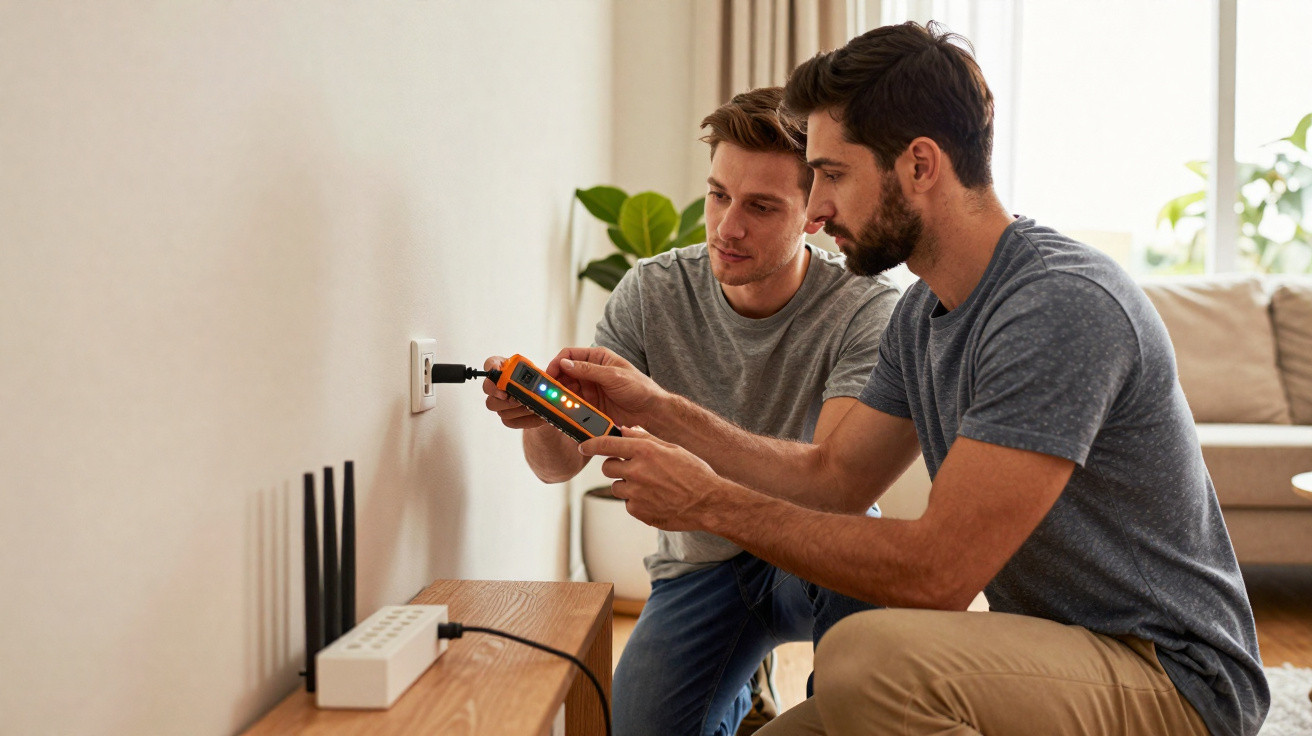
The electrician studies the socket in your living room as carefully as a doctor taking a pulse. A kettle, television and phone chargers are all connected to a single double socket that has probably outlasted your sofa. While you discuss energy bills, he takes a small yellow device from his bag, plugs it in and watches its three tiny lights.
It is probably not a tool you have seen on TikTok. It costs less than a takeaway, is completely silent and looks faintly absurd beside smart thermostats and £1,000 televisions. But this modest socket check may be one reason your electronics survived the last storm without being damaged.
Most people do not discover it until the day something goes bang.
Why electricians rely on a “boring” plug test
Ask an experienced electrician what they inspect first in a property and many will mention the sockets rather than the consumer unit. The ordinary outlets that power so much of daily life are precisely where minor defects can remain hidden. Loose terminals, swapped conductors and a missing earth are invisible faults that can turn a power surge from an unpleasant scare into a costly disaster.
A straightforward socket tester, usually fitted with three lights or a small screen, can identify such issues within seconds. There is no need to open walls or create disruption: it simply gives a clear indication of the condition of the wiring. For such a basic device, it can avert a remarkable amount of trouble.
A London electrician once described a client whose routers repeatedly failed whenever there was a thunderstorm. The broadband provider blamed the connection, while the client blamed the inexpensive router. Nothing improved until a routine call-out for “just a new socket” resulted in the same small tester being plugged in.
The light sequence was incorrect. The socket supplying the router had no proper earth, meaning the surge-protected plug in it was like a seatbelt without an anchor point. A surge came in from the street with nowhere safe to dissipate, and the electronics were ruined. Testing that cost £15 ultimately stopped hundreds of pounds’ worth of equipment from ending up in the bin.
Electricians encounter stories like this regularly, though they seldom travel beyond the customer’s front door.
In theory, a home has several lines of protection against surges. The consumer unit may include surge protection, extension leads may advertise the same feature, and individual appliances contain their own small protective circuits. That can sound reassuring.
However, every one of those safeguards depends on the fundamentals being correct: live connected to live, neutral connected to neutral, and a sound route to earth. A loose terminal left unnoticed or two wires connected the wrong way can reduce all that technology to little more than a decorative claim.
This is where a socket test proves its value without fuss. It will not prevent a surge from reaching the house, but it helps ensure your home can cope when one does.
The overlooked socket tester check that takes 10 seconds per outlet
The basic action electricians repeat could hardly be simpler: plug it in, check the lights and continue to the next socket. A standard socket tester has a guide printed on its front, and the pattern of lights indicates whether the outlet is wired correctly, has no earth, or has reversed live and neutral connections.
Professionals go from room to room, checking each socket as if taking a heartbeat. The one hidden behind furniture, the isolated outlet near the front door and the particularly old-looking socket in the understairs cupboard all receive the same check. It is not dramatic; it is a methodical round of quiet prevention.
That is how they find the socket that could turn the next voltage spike into a smoking television rather than an uneventful flicker.
People often focus on large, dramatic risks: lightning, power cuts and “the grid”. Electricians more often see problems caused by something far smaller: one suspect socket used for expensive equipment. It may be the home-office extension lead that has been daisy-chained three times, or the kitchen outlet serving a toaster, microwave and coffee machine at once.
At a human level, that rarely reflects carelessness. It is simply everyday life: rushed renovation work, a previous owner who “knew a guy”, or a DIY repair made ten years ago as a temporary measure that was never revisited. On an ordinary quiet Tuesday, everything may appear fine. When a storm brings a surge, the weak points become obvious very quickly.
A single badly wired socket in the wrong location can undermine all the caution you have exercised elsewhere.
Technically, surges seek the route with the least resistance. In a correctly wired property, that route is managed: through the earth, via surge protection and into the ground where it should go. The energy still reaches the property, but it has a safe exit path.
Where a socket lacks an earth or has a high-resistance connection, the surge can strike connected equipment much more severely. Voltage may build up on metal casings, sensitive components can be put under strain, and the effects are not always instant or dramatic. It may instead mean a shorter working life, an unexplained fault or a fridge that “never felt quite right” after a major storm.
That unremarkable socket test enables electricians to identify missing or weak links before a surge arrives.
How to make this professional check part of an ordinary home routine
Bringing the habit into your own home requires only a small purchase and a quiet half-hour. Socket testers are widely sold in the UK and often cost less than a decent broadband router. Select one that clearly indicates “correct”, “missing earth” and “reversed polarity” through an easy-to-read light pattern.
Then work through the property in an organised order: start with the living room, followed by the kitchen and bedrooms. Plug in the tester, read the lights, compare them with the chart on the device, unplug it and move to the next outlet. Use a notebook or your phone to record any sockets that do not show a correct result.
The aim is not to repair electrical wiring yourself. It is to identify potential weak points, much as a surveyor marks cracks in a wall.
Some people use a tester once, see a row of green lights and forget it for ten years. Others discover one unusual result and immediately worry. The sensible position lies between those reactions. A test only shows the condition at that moment; it is not a lifetime guarantee. Connections can loosen due to heat and vibration, extension leads may be rearranged, and further electrical work may take place.
A gentle routine is useful: check sockets when you move furniture, purchase an expensive new device or have building work done. In a rented home, test them when moving in and retain photographs of the results. If something unusual appears later, you will have evidence rather than relying on memory.
Let’s be honest: nobody really does this every day. But most of us can manage a few unobtrusive checks each year.
Electricians often discuss the emotional aspect of their work privately, even though they may not raise it directly with customers. They witness the tears after a house fire, a child’s bedroom blackened by smoke and an older couple left without heating after a boiler control has been destroyed.
“People think we’re there to put in shiny new sockets,” one Bristol electrician told me. “Half the time, my real job is stopping future heartbreak with a £20 tool and a bit of honest chat.”
Seen this way, a socket test is less another household task and more a small act of care for your future self.
- Check the sockets you use most: the television area, home office and kitchen worktop.
- Photograph any “fault” light patterns to show a qualified electrician.
- Never overlook buzzing, warmth or scorch marks; stop using that socket.
- Only use surge-protected extension leads with correctly wired sockets.
- Following major storms or grid problems, retest key sockets as a quick condition check.
The quiet safety habit that spreads by word of mouth
On a wet Sunday evening, when lights flicker and wind is howling outside, most people think of candles and phone batteries. Hardly anyone considers the condition of the socket behind the television or the router blinking quietly in the hallway. Yet that is where a storm’s effects can unfold, silently and within a fraction of a second.
An often-forgotten socket test does not make compelling Instagram content. It is neither clever nor futuristic. It resembles brushing your teeth: routine, repetitive and strangely reassuring. Yet real safety often looks exactly like that: not heroic, but quietly consistent and persistently low-tech.
We have all experienced the moment when everything abruptly goes dark, the house becomes silent and your stomach sinks. A power cut. A surge. Something. Is everything ruined? You wait for the lights to return, half expecting the smell of melted plastic.
If you know the sockets have already been checked, that moment feels different. There is less helplessness and more of a “let’s see what’s what” response. A surge may still occur, but it is less likely to become a financial and emotional mess. That is not paranoia; it is basic respect for the home you live in.
There is something quietly communal about the habit, too. You learn to use the tester, mention it to a neighbour and lend it to your sister after she moves into an older flat. It spreads not as a trend, but as the sort of recommendation people share for a good local GP or dependable plumber.
Electricians have tried to communicate this for years, often one living room at a time. The more people understand that a ten-second socket check allows every other form of surge protection in the chain to work properly, the fewer horror stories there should be after the next major storm.
The test will never become viral. But it could prevent your toaster, television and old hard drive full of family photographs from doing so in a shower of sparks.
| Key point | Detail | Why it matters to the reader |
|---|---|---|
| Basic socket tester | A small device with three indicator lights that checks wiring and the presence of an earth | Identifies sockets at risk from surges within seconds |
| Checking routine | Go room by room, test key sockets and record any irregularities | Creates a straightforward map of weak points for a professional to correct |
| Protection in a chain | Surge protectors, the consumer unit and the earth only work if the socket is correctly wired | Genuinely improves the chance that your devices survive power surges |
FAQ:
- What exactly does a socket tester check? It verifies whether live, neutral and earth are connected in the correct positions, and commonly identifies a missing earth or reversed polarity. More advanced models may also display voltage and detect certain wiring faults with greater precision.
- Can I rely on surge-protected extension leads alone? No. Where the wall socket has no proper earth or has been wired incorrectly, the surge protection within the extension lead cannot operate correctly and may create a false sense of security.
- How often should I test my sockets at home? A quick check once or twice yearly is a sensible baseline, along with checks after significant building work, when moving into a new property or before connecting costly new equipment.
- Is it safe to repair a faulty socket myself if the tester identifies a problem? A qualified electrician should deal with wiring faults, particularly in the UK, where regulations are strict and errors can be dangerous or invalidate insurance.
- What warning signs suggest a socket may be unsafe? Warm faceplates, buzzing or crackling sounds, discoloured plastic, loose-feeling plugs and circuit breakers that trip repeatedly when that socket is used are all reasons to stop using it and arrange an inspection.






Comments
No comments yet. Be the first to comment!
Leave a Comment