
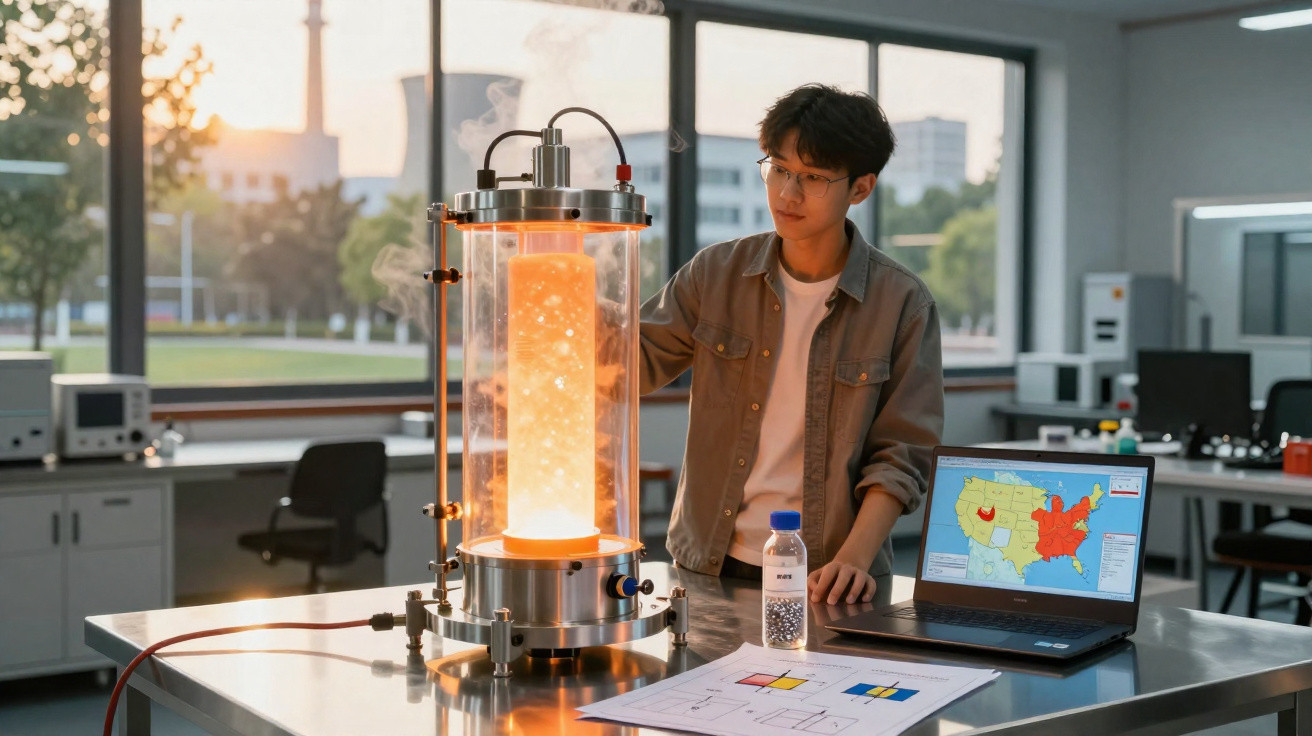
Industry and government signals are now converging on the same outcome: smaller, hotter and safer reactors are moving beyond PowerPoint presentations into steel and concrete. The opportunity extends well beyond electricity, encompassing industrial heat, desalination and medical isotopes.
A campus experiment with national implications
Natura Resources intends to bring MSR‑1, a 1 MW molten-salt reactor, into operation at Abilene Christian University in Texas in 2026. The Nuclear Regulatory Commission has issued a construction licence for the nation’s first liquid-fuel MSR, marking a shift for the technology from theory towards physical deployment. Natura developed the scheme with backing from the Department of Energy, Texas funding and industrial collaborators including Zachry Nuclear Engineering and Teledyne Brown Engineering.
NRC cleared construction for the first liquid‑fuel molten‑salt reactor in the United States. Target start-up: 2026 in Texas.
The demonstrator is intended to confirm core physics, materials and operating practices using HALEU fuel: high-assay, low-enriched uranium enriched to no more than 20%. By the end of 2025, the company expects to file two further licence applications: one for medical isotope production and another for grid-scale electricity. This order of development indicates an ambition to move swiftly from laboratory-scale experience into commercial services.
The case for molten-salt reactors
Rather than using solid fuel pellets, molten-salt reactors dissolve nuclear fuel in liquid salts and operate at low pressure while delivering very high outlet temperatures. Together, these characteristics alter the risk profile and broaden applications beyond power generation. Higher temperatures improve efficiency, while low-pressure operation reduces stress on large vessels and lowers explosion risk. Liquid fuel allows online refuelling and may enable the recycling of certain legacy waste streams. Heat and neutrons from the salt can also be used to make isotopes for cancer diagnosis and treatment.
- Low-pressure operation reduces mechanical complexity within containment.
- High temperatures improve thermodynamic efficiency and make industrial heat possible.
- Liquid fuel allows flexible operation and may support fuel recycling.
- Neutron economy can enable the production of important medical isotopes.
MSR‑1 will use HALEU to maintain reactivity and lengthen core life. However, this decision also presents a supply-chain difficulty. Russia is still the leading commercial supplier, while the US is working to establish domestic capacity through the DOE’s HALEU programme and Centrus’s expansion in Ohio. Initial kilograms have already been produced, but dependable multi-tonne production remains the obstacle facing every advanced-reactor developer.
From MSR‑1 to MSR‑100
Natura’s proposed commercial model is the MSR‑100, a 100 MW reactor manufactured in factories and assembled on site. Its intended markets are sectors where dependable supply and high-grade heat are especially valuable, including petrochemical clusters, desalination facilities, data centres and mining sites. The company compares its proposed pricing with US gas-fired generation, offering continuous decarbonised energy without exposure to fuel-price volatility.
Potential applications include:
- Continuous electricity for grids managing variable renewable generation.
- Thermal desalination in dry inland regions and coastal cities.
- Reliable on-site heat and power for remote industrial locations.
Texas has committed approximately $120 million to the prototype, with private investment matching that amount. This funding supports procurement, commissioning and operator training. The near-term commercial programme depends on three tasks: filing the operating licence application, securing fuel and component contracts, and agreeing electricity and isotope offtake deals.
State funding and private money put about $240 million behind the first step, with a clear push toward revenue‑earning use cases.
Why Generation IV reactors matter now
Generation IV reactors are designed to achieve higher temperatures, reduced waste and stronger economics from smaller sites. The category includes molten-salt reactors, high-temperature gas reactors and fast reactors cooled with sodium or lead. These technologies promise more than lower-carbon electricity: they could provide dependable industrial heat, a major source of global emissions that is difficult to decarbonise through wind and solar alone.
Importantly, some designs can use recycled fuel or depleted stocks, partially closing the fuel cycle and reducing waste inventories. Others combine with thermal storage so they can respond rapidly alongside renewables. The intended outcome is an electricity system that combines variable wind and solar generation with compact, low-carbon heat sources that provide dependable support.
A competitive field led by Chinese and Russian progress
The US effort enters a competition that has continued without pause. China’s CFR‑600 fast reactors in Fujian support its ambitions for a closed fuel cycle. Russia already operates the BN‑800 and is pouring concrete for both the BN‑1200 and the BREST‑OD‑300 lead-cooled reactor. In Canada, Terrestrial Energy continues the licensing process for its Integral Molten Salt Reactor. Across Europe, newcleo is developing a lead-cooled fast reactor, France’s CEA is examining compact Gen‑IV designs, and Belgium’s MYRRHA project is pursuing an accelerator-driven system for research and fuel transmutation.
Unlike China’s state-directed construction programme, the US approach combines federal initiatives, state support and private capital. That combination could progress quickly once supply chains are established. The NRC’s first MSR construction licence demonstrates that the regulatory route can be opened when reactor designs and safety cases satisfy the required standard.
Selected projects to watch
| Project | Country | Technology | Status/timeline |
|---|---|---|---|
| MSR‑1 (Natura) | United States | Liquid-fuel molten-salt | Construction licence granted; start-up targeted 2026 |
| CFR‑600 | China | Sodium-cooled fast reactor | Two units under construction in Fujian |
| IMSR (Terrestrial) | Canada | Molten-salt with sealed fuel cartridges | Licensing in progress; industrial heat focus |
| BREST‑OD‑300 | Russia | Lead-cooled fast reactor | Civil works advancing; prototype targeted this decade |
What MSR‑1 success could change
Should MSR‑1 demonstrate successful operations, the US would have a clearer path to dispatchable, low-carbon heat that works alongside wind, solar and storage. Industrial customers could replace gas boilers with nuclear heat while retaining reliable supply. Oil and gas centres such as the Permian Basin could reduce emissions from energy-intensive field operations by installing modular MSRs on site. Hospitals and radiopharmacies could also gain more dependable access to vital isotopes as reactors worldwide reach the end of their lives.
The project also brings nuclear skills into sharper focus. Operators trained on small MSRs could create a workforce pipeline for larger reactor fleets. Fabricators able to produce salt-compatible alloys and pumps could supply a new export market. Universities hosting operational hardware would gain both a research advantage and an attraction for talent.
Risks, barriers and the fuel reality
Three limitations are particularly important. First, domestic HALEU production must increase, otherwise projects may remain dependent on sources exposed to geopolitical risk. Second, corrosion and material performance in high-temperature salts require demanding tests over years rather than months. Third, the commercial case relies on predictable schedules: every postponement raises financing costs and unsettles investors.
- Fuel: secure multi-tonne US HALEU production, supported by contingency arrangements.
- Materials: certify alloys, welds and coatings for prolonged exposure to salt.
- Licensing: make reviews more efficient while maintaining firm safety margins.
- Public trust: release data, conduct drills and communicate clearly.
Practical notes for readers
Term to know: HALEU means high-assay low-enriched uranium. It falls between current reactor fuel and weapons-grade material, which is why regulators monitor it closely. The higher assay improves reactor physics in many advanced designs and reduces fuel volume.
Scenario to watch: a combined heat-and-power MSR coupled with thermal storage. Molten-salt tanks can retain excess heat before supplying a turbine during periods of peak demand, helping to smooth grid load. Such an arrangement complements solar generation in the US South-West and may reduce operators’ revenue risk.
Adjacent activity: medical isotope production. Short-lived isotopes including Mo‑99/Tc‑99m and Lu‑177 support imaging and targeted therapies. An MSR designed to recover isotopes could create an additional revenue stream with strong demand growth while improving healthcare resilience.



Comments
No comments yet. Be the first to comment!
Leave a Comment