
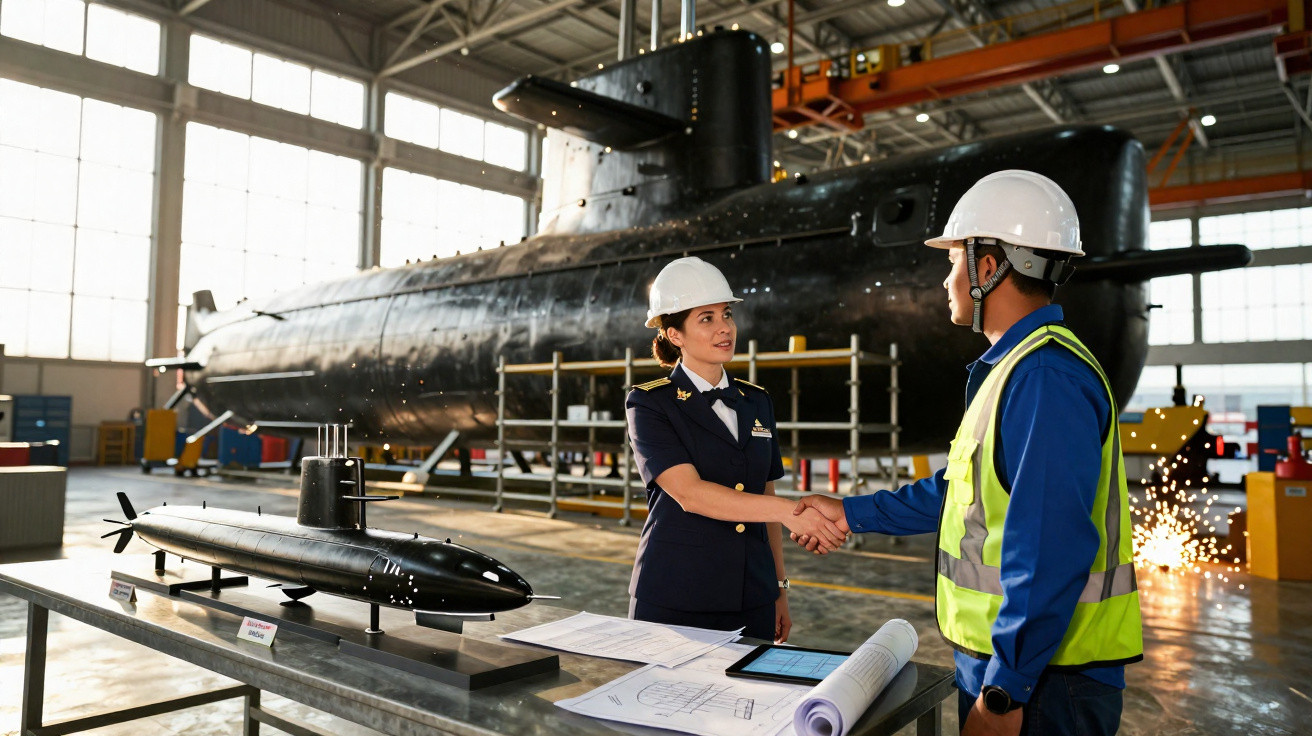
US Navy commits US$76.6 billion to Virginia Block VI and Columbia Build II submarines
Following several years shaped by rising industrial costs and the after-effects of the pandemic on shipbuilding, the US Navy has formally awarded contracts worth US$76.6 billion to proceed with the construction of nine Virginia Block VI nuclear-powered submarines and five Columbia Build II strategic submarines. The decision is one of the US government's largest financial commitments to preserve its undersea superiority and ensure the renewal of the naval element of its nuclear deterrent in the decades ahead.
The contracts were awarded on 29 July to General Dynamics Electric Boat and Huntington Ingalls Industries (HII) Newport News Shipbuilding, the principal builders of the US Navy's nuclear-powered submarines. Of the total, US$42.1 billion will fund nine Virginia Block VI attack submarines and materials for a tenth boat; US$29.5 billion will pay for five Columbia Build II ballistic missile submarines (SSBN-828 to SSBN-832); and the remaining US$5 billion will be invested in productivity improvements and industrial infrastructure at both shipyards. The work is expected to continue until July 2038.
Production will remain under the established co-operation model between the two companies. Electric Boat will build the submarines' central section, containing the nuclear reactor and, in the Columbia boats, the compartments for Trident II D5 ballistic missiles. HII Newport News will manufacture the bow, stern and other structural modules. The forthcoming Virginia Block VI boats will be the second variant fitted with the Virginia Payload Module (VPM), an additional section that considerably expands the capacity to launch Tomahawk cruise missiles and could also accommodate the long-range hypersonic missile currently being developed for the US Navy in future.
Strategic importance of the submarine contracts
When announcing the awards, Vice Admiral Robert Gaucher, director of the US Navy's Submarine Programme, emphasised the strategic significance of the agreement, stating: “This historic investment underscores the Department's continued commitment to undersea superiority and to recapitalising our nuclear triad.” The statement reflects the Pentagon's priority of simultaneously renewing its attack submarine fleet and the ballistic missile submarines that form the maritime component of US nuclear deterrence.
The formal award of these contracts concludes almost three years of talks between the Navy and the shipbuilding industry. The process was influenced by the sharp rise in production costs after the COVID-19 pandemic, wage discussions aimed at retaining specialised workers, and difficulties in expanding shipyard capacity. It was also affected by delays carried over from negotiations launched in 2022 for the final Virginia Block V submarines; resolving them later enabled planning for Block VI and the second series of Columbia-class submarines to move forward.
Virginia and Columbia programmes continue as Ohio SSGNs begin retirement
The contract awards also confirm the continuation of the ambitious programme to modernise the US submarine force. In May this year, USS Utah (SSN-801), the final Virginia-class submarine from Block IV, was launched, bringing that production phase to a close before serial construction of Block V and, later, Block VI begins. Meanwhile, the Navy continues developing the Columbia class. Its first vessel, USS District of Columbia (SSBN-826), is scheduled for delivery in March 2029, followed by USS Wisconsin (SSBN-827) in April 2030, while the new Build II series will begin with USS Groton (SSBN-828).
While gaining new capabilities, the US submarine force is also beginning the gradual retirement of notable platforms. USS Georgia (SSGN-729), one of four Ohio-class nuclear-powered ballistic missile submarines (SSBNs) converted into cruise missile submarines (SSGNs), will leave active service on Friday, 31 July, after more than 42 years of service.
Its decommissioning will begin the phased withdrawal of the four Ohio-class SSGNs, which also include USS Ohio, USS Michigan and USS Florida. At present, no direct replacement exists for these vessels, which can carry up to 154 Tomahawk cruise missiles and support covert special forces operations. Consequently, as the US Navy renews its strategic and attack components through the Virginia and Columbia programmes, it also faces the challenge of replacing unique capabilities that will disappear when the Ohio-class SSGNs are retired.




Comments
No comments yet. Be the first to comment!
Leave a Comment