
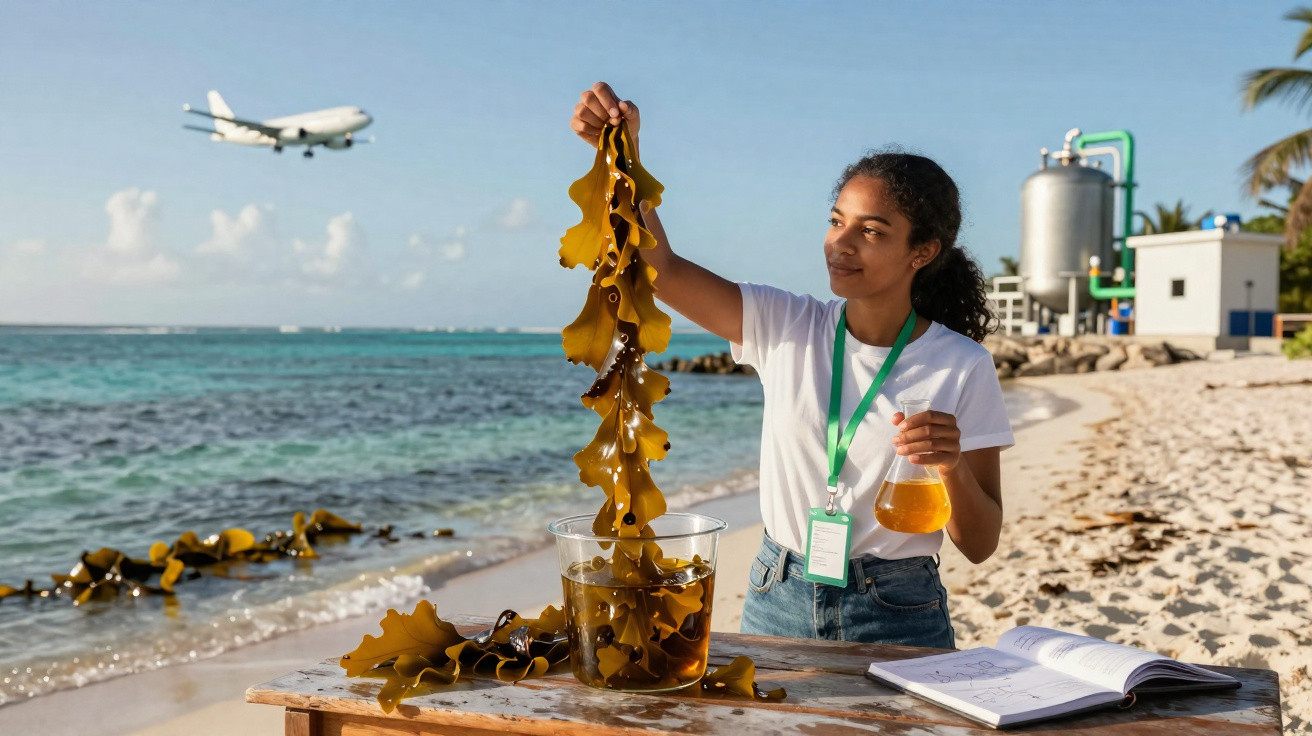
Each year, Caribbean countries face an environmental challenge that affects beaches, tourism and coastal ecosystems while creating substantial clean-up costs: sargassum. But what if this abundant biomass were considered not simply a problem, but a valuable resource?
That question was the focus of a recent discussion convened by the International Air Transport Association (IATA). It brought together representatives from aviation, energy, tourism, government, finance and academia to examine sargassum’s potential as a feedstock for Sustainable Aviation Fuel (SAF) production in the region.
Sargassum and Sustainable Aviation Fuel in the Caribbean
SAF is the aviation industry’s leading tool for cutting carbon emissions in the short, medium and long term. Unlike other solutions that require years to deploy at scale, SAF is a “drop-in” fuel: it is compatible with existing aircraft and infrastructure, while delivering significant lifecycle emissions reductions. As worldwide demand rises, regions that establish sustainable feedstocks and viable production pathways will gain a competitive advantage.
For the Caribbean, the opportunity reaches beyond aviation. The region depends heavily on air connectivity, which supports tourism, trade, investment, access to healthcare and family ties, particularly between islands.
At the same time, it imports much of its fuel, leaving it exposed to global disruptions and price volatility. Building local SAF production capacity, even at a modest level, could diversify the energy mix and help deliver the aviation sector’s sustainability goals.
Turning sargassum biomass into SAF feedstock
Using sargassum within the SAF production chain is a promising possibility. For years, efforts have focused on limiting sargassum’s environmental effects; interest is now increasing in converting this biomass into a valuable input for renewable fuels. Achieving this will require innovative technologies, including those developed by industry, that broaden the feedstock portfolio available for SAF production.
Sylvain Verdier, Senior Strategy Manager at TOPSOE, notes: “No single feedstock will be enough to meet global demand for SAF and other renewable fuels. Expanding the range of sustainable materials, including marine biomass, is essential to accelerate the energy transition in hard-to-decarbonise sectors such as aviation and maritime transport.”
Yet the challenge extends beyond technology. A successful SAF ecosystem requires coordination across the entire value chain: from feedstock collection and logistics to refining capacity, financing, certification and sustainable market demand. Feedstocks must be available, accessible, sustainable and economically viable. Investors need regulatory certainty; producers require suitable regulatory frameworks and incentives; and airlines need dependable, competitive supply. Success relies on these elements progressing in a coordinated way.
This is why cross-sector collaboration and an integrated approach are essential. Markets fail when policies are introduced in isolation or at the wrong time, but they thrive when implementation is coordinated with consideration for the energy system and its knock-on effects.
Regional partnerships for Caribbean SAF development
SAF development sits at the intersection of aviation, energy, economic development, environmental protection and climate resilience. Governments, regulators, airlines, airports, the tourism industry, financial institutions, research centres and development partners all have a crucial role in creating the conditions needed to drive this growth.
As ICAO has emphasised, aviation decarbonisation will require coordinated action and strong regional partnerships. Christopher Barks, ICAO Regional Director for North America, Central America and the Caribbean, states: “For Small Island Developing States, aviation is more than transport: it is a vital economic driver. Advancing decarbonisation in the region will depend on strengthening regional collaboration and creating an environment that encourages innovation, investment and implementation, bringing together governments, industry and partners for sustainable solutions tailored to local needs.”
The outlook is encouraging: the Caribbean has unique resources, entrepreneurial talent and a shared interest in strengthening sustainability and resilience. Although considerable work remains to assess feasibility, establish supply chains and attract investment, the foundations for meaningful progress are already in place.
The conversation has shifted: the issue is no longer solely how to manage sargassum, but how to rethink its potential. To achieve this, innovation must be advanced and a pioneering government-backed pilot project created to establish a sustainable SAF ecosystem in the region.
Converting an environmental challenge into an economic opportunity will not happen quickly. However, if the Caribbean aligns its stakeholders, encourages innovation and builds partnerships to advance SAF, it could turn a persistent problem into a catalyst for sustainable growth.
By Annaleen Lord, Caribbean Regional Manager at the International Air Transport Association (IATA)





Comments
No comments yet. Be the first to comment!
Leave a Comment