
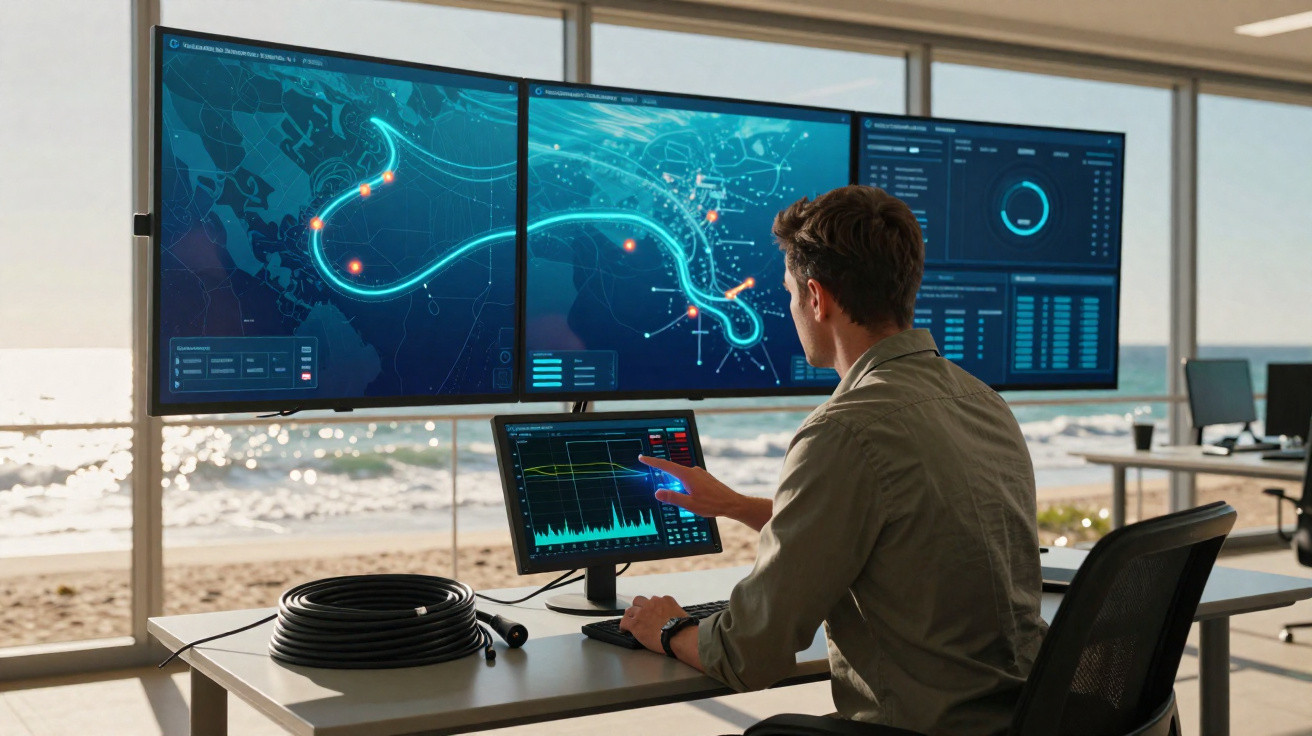
The Australian government announced this week that it will invest A$18 million over four years in a new centre intended to safeguard the undersea cables that underpin the country’s internet.
The Cable Connectivity and Resilience Centre will be responsible for helping protect essential undersea telecommunications cables across the Indo-Pacific against intentional disruption by malicious actors and unintentional damage.
This is an important task. The internet contributes at least $167 billion annually to Australia’s economy. These cables support everything from everyday social media posts to the vast transactions that keep the global economy moving.
So why is Australia now moving with greater urgency to protect these vital cables?
The backbone of the internet
Submarine telecommunications cables run along the seabed at depths of up to 8,000 metres. Their history reaches back to the mid-19th century, when commercial priorities and the demands of imperial control drove their development.
The British Empire funded cables to link and govern its far-flung territories. Indeed, they came to be known as the "nervous system of the British Empire".
The first transatlantic cable, laid in 1858, showed that fast communication between continents was possible. It transformed both commerce and government.
Usually no thicker than a garden hose, these cables contain optical fibres enclosed by a substantial protective plastic coating. They can carry data between their endpoints at speeds of up to 300 terabits per second.
To put this in perspective, 20 terabits per second can simultaneously stream roughly 793,000 ultra-high-definition films. At 300 terabits per second, their potential for processing digital data is almost unlimited.
Around 1.4 million kilometres of submarine cable are currently operational worldwide. Just 15 known international cables handle 99% of Australia’s data traffic.
What will the new centre do?
The new centre will offer technical support and training throughout the Indo-Pacific. It will also help regional governments develop stronger policies for undersea cables.
The initiative builds on Australia’s long-running commitment to defending undersea cables against risks including accidental fishing-related damage and attacks by malicious actors, whether state or non-state entities.
In 2011, Australia became the first nation to join the International Cable Protection Committee, which seeks to strengthen the security of undersea cables.
Australia has introduced cable protection zones alongside strict rules governing undersea cables. Other nations and industry organisations regard this framework as the gold standard.
By creating the Cable Connectivity and Resilience Centre, Australia is responding to vulnerabilities created by its increasing reliance on the internet.
However, wider global techno-political developments have also been a major factor.
New threats
Artificial intelligence (AI) has emerged as the central element in competition between the United States and China for technological supremacy. Access to internet-based AI tools depends on undersea cables.
Developments in AI could also transform productivity, industry and innovation. It is already used in medical research, diagnosis, banking and workflow optimisation. The defence sector, meanwhile, is becoming ever more dependent on AI for data analysis and sophisticated weapons.
This makes the need for strong data protection even more pressing, including the protection of undersea cables.
The Cable Connectivity and Resilience Centre is therefore more than an economic requirement. It is equally important for national security, enabling Australia to present itself as a leading provider of digital security in the region.
Nuance is needed
Yet the highly specialised nature of undersea cable technology calls for a careful and nuanced strategy.
Although Australian public servants will staff the new centre, its effectiveness will depend on close cooperation with private-sector specialists who understand cable manufacturing, installation and monitoring.
Such collaboration is essential to tackle both physical and digital weaknesses while managing complicated industry and geopolitical pressures.
The influence of technology giants including Google and Amazon adds another layer of complexity. Together, they control more than 20% of new subsea cable installations in the cable industry.
To prevent an excessive concentration of power, the government’s new centre will need to balance national interests against industry control. This matters particularly as big tech becomes increasingly influential.
The government has described the centre as an important contribution to the Quad – the diplomatic partnership of Australia, India, Japan and the US. Yet the centre will also have to work with other international partners.
For instance, Australia could learn from countries such as Singapore, which has ambitious cable management policies, including a plan to double its cable network by 2033.
Working with countries outside the Quad would further strengthen the resilience of Australia’s digital infrastructure.
A new way forward
The announcement of the Cable Connectivity and Resilience Centre marks a change in Australia’s approach to digital infrastructure security.
Australia has historically adopted a confrontational approach to limiting Chinese technology. One example was its 2016 decision to reject Huawei’s proposal to build the Coral Sea Cable on national security grounds.
However, locating the new centre within the Department of Foreign Affairs and Trade signals a move towards a more diplomatic strategy.
It indicates Australia’s intention to reduce China’s influence over subsea infrastructure, AI and technology standards, while balancing security concerns with diplomatic engagement.
Will this succeed? Time alone will provide the answer. Nevertheless, the move away from confrontation and towards diplomacy is welcome. It is likely to help Australia manage an ever more complex global technological environment.
Cynthia Mehboob, PhD Scholar in Department of International Relations, Australian National University
This article is republished from The Conversation under a Creative Commons licence. Read the original article.




Comments
No comments yet. Be the first to comment!
Leave a Comment