
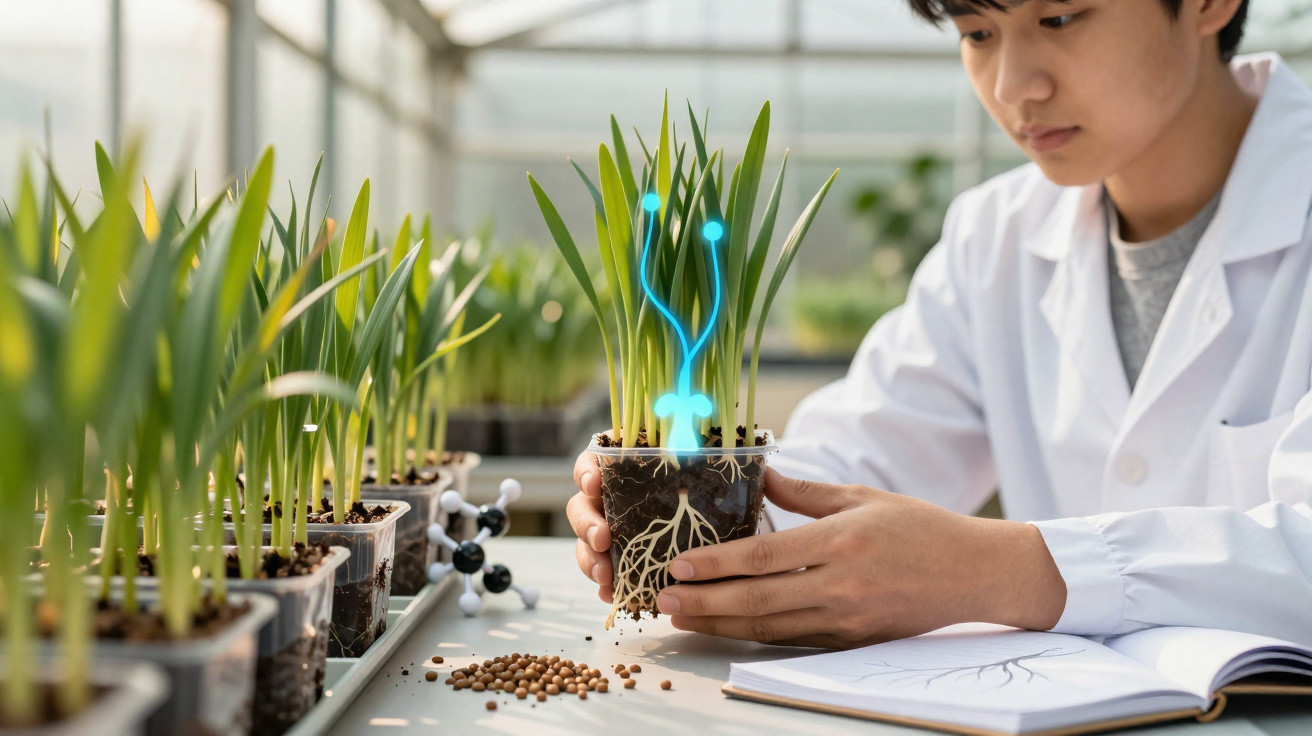
Farmers lose roughly half of each application of fertiliser. A large share runs into waterways, disperses into the atmosphere or remains in the ground, increasing both expense and pollution.
Scientists have identified the plant protein that signals crops to halt nitrogen absorption even when the soil still contains ample supplies.
When that protein was removed, a laboratory plant took up almost three times as much nitrogen, suggesting crops could potentially make much better use of fertiliser.
Fertiliser waste is a worldwide issue
Nitrogen fertiliser has increased crop production for many decades. However, plants take up only about 50% of the nitrogen fertiliser applied to fields. Much of the remainder seeps into water systems, where it can harm aquatic organisms and fuel damaging algal blooms far from its source.
Nitrogen remaining in the ground also increases nitrous oxide emissions. Across a 100-year timeframe, this gas retains heat 273 times more effectively than carbon dioxide.
Cost creates a third concern. Producing and transporting fertiliser is costly and vulnerable to geopolitical pressures, while its unstable nitrogen component can make storage hazardous.
The research was headed by Gloria Coruzzi, the Carroll and Milton Petrie Professor in NYU’s Department of Biology. She conducted the study with Mariana Obertello of INGEBI in Buenos Aires.
“Improving the efficiency of fertilizer usage would have important environmental, economic, and geopolitical impacts,” says Coruzzi.
How plants detect nitrogen satiety
The researchers searched for genes that respond to nitrogen according to dosage rather than merely detecting whether it is present. They aimed to identify regulators that become active only at particular concentrations.
They cultivated Arabidopsis, a small flowering plant widely used as a model in plant biology. The team exposed its roots to six nitrogen concentrations for two hours before sequencing them.
This investigation identified a protein named HHO5. It is a transcription factor, meaning a protein that activates or deactivates other genes. HHO5 was found to direct genome-wide gene expression and plant growth in response to nitrogen dosage.
The signal depended on the nitrogen form as well as its quantity. HHO5 concentrations increased after the plant accumulated sufficient organic nitrogen, which is used for transport, storage and amino acids.
“By identifying gene regulators that are sensitive to different levels and types of nitrogen, we uncovered a regulatory factor controlling nitrogen use and a key to improving nitrogen uptake and assimilation into organic nitrogen in plants,” says Coruzzi.
HHO5 puts plants into an energy-saving state
After activation, HHO5 performed two functions simultaneously. It boosted genes involved in organic nitrogen and amino-acid metabolism, while suppressing genes responsible for taking additional inorganic nitrogen from the soil.
Transforming inorganic nitrogen into organic nitrogen demands substantial energy from a plant. Shutting off uptake once its reserves are full appears to be a means of preserving that energy.
“This became the model of how plants establish nitrogen satiety via HHO5,” says Will Hinckley, an NYU doctoral student and the study’s lead author.
A second protein alters the response
The protein’s two roles depended on its partner. By itself, HHO5 switches off uptake genes; when joined by a second protein, WRKY21, it instead becomes an activator.
The researchers verified this using a technique known as DoubleTARGET. The two proteins are separately labelled with fluorescent markers, expressed in isolated plant cells and then sequenced to reveal which processes the pairing controls.
Plant cells with high quantities of both HHO5 and WRKY21 had greater expression of organic nitrogen genes as well as defence genes.
Coruzzi and Hinckley jointly responded by email to questions from Earth.com, saying this dual function was the aspect that departed from textbook expectations.
“Classically, transcription factors (TFs) have been seen as either activators of gene expression OR repressors, not both,” they told Earth.com.
They say that identifying WRKY21 as the partner that changes HHO5 from a repressor into an activator was central to the mechanism. Other HHO-family proteins are known to repress inorganic nitrogen uptake, but HHO5 is unique in activating organic nitrogen responses.
Removing HHO5 increases nitrogen uptake
The researchers’ final experiment involved eliminating the protein. Teams in Argentina and at NYU examined Arabidopsis plants entirely lacking HHO5.
The increase appeared under the conditions where it would be most relevant to farming. According to Coruzzi and Hinckley, plants without HHO5 absorbed almost three times more nitrogen when grown in low-nitrogen conditions.
“In simple terms, the plants would have increased nitrogen use efficiency,” they say. “This would save farmers the cost of N-fertilizer, and could also help reduce the environmental impact of excess N use.”
“Moreover, since removal of HHO5 improves nitrogen uptake, this indicates that modifying HHO5 has the potential to lead to tangible improvements in plant nitrogen assimilation and metabolism,” says Obertello.
NYU has submitted a patent application relating to the findings, intended to improve nitrogen use efficiency in plants.
Greater uptake has disadvantages
The findings have limitations that should be clearly acknowledged. This work involved Arabidopsis grown on agar plates and in hydroponic tanks, rather than maize cultivated in fields.
The mutant plants also incurred a cost for their increased absorption. Eliminating HHO5 reduced root growth, decreased the number of seeds in each silique and lowered the seeds’ nitrogen content.
This is significant because fertiliser is intended to produce grain rather than root mass. Nitrogen uptake benefits people only when it is delivered to edible plant parts.
HHO5 also differs from related proteins in another respect. It is found in phloem cells, the tissue that transports nitrogen throughout the plant, potentially explaining why the loss of this single gene has such a strong effect.
“We were excited to find that HHO5 was specifically expressed in phloem,” Coruzzi and Hinckley say. “Phloem cells are highly specialized, and are important for N transport.”
The researchers designed the study to examine nitrogen dose and form. They say the protein’s position within the plant proved equally important.
Towards crops with more efficient nitrogen use
The broader ambition is to develop a crop that continues absorbing nitrogen while the soil retains available supplies. Other research groups are pursuing the same aim through nitrogen-fixing bacteria instead.
“This knowledge may aid the engineering of ‘gluttonous’ plant varieties that absorb more available nitrogen,” says Hinckley.
The team expresses greater confidence than this wording might imply. Coruzzi and Hinckley say nitrogen-response genes are strongly conserved between Arabidopsis and maize, while HHO5 itself lies at the centre of a nitrogen-response network shared by Arabidopsis and rice.
“We have also shown that increased NUE phenotypes observed in Arabidopsis mutants are conserved in the orthologous mutants of maize,” they say. “So, the results for HHO5 and N-use in Arabidopsis will likely be translatable to maize and rice.”
It remains to be demonstrated in field conditions whether this switch acts similarly in wheat, rice or maize. The seed reduction observed in Arabidopsis would be the first problem that a crop-based version must address.
The National Institute of General Medical Sciences at the NIH funded the research, with Argentinian support provided by ANPCyT and CONICET.






Comments
No comments yet. Be the first to comment!
Leave a Comment