
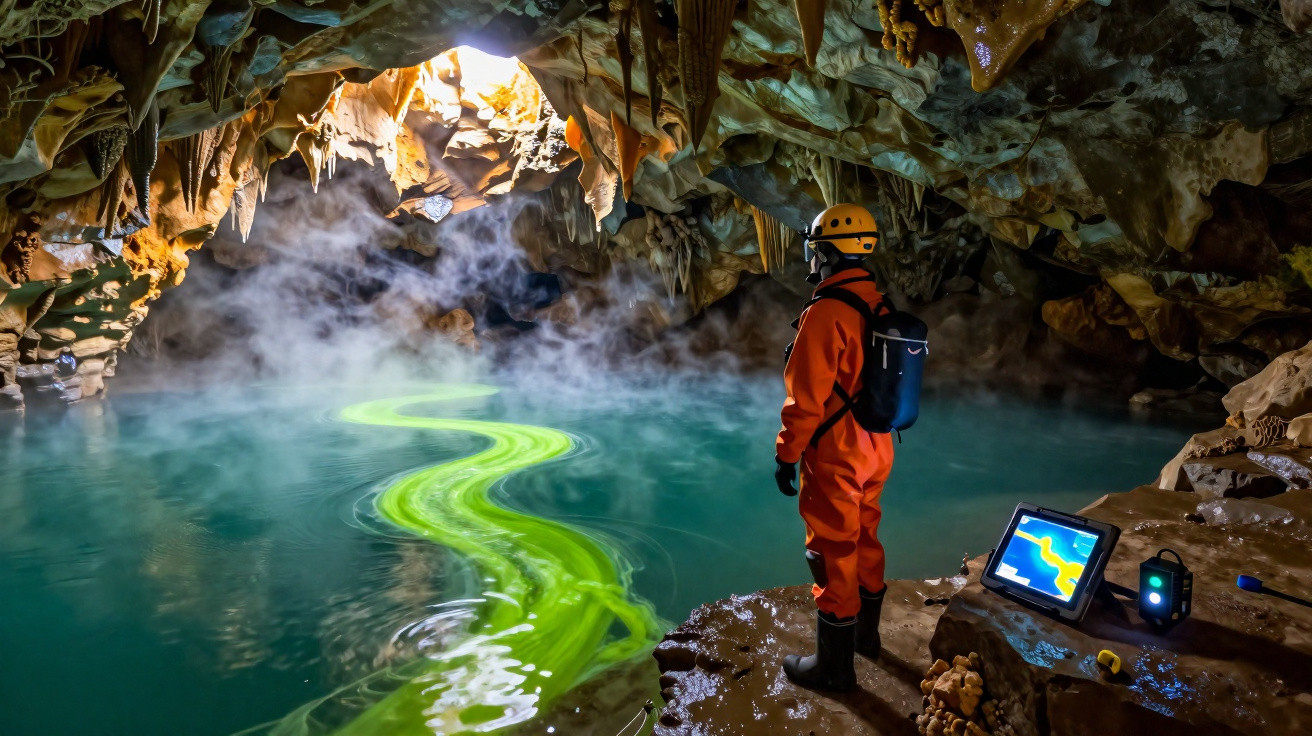
Scientists have verified the largest known underground lake of warm water, lying roughly 100 metres beneath the Albania-Greece border.
Tests indicate that water from the concealed lake can travel through linked caves within only a few hours, changing scientists’ understanding of the behaviour of these subterranean water networks.
Steam reveals a route underground
Steam billowing from a stony valley close to Konitsa, a town in north-western Greece, drew cavers towards an otherwise ordinary-looking opening.
By following the vapour beneath the surface, Marek Audy, a Czech speleologist from the Czech Speleological Society, arrived at warm water deep below.
A plume of steam climbing the hillside brought Audy back to the location, and the team reached the lake in February 2025.
Detailed surveying transformed the initial find into a hydrological puzzle with potential implications for every spring in the valley.
Atmos Cave and the underground lake
Explorers discovered the warm pool within Atmos Cave, on the Albanian side of the frontier, where it occupies a collapsed chamber.
Laser surveys and underwater scans found that it is about 138 metres long and 42 metres wide, containing 2.2 million gallons of mineral-rich water.
“When we first entered this cave and saw the lake, we were amazed,” said Audy.
Known as the Lake of Nerves, the pool provided the starting point for experiments tracing where its warm water emerged.
Toxic gas below ground
A rotten-egg smell in the air near the lake indicated hydrogen sulphide, a poisonous gas produced by sulphur-rich water.
Handheld monitors recorded concentrations between 2 and 22 parts per million in open cave areas. Safety guidance sets a 10-ppm upper limit and identifies 100 ppm as immediately dangerous for hydrogen sulphide, making the recorded cave levels significant.
“We had to have gas detectors so we could be alerted in time,” said Audy, adding that the gas helps shape the cave.
Caves formed from underneath
When the dissolved gas met air, part of it became acid, beginning the process of dissolving the limestone.
Geologists refer to this as sulphuric acid speleogenesis: cave formation powered by reactions involving sulphuric acid, which can excavate chambers from beneath.
Turbulent water released additional gas into the cave atmosphere, meaning corrosion was most intense around rapids rather than across still lake water.
As time passed, collapses sealed former passages, held warm water in basins and diverted it through fractures that opened fresh pathways.
Dye traces underground water flow
To map the hidden connections, the researchers carried out tracer tests, releasing dye into several caves to follow underground water movement.
Within hours, the dye appeared at almost every spring in the valley, including springs supplied through narrow fissures.
Water travelled at speeds of up to 30 kilometres per day, while deep thermal water moved much more rapidly than anticipated.
The findings challenged the assumption that every crack carried separate, untouched water and recast the way the caves are understood to be connected.
Environmental threats below the surface
Springs downstream discharged about 12,000 litres per minute, showing that the cave water was not contained underground.
In karst landscapes, which are formed as limestone dissolves, cracks can carry water swiftly while allowing very little opportunity for natural filtration.
This rapid movement means surface contamination or major construction could enter the same fractures and reach cave habitats before it is detected.
Safeguarding the valley therefore requires attention to both groundwater and decisions made at the surface, as the underground lake relies on conditions above it.
A stable thermal water system
Temperatures remained close to 26°C throughout the year, indicating a consistent supply of heat from depth.
Groundwater rising towards the surface absorbed warmth underground before moving through cracks laden with dissolved minerals that created its distinctive chemical signature.
In the Vromoner valley along the Albania-Greece border, springs shared the lake’s temperature and chemistry, suggesting a single origin.
This consistency enabled researchers to use the lake to interpret the area’s geothermal water system instead of attributing its characteristics to seasonal weather.
Life in hostile water
Slimy biofilms, microbial layers coating cave sediment, blanketed streambeds and formed the foundation of the subterranean food chain.
Rather than using sunlight, the microbes gained energy from sulphur compounds and created nutrients consumed by small animals.
The study identified dense populations of insect larvae in the Vromoner caves, but few animal varieties, because the water contained little oxygen.
The same rapid links also provided migration corridors, so disruption in one cave could quickly affect the entire network.
Protecting a vulnerable network
Local authorities have begun discussions with the exploration team about protecting the caves within Vjosa National Park.
National park designation could restrict road construction and waste dumping near sinkholes, reducing the likelihood that pollutants enter the linked springs.
Proposals for a dam on the Greek side of the Sarantaporos River, which forms part of the border, could alter water levels in the caves.
Decisions across the border will be important because, once the water begins to flow, the lake and its springs do not recognise political boundaries.
What happens next
The lake and its swiftly moving pathways have turned a caving discovery into evidence of how warm groundwater can reorganise underground landscapes.
Further tracer experiments in other sulphur-rich caves could assess the revised model, while local conservation choices will determine how quickly research can continue.
Photo: Marek Audy archives




Comments
No comments yet. Be the first to comment!
Leave a Comment