
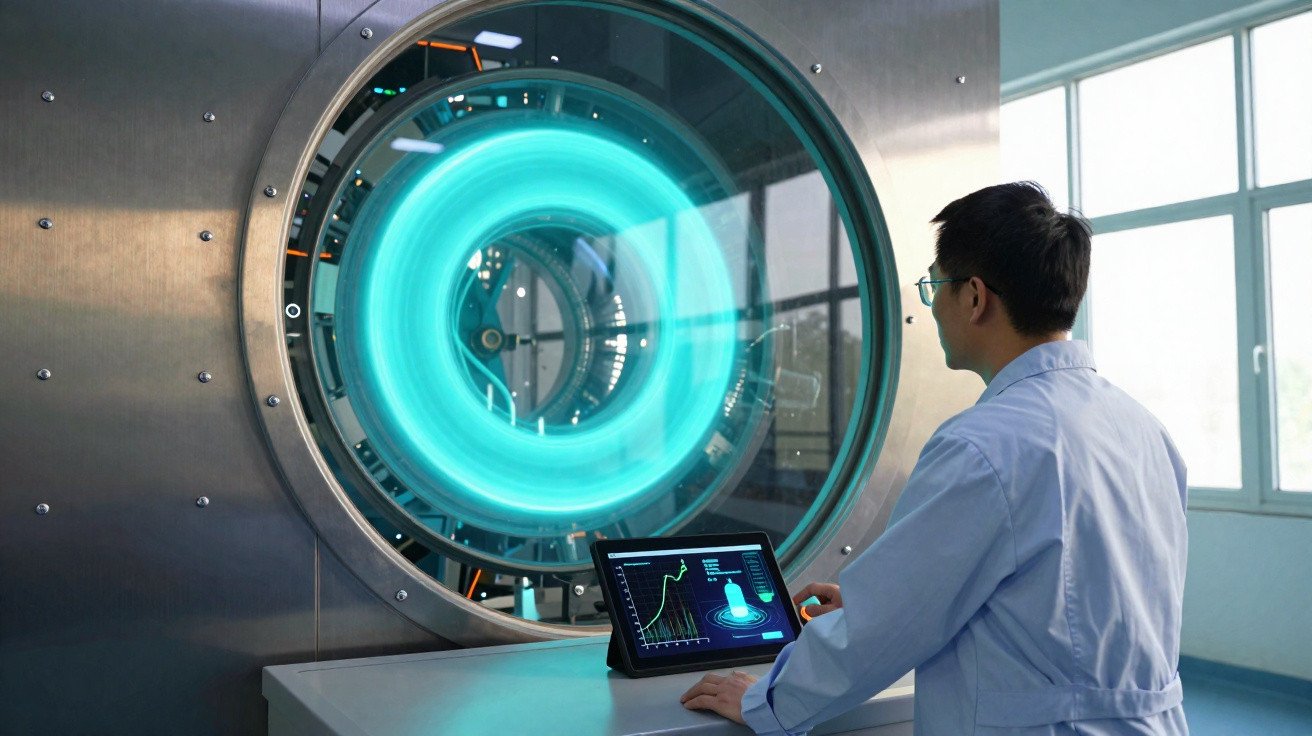
Scientists in China have shown that fusion fuel can remain stable at densities previously believed to cause failure in magnetic fusion reactors.
The finding recasts a long-established physical constraint as a condition that can be managed, potentially moving continuous, higher-power fusion operation nearer.
How the fusion density limit was exceeded
The advance was achieved in China’s fully superconducting Experimental Advanced Superconducting Tokamak (EAST), where dense fusion fuel kept operating rather than collapsing.
Professor Ping Zhu of Huazhong University of Science and Technology (HUST) directly observed this effect, recording stable plasma states above the density threshold that has limited tokamaks for decades.
The study found that high density alone did not create instability, provided interactions between the plasma and reactor wall remained within a tightly controlled range.
That threshold helps explain both why fusion density limits develop and how forthcoming reactors could intentionally go beyond them.
Why density is crucial for fusion
Within a fusion reactor, plasma - a superheated gas made up of charged particles - must remain hot while also containing a large amount of fuel.
Putting in additional fuel increases the chance of collisions, but the hydrogen fuels used for fusion must still reach roughly 150 million kelvin before fusion properly begins.
Greater density allows the same hot volume to produce much more fusion, although the extra particles also increase cooling losses.
Such events, called disruptions, are marked by an abrupt loss of stability and magnetic confinement - a danger that has long discouraged engineers from raising plasma density too far.
The Greenwald density ceiling
Since its introduction in 1988, the Greenwald density limit - an empirical reference point that varies with plasma current - has shaped high-density fusion research.
In a tokamak, a doughnut-shaped, magnet-based reactor, exceeding this threshold frequently resulted in an abrupt shutdown.
Even where extra fuel could have increased fusion output at the same temperature, operators learned to remain below the line.
Researchers subsequently spent decades seeking a way past the limit, with the reactor wall emerging as a leading source of concern.
Wall conditions determine stability
At the plasma edge, hot particles collide with metal surfaces, releasing impurities: stray atoms that radiate energy away.
Fast ions may also cause sputtering - impacts that dislodge wall atoms - increasing the impurity cloud and cooling the plasma.
A theory known as plasma-wall self-organization (PWSO), in which wall conditions influence stability, predicted that this balance could settle into a more secure state.
EAST provided practical evidence for the idea, showing that controlling the wall early can allow density to continue rising without causing disruptions.
Direct electron heating
At start-up, the EAST researchers applied higher gas pressure alongside electron cyclotron resonance heating (ECRH), which uses microwave power to heat electrons directly.
Microwaves from ECRH enabled the fuel to ignite more rapidly, meaning fewer wall atoms reached the core and fewer photons removed energy.
Successive ECRH shots also improved wall conditions over time, while Zhu’s HUST team found that later experiments reached higher densities with lower radiation.
These initial decisions established the wall-plasma balance that PWSO identifies as determining whether an experiment encounters the limit or avoids it.
Stable fuel at very high density
In a newly demonstrated operational state, the plasma stayed stable as further fuel was introduced into the reactor.
In these experiments, EAST achieved fuel densities approximately 1.3 to 1.65 times above its usual operating range.
Cleaner reactor conditions reduced energy losses, enabling the plasma to remain hot rather than disintegrating.
So far, this stability has only been demonstrated during start-up. Maintaining it in higher-performance operation is the next task.
Moving towards fusion ignition conditions
Achieving fusion ignition - self-heating that allows reactions to continue - requires more than raising density in one device.
Satisfying the Lawson criterion, the density-temperature-time requirement for net energy, also calls for higher temperatures and longer confinement.
The EAST team will next trial the same start-up approach in high-confinement mode, an operating state that limits heat leakage.
If successful, it would aid progress towards burning plasma, in which fusion products maintain the heat, although reactor walls would still need to withstand severe bombardment.
Challenges still to overcome
Even if the density constraint is overcome, hot plasma still tends to reach the walls, where contact can melt surfaces within seconds.
Fast neutrons also transport energy away from the reaction, while repeated impacts gradually degrade metals and coatings.
Wall control must perform reliably from one shot to the next, as minor differences in surface condition can alter the following experiment.
For now, the development eliminates one bottleneck, but it does not ensure a reactor will generate more power than it uses.
Next-generation fusion devices
In reactors fitted with tungsten-facing components, lower wall temperatures may reduce sputtering and radiation sufficiently to maintain stable dense plasmas.
“The findings suggest a practical and scalable pathway for extending density limits in tokamaks and next-generation burning plasma fusion devices,” said Zhu.
The EAST experiments connected a long-feared density threshold with wall behaviour, giving engineers a new means of control.
Before ignition can be described as being within reach, future research must demonstrate the same stability under higher-performance conditions.




Comments
No comments yet. Be the first to comment!
Leave a Comment