
A remarkable find near Maryborough
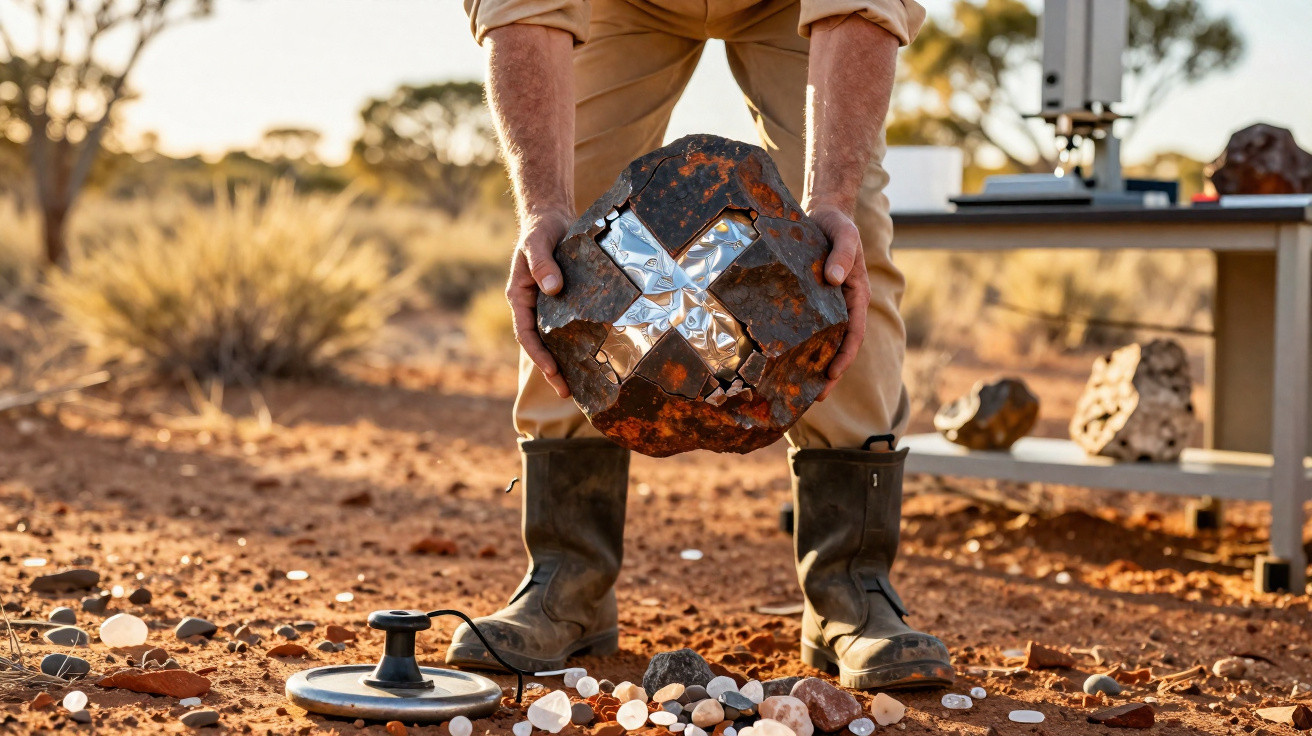
While prospecting in Maryborough Regional Park, near Melbourne, Australia, in 2015, David Hole came across an unusual object.
Using a metal detector, he located an exceptionally heavy reddish stone embedded in yellow clay.
Hole brought the object home and attempted every possible method to split it open, convinced it contained a gold nugget. Maryborough lies within the Goldfields region, after all, where the Australian gold rush reached its height during the 19th century.
He used a rock saw, an angle grinder and a drill, and even poured acid over his discovery. Yet a sledgehammer could not produce so much as a crack. The object he was determined to open was not a gold nugget.
Years afterwards, Hole learned that it was an uncommon meteorite.
"It had this sculpted, dimpled look to it," Melbourne Museum geologist Dermot Henry told The Sydney Morning Herald in 2019.
"That's formed when they come through the atmosphere, they are melting on the outside, and the atmosphere sculpts them."
The Maryborough meteorite is identified
Though he could not break open the ‘rock’, Hole remained curious and took the nugget to Melbourne Museum for identification.
"I've looked at a lot of rocks that people think are meteorites," Henry told Channel 10 News.
Henry explained that, during 37 years at the museum and after inspecting thousands of rocks, just two submissions had proved to be genuine meteorites.
This was one of those two.
"If you saw a rock on Earth like this, and you picked it up, it shouldn't be that heavy," Melbourne Museum geologist Bill Birch explained to The Sydney Morning Herald.
The scientists described the 4.6 billion-year-old meteorite in a scientific paper, naming it Maryborough after the nearby town where it was discovered.
At an imposing 17 kilograms (37.5 pounds), it was cut with a diamond saw so that researchers could remove a small sample. They found it contained a high proportion of iron, classifying it as an H5 ordinary chondrite.
The cut surface also reveals tiny crystallised droplets of metallic minerals, known as chondrules, distributed throughout the meteorite.
"Meteorites provide the cheapest form of space exploration. They transport us back in time, providing clues to the age, formation, and chemistry of our Solar System (including Earth)," said Henry.
"Some provide a glimpse at the deep interior of our planet. In some meteorites, there is 'stardust' even older than our Solar System, which shows us how stars form and evolve to create elements of the periodic table.
"Other rare meteorites contain organic molecules such as amino acids; the building blocks of life."
Where the Maryborough meteorite may have originated
The researchers have not established either the meteorite’s origin or how long it has been on Earth, although they have several possible explanations.
Our Solar System began as a rotating mass of dust and chondrite rocks. Gravity eventually gathered much of this material into planets, while most of the remaining debris formed a vast asteroid belt.
"This particular meteorite most probably comes out of the asteroid belt between Mars and Jupiter, and it's been nudged out of there by some asteroids smashing into each other, then one day it smashes into Earth," Henry told Channel 10 News.
Carbon dating indicates that the meteorite has been on Earth for between 100 and 1,000 years. Several meteor sightings recorded from 1889 to 1951 may match its arrival on the planet.
According to the researchers, the Maryborough meteorite is considerably rarer than gold and therefore much more scientifically valuable.
It is among only 17 meteorites ever documented in Victoria, Australia, and ranks as the second-largest chondritic mass after a 55-kilogram specimen identified in 2003.
"This is only the 17th meteorite found in Victoria, whereas there's been thousands of gold nuggets found," Henry told Channel 10 News.
"Looking at the chain of events, it's quite, you might say, astronomical it being discovered at all."
The Maryborough meteorite is not the first space rock to take years to reach a museum. In another extraordinary case covered by ScienceAlert in 2018, a meteorite spent 80 years passing through two owners and serving as a doorstop before its real identity was finally recognised.
This may be an excellent moment to inspect your garden for especially heavy rocks that refuse to break - you could be sitting on a metaphorical gold mine.
The study appeared in Proceedings of the Royal Society of Victoria.
An earlier version of this article was published in July 2019.






Comments
No comments yet. Be the first to comment!
Leave a Comment