
[+ ADD ZONA MILITAR IN GOOGLE]
Why add us? Get the latest from Zona Militar in your Google feed.
[JOIN THE WHATSAPP CHANNEL]
Join our official WhatsApp channel and receive the news as it happens.
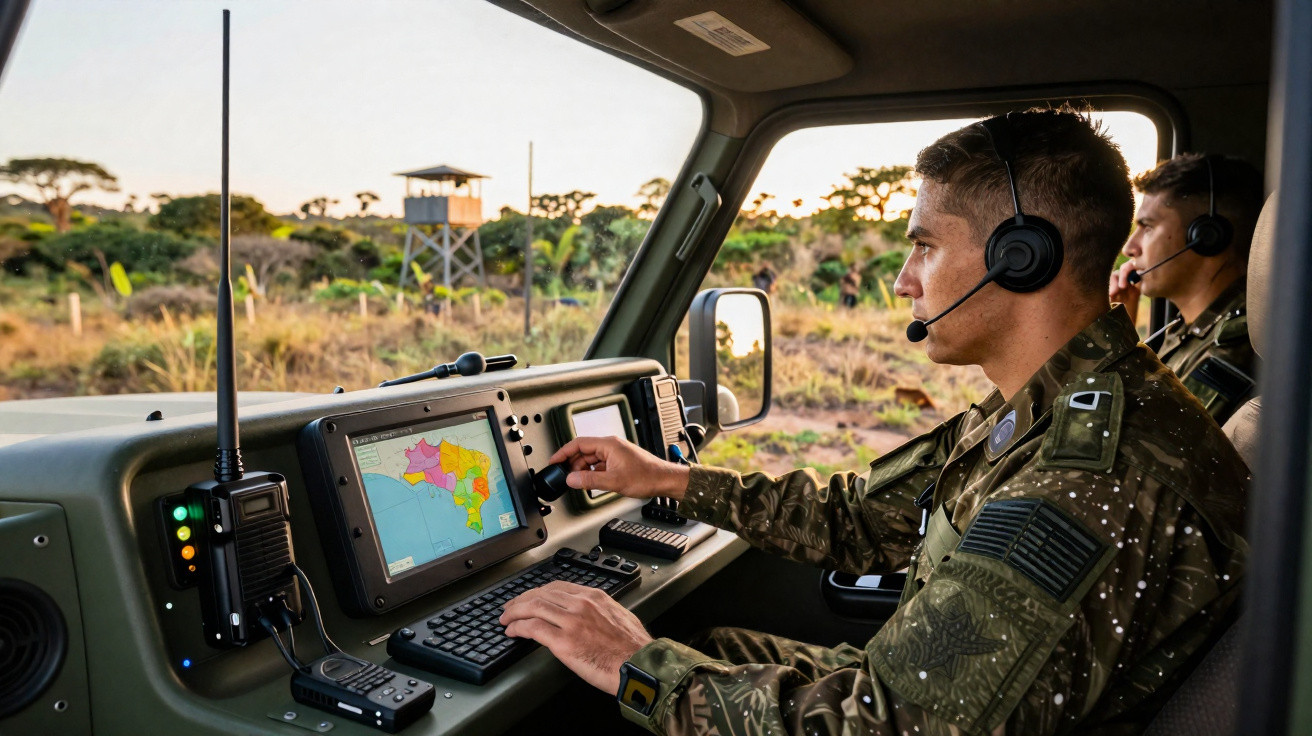
The Brazilian Army is moving into a new phase in the modernisation of its command, control and communications capabilities by upgrading the Infantry radio vehicles used within the Integrated Border Monitoring System (SISFRON).
👉 Also read: Brazilian Navy deploys South America’s largest warship for the first time during the Rio Grande Elevation
Brazilian Army radio vehicles and SISFRON modernisation
With Modirum GESPI taking part, the project involves converting and modernising these mobile platforms. It will introduce new communications systems, vehicle-mounted equipment and operational structures intended to expand the flow of information between military units.
📌 You may be interested in:
- Leonardo receives the first contract for serial production of the Brazilian Army’s 98 new Centauro II 8×8 VBCs
- After 42 years of service, the Peruvian Navy bids farewell to the B.A.P. “Eten” tank landing ship
Rather than merely replacing equipment, the initiative is part of a broader shift in how the Brazilian Army conducts its operations. At a time when the pace of information has become decisive on the modern battlefield, communications systems have a strategic role in ensuring situational awareness and coordination among the Brazilian Army’s different components.
Radio vehicles serve as key nodes in the Army’s command-and-control network, linking deployed troops, command centres and monitoring systems. Upgrading these assets increases data-transmission capacity, improves integration between units and reinforces the operational response across vast areas, particularly along Brazil’s border regions.
Integrated border surveillance and command-and-control networks
Established as one of the Army’s Strategic Programmes, SISFRON aims to create an integrated network of sensors, radars, communications systems and control centres to strengthen Brazil’s ability to monitor and protect its borders. These borders represent one of the largest land areas for which a military force is responsible anywhere in the world.
As it has developed, the programme has moved beyond being solely a framework for the physical monitoring of the frontier. It has incorporated network-centric warfare concepts, providing closer integration between sensors, operational units and decision-making centres.
The radio vehicle upgrade supports this transition by enabling conventional platforms to function as connected components within a digital command-and-control architecture. This capability is essential for surveillance operations, territorial defence and joint activities involving other government bodies.
Installing new on-board systems in the radio vehicles marks another stage in the development of SISFRON’s technological infrastructure. It expands the Brazilian Army’s ability to operate in environments where connectivity, mobility and rapid access to information are decisive to mission accomplishment.
Communications for Brazil’s border regions
In border areas defined by vast distances and logistical challenges, the availability of modern communications assets delivers greater integration between units, more effective operational coordination and improved efficiency in the use of Brazilian Army resources.
Photographs: Modirum GESPI.





Comments
No comments yet. Be the first to comment!
Leave a Comment