
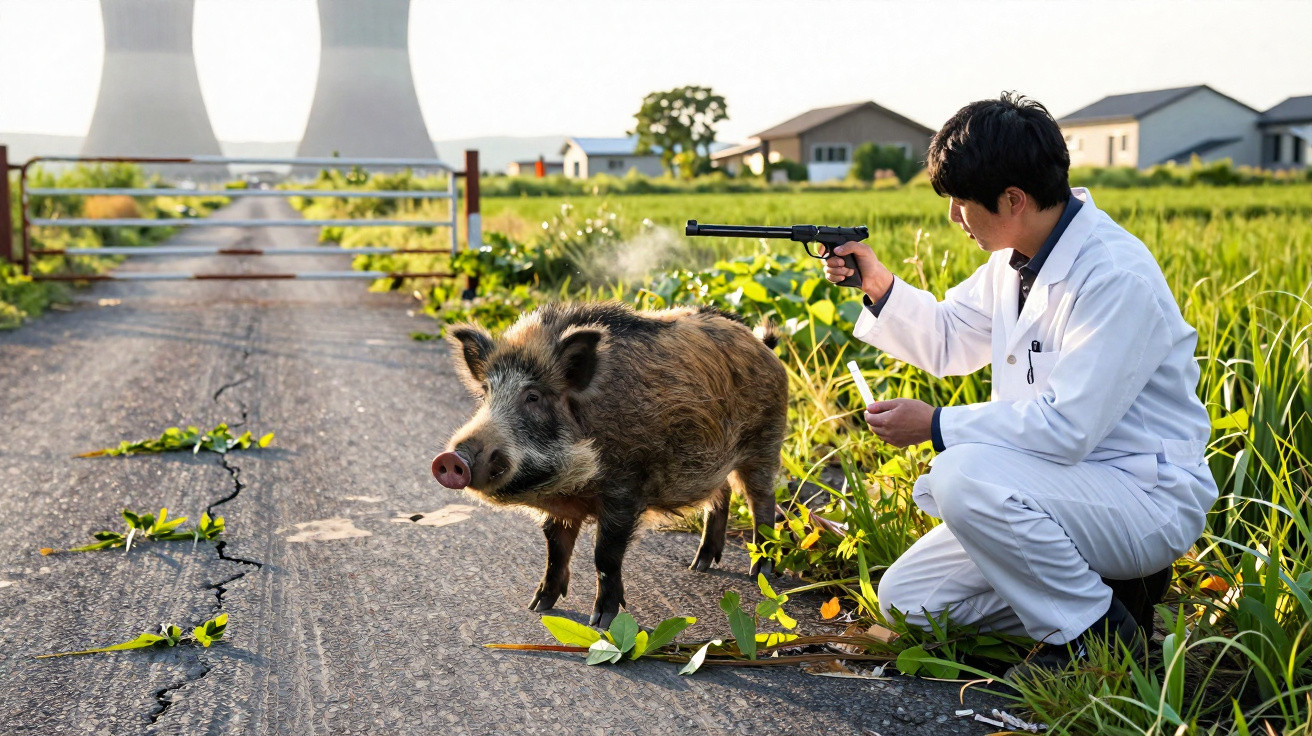
Escaped domestic pigs that mated with wild boars after the Fukushima disaster created hybrids that move through generations at an unusually rapid pace, making pig genes disappear from the population quickly.
This maternal effect shows that one escape episode can temporarily alter a wild population before becoming largely undetectable genetically within only a few years.
Evidence in hybrid pig DNA
Genetic testing of boars in Fukushima, north-eastern Japan, found that hybrid animals born to pig mothers had unexpectedly small amounts of pig nuclear DNA.
Using these specimens, Professor Shingo Kaneko, a wildlife geneticist at Fukushima University, connected pig maternity with quicker generational change.
Kaneko’s researchers found that mothers from pig lineages transmitted fast breeding patterns, allowing wild boar genes to replace pig genes more rapidly.
This swift process makes the effects of hybridisation more predictable, while also concealing the initial escape among animals that appear mostly wild.
The post-evacuation escape
Following the 2011 nuclear plant accident, people abruptly left the area, farms were deserted and pigs spread into forests and fields.
About 30,000 pigs escaped from abandoned enclosures, producing an unusual, one-off influx of domestic genes into wild boar populations.
As pig farming had stopped and few people remained nearby, hybrids multiplied without the ongoing restocking that characterises many feral pig outbreaks.
These clearly separated initial conditions enabled scientists to assess cause and effect more directly than in areas where additional pigs escape every year.
Female pig hybrids retained rapid breeding
Domestic pigs can reproduce throughout the year, whereas female wild boars generally rear one litter during a single season.
If a pig was the mother, her female offspring maintained this rapid cycle, reducing the interval between births and generations.
Quicker generations also created more opportunities for further mating with wild boars, particularly after the first escape event.
Every subsequent litter incorporated more wild boar DNA, causing the domestic pig share to decline faster than many people had anticipated.
Two DNA systems
To trace the hybrids, the researchers examined DNA from 191 wild boars and 10 pigs gathered between 2015 and 2018.
One marker was mitochondrial DNA – DNA inherited solely through the mother – which identified animals descended from escaped sows.
The other evidence came from the remainder of the genome, where genes from both parents are rearranged with each generation.
This broader material, known as nuclear DNA – DNA combined from both parents in every generation – revealed dilution but could not identify the genes responsible for breeding patterns.
Backcrossing removed ancestry
Continued breeding between hybrids and wild boars drove most pig DNA from the population in only a few generations.
Scientists describe this process as backcrossing – mating hybrids again with a parent species – with every round reducing the amount of pig genetic material further.
Within the dataset, 21 of 31 pig hybrids were already past the fifth generation, indicating a turnover rate faster than annual breeding.
This rapid dilution limited the overall domestic pig effect, although maternal lineages may endure and make wild boar management decisions more difficult.
Pig maternal lines remained
Pig maternity could still be identified because mitochondrial DNA does not combine with paternal DNA during reproduction.
This one-directional inheritance allowed pig-associated mitochondrial DNA to remain in certain animals even once most of their other DNA appeared wild.
As time passes, pig hybrids may behave and travel like wild boars while continuing to carry a pig maternal marker.
Without genetic screening, wildlife managers could overlook these lineages until another escape introduces fresh pig genes into the population.
Radiation was not the main factor
Although many expected nuclear fallout to disrupt animal DNA, the clearest pattern in this case resulted from breeding rather than radiation.
Wide-ranging genetic studies of plants and mammals around Fukushima have not identified clear evidence of increased mutation rates.
Hybridisation – reproduction between two related animal groups – produced the changes that researchers could measure and follow in boar populations.
For risk planning, managers can lessen hybrid pressures without presuming that radiation is altering animal DNA.
Invasive pigs in other regions
Across the United States, authorities are tackling feral swine, with the U.S. Department of Agriculture putting the yearly cost at roughly $2.5 billion.
These animals damage crops by rooting, spread diseases and reproduce swiftly, meaning even a modest genetic benefit can be significant.
Comparable crossings between boars and pigs occur in Europe and other places, and mother-led turnover could affect how long domestic features remain.
Fukushima provided a distinct opportunity to observe the process, but the same biology may complicate control strategies wherever pigs continue to enter wild herds.
Managing pig hybrids
Field teams commonly remove pigs according to appearance alone, but genetic testing can indicate which hybrids are likely to continue breeding rapidly.
Maternal swine lineages could provide useful genetic markers for agencies planning focused removal programmes.
The results can support wildlife management and invasive-species damage-control strategies.
Maternal swine lineages speed up generational turnover and enable authorities to predict population explosion risks more precisely.
Limitations and next steps
Maternal pig lines increased reproductive speed, allowing wild boar genetics to reassert themselves quickly despite the disorderly escape.
Future surveillance requires broader samples and stronger field records, as new releases could trigger the same process again in other locations.




Comments
No comments yet. Be the first to comment!
Leave a Comment