
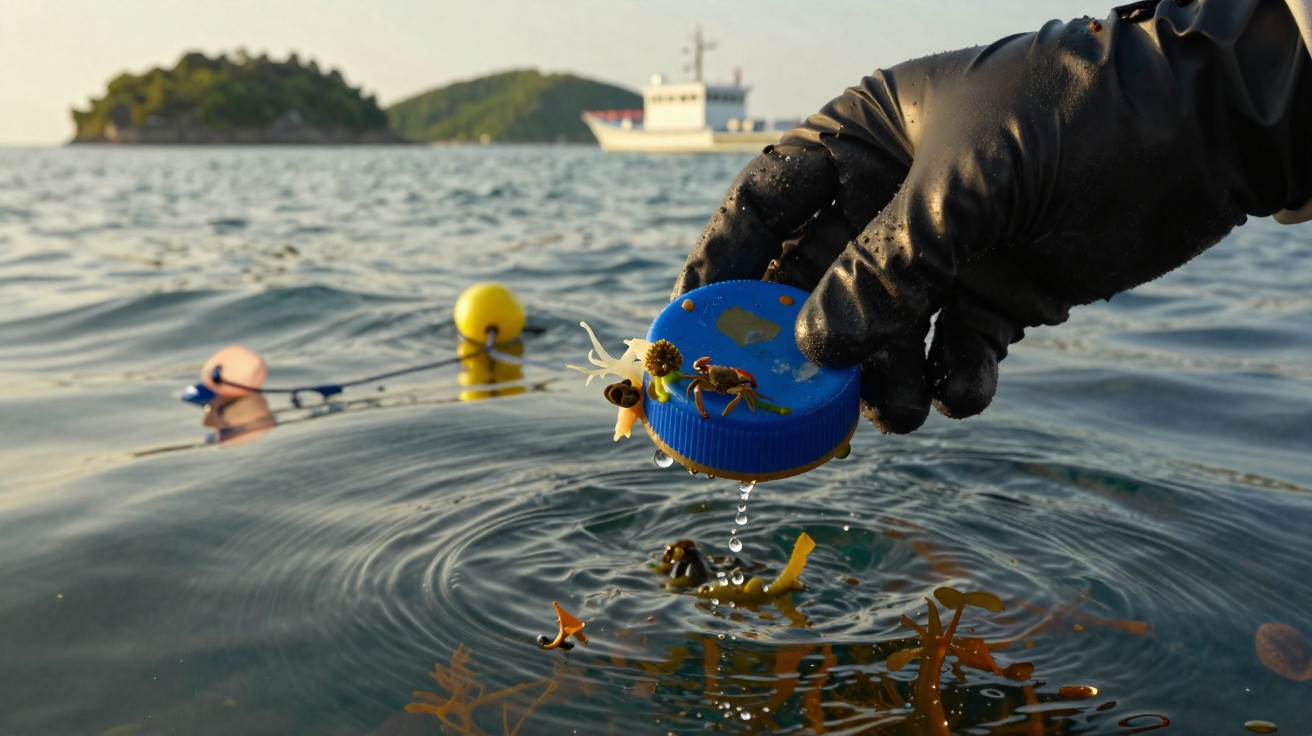
A plastic bottle cap recovered from waters off southern Japan was found to conceal a complete miniature ecosystem. It carried 307 organisms across nine distinct groups, among them a worm species that had never previously been documented in Japanese waters.
Drawing on details from the cap’s label, chemical signatures preserved within minute shells and simulations of ocean currents, scientists were able to reconstruct the approximate route taken by this small item of rubbish.
The finding offers an unusually detailed snapshot of how one floating piece of plastic can unobtrusively transport entire marine communities over long distances.
It is the first study to bring together biological, chemical and oceanographic evidence to track the drifting history of one small item of ocean plastic.
Ocean plastic rarely travels alone
It is widely recognised that plastic in the sea harms wildlife, whether animals ingest it or become entangled in it. Yet there is a less visible concern: plastic provides an effective means of transport for “hitchhikers.”
Unlike seaweed or driftwood, which usually degrade or sink comparatively quickly, plastic can remain afloat at the sea surface for extended periods.
Its persistent durability therefore makes it an increasingly important route for marine organisms to reach locations they could not otherwise access independently.
Life crowded onto one cap
On this single cap, the team recorded 307 individual organisms representing nine taxonomic groups. The inhabitants included minute tube-building worms, bryozoans, goose barnacles, foraminifera, flatworms and larger polychaete worms.
Around three quarters of all the individuals were small worms that construct compact, coiled, chalk-like tubes as homes.
One inhabitant, however, was particularly notable.
“The most striking colonist was a polychaete worm, Eunice bipapillata,” said lead author Naoto Jimi, a lecturer at Nagoya University’s Sugashima Marine Biological Laboratory. “It built a nest that transformed the cap into a complex three-dimensional habitat.”
“Inside, we found organisms that normally live in southern tropical waters.”
In effect, the worm converted a discarded object into viable accommodation. Its robust shelter supported an entire group of species that would not normally be expected to survive together so far from their tropical origin.
“Geographic range extensions of some species may be occurring under the radar, so if this waste can be properly disposed of, we may reduce the number of non-native species carried into new habitats,” Jimi said.
Following the bottle cap across oceans
To establish the cap’s likely route, the researchers used three independent sources of evidence.
First, they examined the organisms that had accumulated on the cap. They identified species associated with coastal seabeds alongside more typical open-ocean hitchhikers.
This indicated that, at different stages, the bottle cap had travelled through both nearshore waters and the open ocean.
Next, the researchers studied foraminifera, microscopic single-celled organisms that form elaborate shells. As these shells develop, they retain a record of the surrounding water temperature.
Stable isotope analysis revealed evidence that the organisms had travelled through warmer waters before ultimately arriving at the collection location, where the water temperature was about 22 °C.
Finally, the team used ocean modelling. They introduced virtual particles into simulations of surface currents to identify credible routes the cap might have followed.
The modelled paths pointed back to the northern Philippines. Before reaching shore at the collection site, the cap probably travelled within the Kuroshio Current system for at least 70 days and potentially for several months.
Plastic moves more than species
Together, the evidence presents a striking scenario. Tube-building worms and similar animals can make a plastic fragment into a functional refuge, enabling several species to withstand the voyage as a community rather than dispersing as isolated individuals.
Whole biological communities, rather than only occasional individual organisms, may therefore arrive in a new place and potentially establish themselves there.
“The marine plastic problem should therefore be considered not only from the perspectives of aesthetic damage, ingestion, and entanglement, but also from those of biogeography and invasive species risk,” Jimi said.
“Multi-method reconstructions of the drift history of marine debris may support future estimation and control of invasive species pathways originating from ocean waste.”
What happens after they arrive
The researchers say future work should investigate how frequently small plastic fragments become home to organisms that normally live on the seabed. They also aim to identify which species are most likely to endure a lengthy ocean crossing.
The next stage will examine the ecological consequences after these plastic-borne hitchhikers arrive in an unfamiliar location and attempt to remain there.
What began with one dirty bottle cap has raised a far broader question: how many complete ecosystems may already be travelling unnoticed, carried by plastic that people discard without a second thought?





Comments
No comments yet. Be the first to comment!
Leave a Comment