
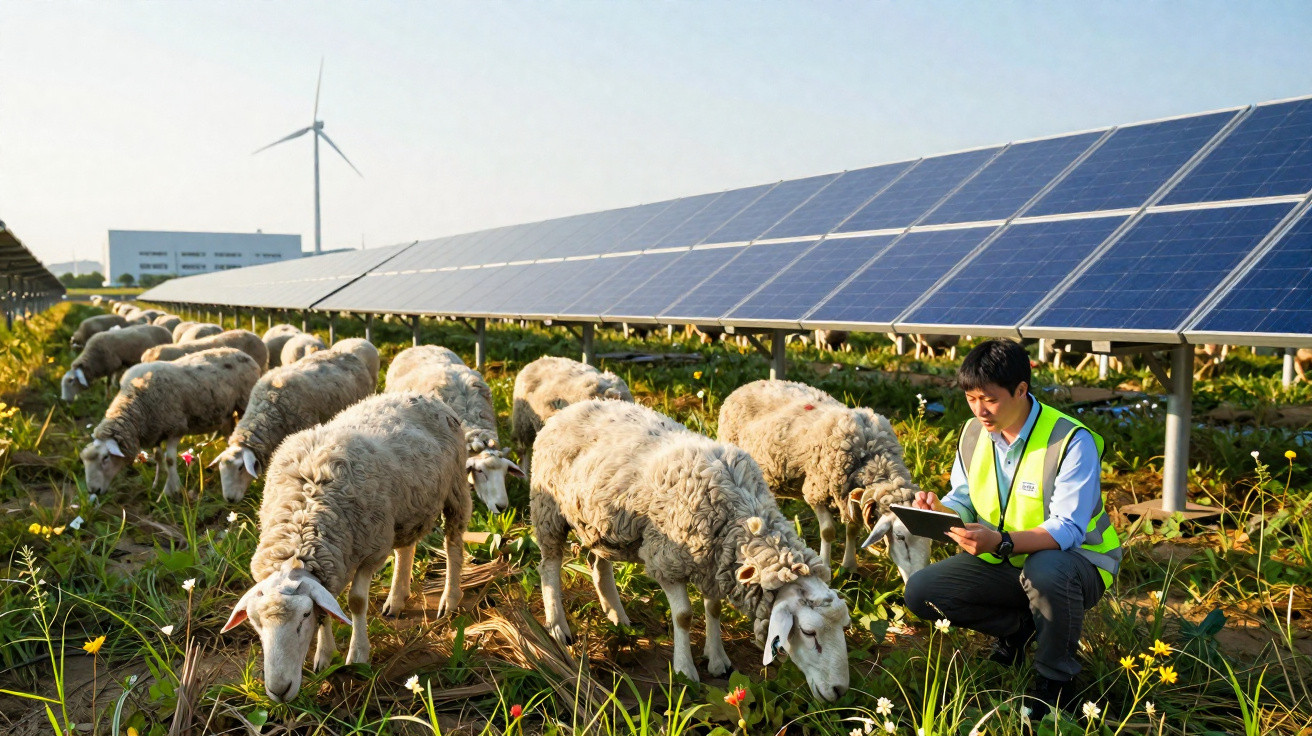
At a solar farm next to Volkswagen Poznań’s Września factory in western Poland, the maintenance team now has some four-legged members.
Almost 100 Greater Poland sheep are grazing beneath more than 31,000 panels, keeping vegetation in check that would otherwise need to be cut mechanically.
This unusual arrangement is also developing into a substantial research project. The sheep are not increasing the panels’ electricity output.
Rather, they are reshaping the management of a 67-acre industrial energy site as scientists assess whether power production and livestock grazing can occupy the same land.
That practical dual use, rather than the striking images, is the central point of the project.
Sheep take over from mowers
Vegetation at a solar installation cannot be left unmanaged. Long grass and woody plants may restrict access and make inspections harder, while conventional mowing equipment has to navigate metal frames and electrical infrastructure.
Sheep, by contrast, can pass between the tight panel rows and graze vegetation down close to the soil.
The flock arrived in late April 2026 and is set to stay until autumn, under the continuous supervision of experienced breeders.
The animals are Greater Poland sheep, a breed developed locally that is now part of a genetic conservation programme.
Marzena Pillich-Grońska, director of the Września plant, said the grazing scheme demonstrates how modern industry can “work in harmony with nature.”
It is an ambitious statement, but one practical shift is already evident: mechanical mowing is no longer the standard maintenance method for the array.
Volkswagen Poznań solar farm supplies factory power
Constructed and run by Quanta Energy, the solar farm occupies roughly 67 acres and has a generating capacity of 18.3 megawatts, indicating the amount of power it can supply at any one time.
The company and the university call it one of Europe’s biggest on-site solar facilities serving an industrial plant.
When conditions are bright, the panels can meet the factory’s full electricity demand.
Over an entire year, though, the installation covers around 25 percent of the plant’s electricity requirements.
As with a household electricity bill, an annual figure reveals more than a single ideal sunny day.
This difference is important. The sheep do not raise the volume of electricity the system is designed to generate, and the official announcement gives no measured improvement in panel efficiency.
Their purpose is land management and research support, rather than electricity generation.
Agrivoltaics explained simply
Agrivoltaics is the use of one site for both solar energy production and agriculture.
The farming element may include crops, grazing livestock or habitats planted for bees and other pollinators. Put simply, the same field performs two functions rather than being allocated to just one.
For many solar farms, sheep are well suited because they can move around panel supports and shelter beneath the structures.
A 2023 field study involving 80 sheep at a California solar farm found that animals grazing in solar areas spent longer feeding than sheep on nearby rangeland.
The researchers proposed that the panels might have protected the animals from heat, wind and rain, though the research was preliminary.
Even so, a flock cannot simply be placed inside a fenced area and left alone. Planning is needed for water, fencing, predator protection, secure cable management and access for routine maintenance.
The grazing timetable is also significant, as the California research showed that the timing of rotations affected how long the sheep fed.
Scientists monitor the entire system
Researchers from Poznań University of Life Sciences are studying animal welfare, behaviour, pasture quality, soil characteristics and the microclimate - the temperature and moisture conditions around the panels.
Dr. Joanna Składanowska-Baryza said agrivoltaics enables scientists to consider solar farms “much more broadly than energy production alone.”
Their aim is to establish practical guidelines for bringing renewable energy production together with agricultural land use.
Initial observations are positive, but they do not amount to final findings. Justyna Nowak-Gajek, who owns the flock, said the sheep had formed smaller groups and grazed quietly in separate parts of the site.
She explained that sheep which feel threatened generally stay closely packed together.
Shade is among the key issues being examined. A separate peer-reviewed study from 2023, carried out in tropical conditions, found that shade from solar panels reduced measures of heat load in sheep.
Poland differs in climate, breed and panel configuration, so conclusions cannot simply be transferred; local measurements remain necessary.
Biodiversity claims require evidence
Company materials state that the site benefits biodiversity, local agriculture and scientific understanding. However, the July announcement included no before-and-after figures for insects, plant species or soil changes.
Any suggestion that the flock has already produced a more diverse ecosystem should therefore be regarded as a possibility being investigated, rather than an established scientific result.
There is, however, a sound case for examining the question. A 2024 study across three Minnesota solar sites found that native plants beneath arrays increased from about 10 percent ground cover after one year to 58 percent after three years.
Scientists recorded 68 of the 101 plant species that had been seeded, indicating that valuable habitat can form under panels.
That Minnesota study concerned pollinator-friendly planting rather than grazing sheep. It provides context, not evidence for the Polish scheme.
Results in Września will be shaped by the vegetation already on site, flock size, grazing timing, weather, soil and long-term management.
A straightforward idea facing a serious trial
The project is notable because its principal tool is neither a robot, an advanced mower nor artificial intelligence. It is a familiar farm animal working within modern energy infrastructure.
This could cut regular mower movements and reduce reliance on mechanical cutting equipment, although the company has not released precise savings for costs or emissions.
For solar operators, the broader potential is more efficient land use. Farmers, meanwhile, could gain grazing access and new contracts for their flocks.
However, the model works only when animals stay healthy, technicians can safely access equipment, vegetation remains controlled and environmental gains can be measured.
What comes next? The flock is expected to remain until autumn as researchers continue to gather data.
The key outcome will not be whether the sheep appear content in photographs, but whether the evidence confirms animal safety, effective maintenance and healthier land while the factory continues to receive solar electricity.



Comments
No comments yet. Be the first to comment!
Leave a Comment