
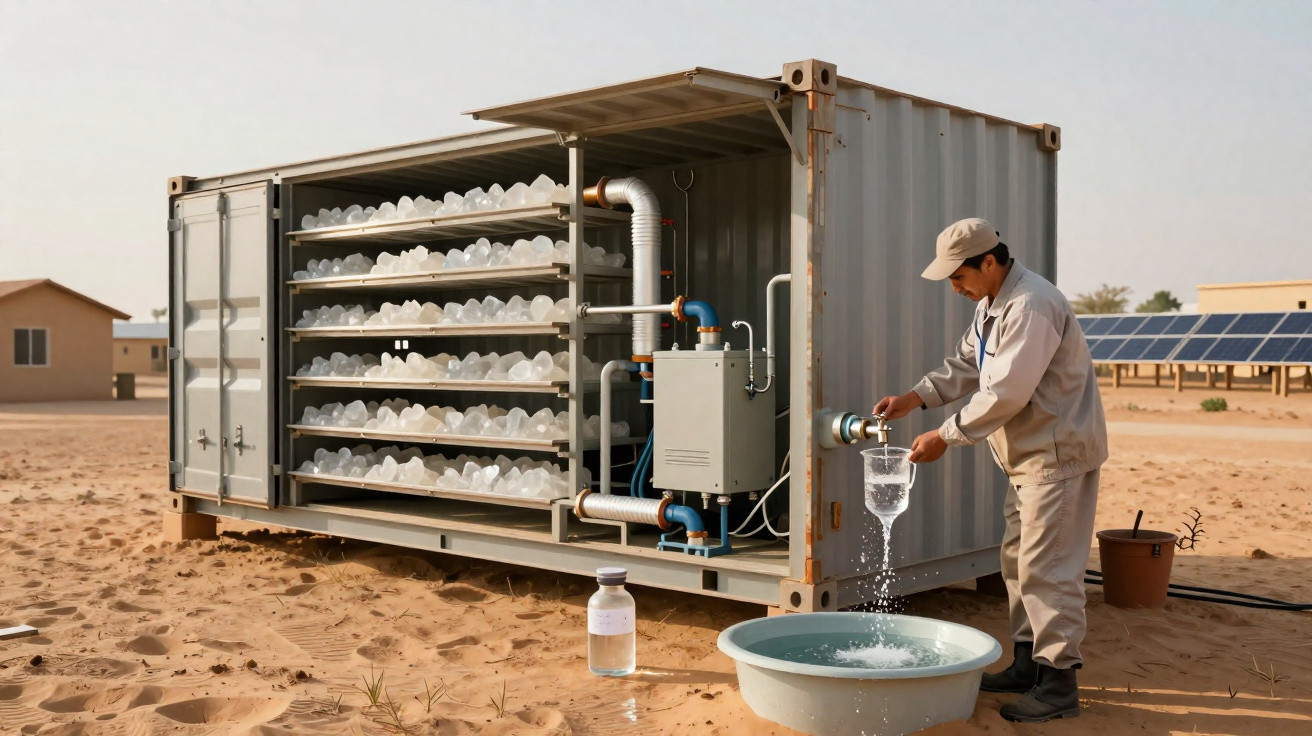
A new machine, contained within a standard 20-foot (6-metre) shipping container, has shown it can draw up to 1,000 litres of clean water a day from dry air, with no need for centralised electricity or pipelines.
This ability recasts the air as a reliable water supply for areas left vulnerable by storms, drought or broken infrastructure.
Capturing air moisture
Within a 20-foot (6-metre) container, the system collects moisture from the surrounding atmosphere and converts it into potable water at the point of use.
Professor Omar Yaghi of the University of California, Berkeley (UC Berkeley) has demonstrated that the modular setup can run separately from damaged power grids while maintaining a consistent daily output.
The unit can keep extracting water even in arid environments, provided that ambient heat is available to power its cycle.
Its output nevertheless varies according to the local climate and whether it can operate continuously, factors that explain how the technology functions in practice.
Heat replaces electricity
Rather than using motors, compressors or a connection to the electricity grid, the system’s cycle was powered by low-grade heat from the air around it.
A slight shift in temperature heated the material to release water vapour, before cooling it so that it could absorb fresh moisture.
Engineers said that a temperature gap of only about 13°F (7°C) was enough to maintain the capture-and-release process throughout the day.
Because it requires so little energy, the equipment can more easily be combined with solar heat or waste heat available on site.
Moisture-catching crystals
Cartridges filled with porous crystals captured water by drawing molecules from the air flowing through them.
Chemists refer to these materials as metal-organic frameworks. These porous crystals have an exceptionally large internal surface area, onto which water initially adheres.
At lower temperatures, water molecules attached themselves to the material; as temperatures increased, they were released, concentrating the vapour until it could condense.
As dust and oils may block the pores, filtration and cleaning procedures are as important as the underlying chemistry.
Chemistry behind water capture
Choices in the design dictated whether the crystals absorbed water at low humidity or only under muggy conditions.
At UC Berkeley, Yaghi’s team employed reticular chemistry, a method of joining molecules into repeating networks, to adjust water-attracting sites.
Narrower pores and stronger bonding enabled the material to retain water even when the air contained only minute amounts.
However, more powerful bonding also makes the water more difficult to release, meaning engineers needed to balance capture, heat input and water flow.
Proof outside the lab
Trials in the field took the concept beyond laboratory benches and demonstrated that the same materials could extract water from desert air.
During a 2023 demonstration in California’s Death Valley, sunlight alone powered the capture cycle and produced condensed liquid water.
Increasing the scale required loading more material into modules, moving greater volumes of air through them and regulating heat with straightforward hardware.
Even with effective materials, moving from a prototype to public infrastructure relies on manufacturing costs, durability and maintenance networks.
Making water safe
Moisture condensed from the air is not automatically safe to drink, as airborne particles may be carried along with it.
Once droplets had formed, filters removed dust and microbes, while disinfection – the destruction of germs using light or chemicals – provided an additional safeguard.
Some systems also restored minerals, as extremely pure water can taste bland and behave unusually in plumbing.
Water-quality testing remained essential, since a fault in filtration or storage could turn a useful device into a danger.
Weather sets the pace
Although dry areas still contain water vapour, daily production varied with humidity, temperature and airflow.
Warm afternoons aided the release of water from the material, whereas cooler nights improved capture by reducing the amount of water the air could hold.
Locations close to the sea, woodland or irrigated farmland had more dependable moisture than high inland deserts.
Seasonal variations may require operators to store surplus water or supplement the units with other sources during the driest periods.
Brine disposal challenges
Coastal areas frequently depend on desalination, but converting seawater into freshwater creates a concentrated waste stream.
One global assessment estimated that desalination facilities generate more brine than drinking water, posing disposal problems and risks to ecosystems.
Dealing with the brine may involve diffusers, deep wells or costly treatment, with every option increasing expense and regulatory oversight.
Water obtained from air avoids discharging into the ocean, although it cannot provide the consistent volume produced by a large desalination plant.
Global water shortages
Global monitoring in 2022 recorded 2.2 billion people without safely managed drinking water and 3.5 billion without safely managed sanitation.
A separate analysis from 2016 estimated that roughly four billion people experience severe water scarcity for at least one month each year.
In his Nobel Prize banquet speech, Yaghi linked water stress with climate action and called on leaders to respond.
“What we need now is courage, courage scaled to the enormity of the task, so we may gift the next generation not only carbon capture, but a planet worthy of their hopes,” said Yaghi.
What happens next
Installing these units at operational sites will reveal whether engineered crystals, basic heat sources and local maintenance can remain dependable over time.
Should costs decline and maintenance prove manageable, air-based water could become a regular part of resilience planning alongside wells and treatment plants.
The original study is detailed in Nature Water.
Photograph: Brittany Hosea-Small/AP.





Comments
No comments yet. Be the first to comment!
Leave a Comment