
[+] ADD ZONA MILITAR TO
Why add us? Get the latest from Zona Militar in your Google feed.
JOIN THE WHATSAPP CHANNEL
Join our official WhatsApp channel and receive the news as it happens.
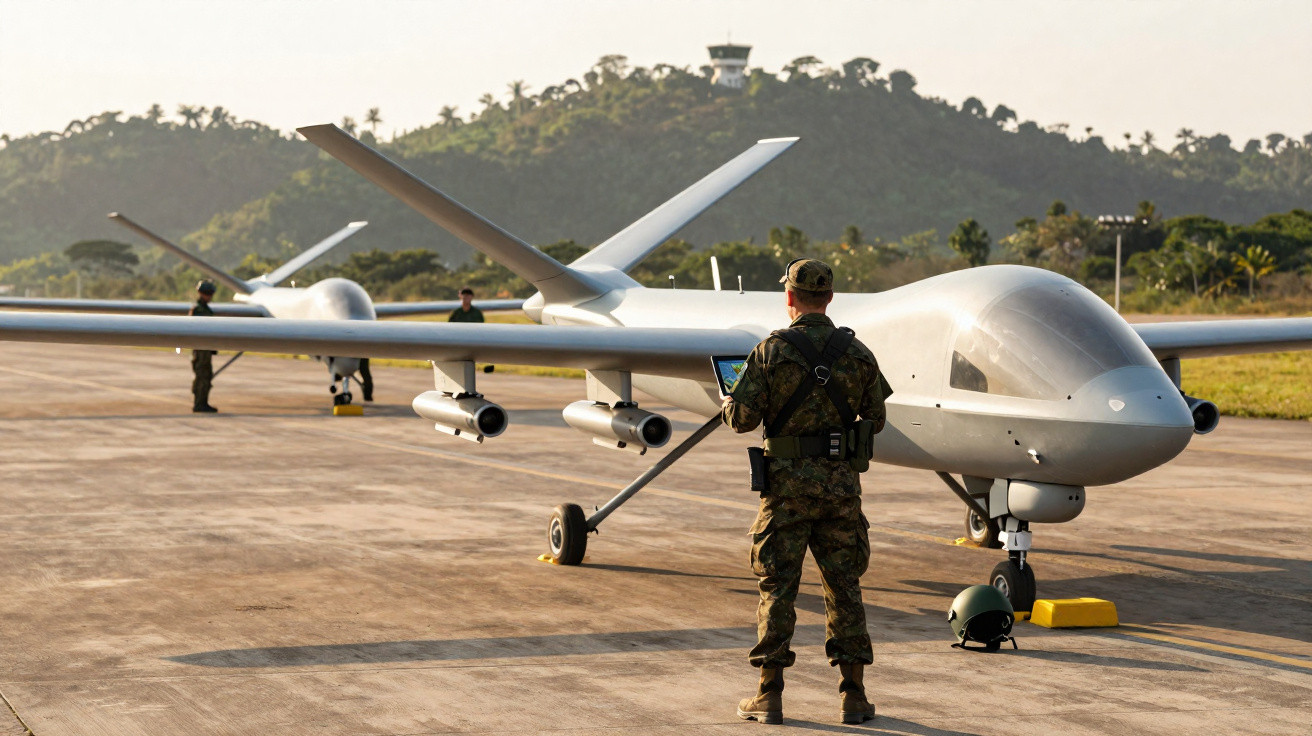
The Brazilian Army Aviation is moving ahead with the creation of a new capability for operating uncrewed aerial systems, with Baykar’s Turkish-made Bayraktar TB3 combat drone emerging as a leading option in the ongoing discussions. Zona Militar obtained this information during its Brazil correspondent Angelo Nicolaci’s visit to Brasília, where he follows the defence agenda and developments connected with the modernisation of the Armed Forces.
👉 Read more: The Air Force safeguards its strategic ISR capability through a new support contract for its MQ-9A Predator B
Bayraktar TB3 leads Brazilian Army Aviation discussions
The first public indication of the matter came on 29 July, during the Operational Readiness Exercise for Operation Membeca 2026, held at the Gericinó Training Area in Rio de Janeiro. On that occasion, the Army Commander confirmed that talks concerning Turkish-origin uncrewed systems were under way, suggesting that the issue had already progressed into negotiations.
On 21 August, shortly afterwards, the Army General Staff issued Resolution EME/C Ex No. 1,805, updating the Army Strategic Programme “Army Aviation and Drones”. The new directive formally incorporates uncrewed aerial systems into the evolution of Army Aviation and sets out the development of capabilities including the use of drones for reconnaissance and strike missions.
📌 You may be interested in
- Leonardo received the first contract for the serial production of the Brazilian Army’s 98 new Centauro II 8×8 armoured fighting vehicles
- With Airfox drones and eight countries involved, the Spanish Navy deploys the offshore patrol vessel BAM Meteoro to the Gulf of Guinea
According to information obtained by Zona Militar, the Bayraktar TB3 is currently the option preferred by Brazil in this process. Talks have made substantial progress, although no selection has yet been publicly formalised. There is also, so far, no official information on quantities, costs or an acquisition timetable, which are now central points in discussions between the parties. Sources familiar with the negotiations expect that a memorandum or contract associated with the process could be announced between mid-2027 and early 2028.
Compared with smaller tactical drones, the TB3 considerably broadens the range of potential operations. The aircraft was designed for intelligence, surveillance, reconnaissance, target acquisition and strike missions, enabling it to keep its sensors and intervention capability over a given area for extended periods.
Operational role and wider Army Aviation modernisation
For the Army, the appeal lies specifically in the prospect of integrating this capability into land operations. The system could broaden situational awareness, find and track targets, support artillery and manoeuvre units, and conduct strike missions without directly placing an aircrew at risk.
This development is also taking place amid closer political ties between Brazil and Turkey. On 24 August, President Luiz Inácio Lula da Silva spoke by telephone with President Recep Tayyip Erdoğan. They discussed expanding bilateral defence cooperation and the possibility of deepening partnerships between companies from both countries. The conversation took place only days after the publication of the new Army Aviation directive and the Army Commander’s confirmation of talks with Turkish industry.
The TB3, however, represents only one element of the broader transformation planned for Army Aviation. The updated programme also covers the renewal of multirole aircraft, new transport capabilities and the eventual introduction of attack helicopters, establishing a framework in which crewed and uncrewed assets are expected to operate in a complementary manner.
The possible arrival of the Turkish system will also demand a structure able to sustain its operations. Training operators, maintenance, data links, integration with command-and-control systems, infrastructure and the availability of weapons will be as important as acquiring the aircraft themselves, alongside the involvement of Brazil’s Defence Industrial Base.
The sequence of events therefore indicates a process that has moved beyond the purely conceptual stage. The programme update, the Army Commander’s public statement and the progress in negotiations all point towards the establishment of a permanent armed-drone capability within Army Aviation, with the Bayraktar TB3 as the principal candidate.
Should the choice be formally confirmed, the Brazilian Army will take a significant step towards incorporating a capability that expands the Land Force’s sensor reach and combat power. It would bring Army Aviation closer to a model in which crewed aircraft and remotely piloted systems operate together on the battlefield.
Photographs used for illustrative purposes.





Comments
No comments yet. Be the first to comment!
Leave a Comment