
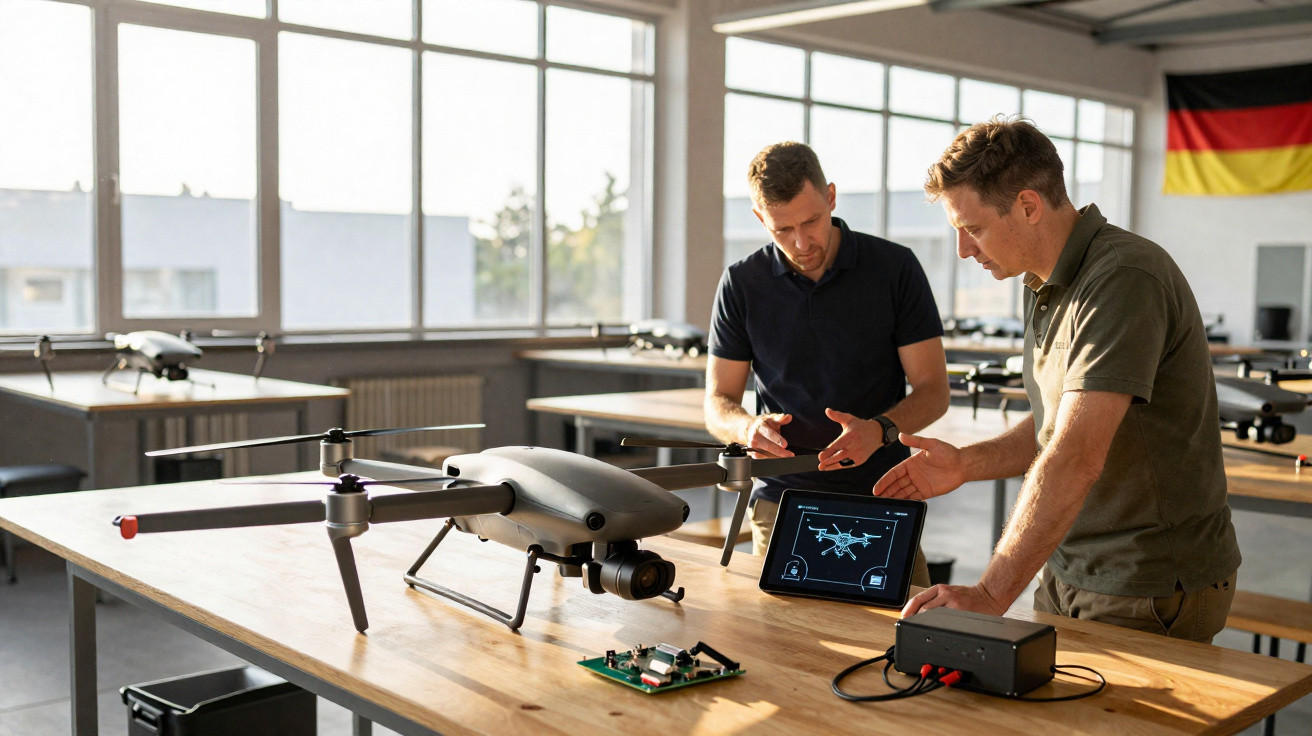
As reported by local media, Germany has begun mass-producing 5,000 new long-range drones for the Ukrainian Armed Forces. The systems are intended to strengthen Ukraine’s ability to strike targets inside Russian territory. According to the reports, the contract involves investment of more than €300 million, with Berlin aiming to complete it by the middle of next year.
👉 Read more: The French Air and Space Force’s “Poitou” Squadron bids farewell to its C-130H Hercules as the Airbus A400M takes over
Production of 5,000 long-range drones in Munich
According to Handelsblatt, the 5,000 drones will be manufactured in the Munich metropolitan area. Munich is both Bavaria’s capital and home to German-American company Auterion, which strengthened its relationship with Ukrainian counterpart Airlogix in February this year to pursue projects of this kind.
The partnership is a joint venture that intends to maintain its operations over the long term if it secures further orders. This would make it possible to establish another production line at an unspecified location in eastern Germany.
Auterion’s current chief executive, Lorenz Meier, addressed the matter, stating: “Germany now has a production line for affordable precision weapons in large quantities. This year, we will deliver proven systems, with costs and production speeds that make it possible to build up large arsenals for deterrence.” Vitaly Kolesnichenko, from the Ukrainian company, added: “This partnership achieves what neither company could accomplish alone: our combat-proven missiles, Auterion’s autonomous software and German industrial capabilities.”
📌 You may be interested in: - Ukraine tests 4 interceptors to counter new Russian jet-powered Shahed drones - The Air Force secures its strategic ISR capability with a new support contract for its MQ-9A Predator B
Artificial intelligence and protection against jamming
Although no further details were provided regarding the specific drones to be produced under the contract, it was highlighted that they will be fitted with artificial intelligence systems designed specifically to improve protection against potential jamming attempts.
This is particularly significant given that Russia is working on developing and deploying new electronic warfare equipment to counter the impact of Ukrainian unmanned systems. The latest of these is known as Volna Kupol Garant, described by Russian sources as a system capable of disrupting the connection to the Starlink satellite network.
German-Ukrainian drone co-production plans
Beyond their effects on the battlefield, it is worth noting that drone co-production between German and Ukrainian companies has substantial backing from the governments in Berlin and Kyiv. In April, they agreed to jointly manufacture seven new types of combat drone, six aerial and one ground-based.
This cooperation could expand further in the near future. President Volodymyr Zelensky has already stated on his Telegram channel that details are being finalised for a new agreement “that provides Germany and Ukraine with additional defence capabilities.”
Broadly speaking, in line with the approach outlined by the Ukrainian president at the end of August, the objective is to manufacture enough drones to triple the number of systems used for attacks against Russia and to intercept those operated by its adversary.
In specific terms, Zelensky set a target of launching 1,000 unmanned systems per day. This is considerably higher than the current average of 300 long-range drones and will require significant co-operation from the country’s Western partners.
Images used for illustrative purposes only





Comments
No comments yet. Be the first to comment!
Leave a Comment