
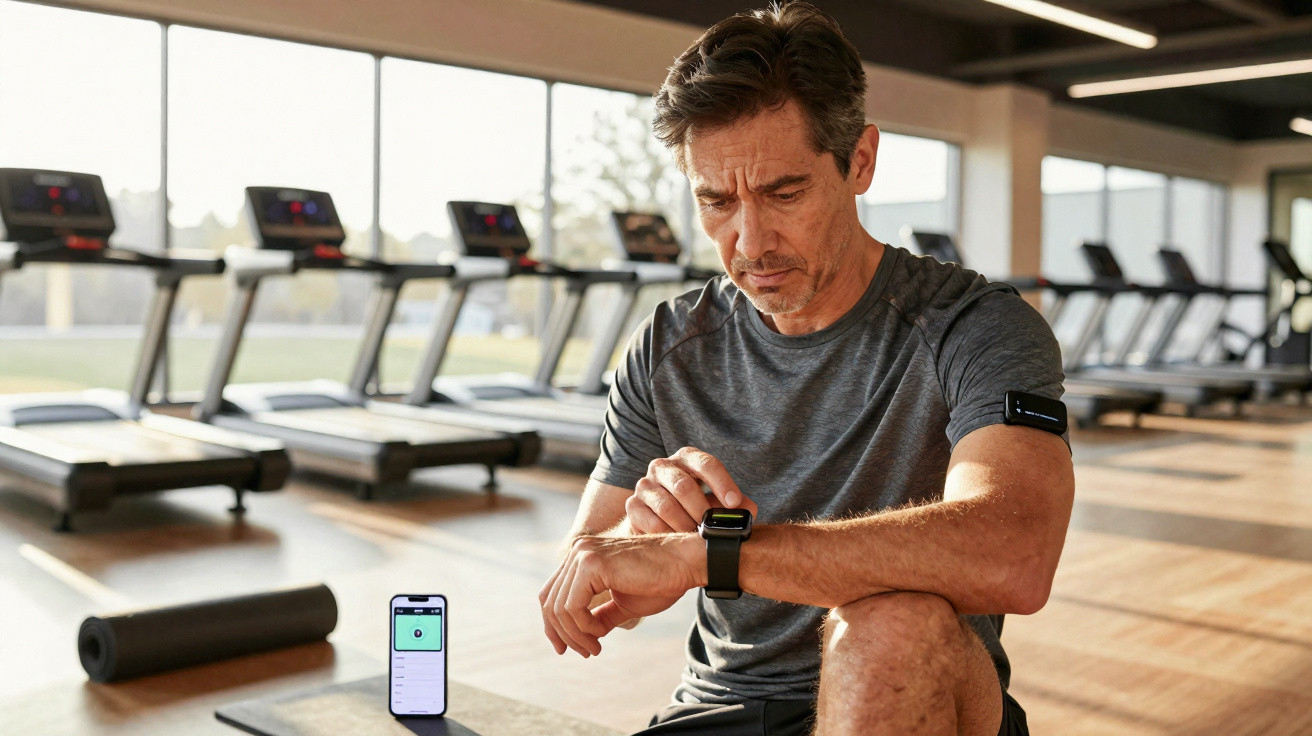
You glance at your smartwatch after a run. Your fitness score is lower. It says you have burnt very few calories. Your recovery score is extremely low, and it recommends avoiding exercise for the next 72 hours.
The frustrating part? The run itself felt brilliant.
Why, then, is your watch reporting the complete opposite?
In short, smartwatches and other fitness trackers are not consistently accurate.
Smartwatches can influence your exercise habits
Wearable fitness technology, including smartwatches, has ranked among the leading fitness trends for nearly a decade. Every day, millions of people globally rely on these devices.
They can affect the way people approach their health and exercise. They offer figures on calories burnt, fitness levels, recovery after activity, and whether you are prepared to exercise again.
Yet smartwatches do not directly measure most of these figures. Many widely used metrics are instead estimates, meaning they may be less accurate than you expect.
1. Calories burnt
Calorie tracking is among the most widely used smartwatch functions. Its accuracy, though, is far from ideal.
Wearable devices may underestimate or overestimate energy expenditure, commonly reported as calories burnt, by over 20%. The size of these inaccuracies also differs by activity. Strength training, cycling and high-intensity interval training, for instance, may produce even greater errors.
This is important because people frequently use these figures to decide how much to eat.
If your watch overstates the calories you have burnt, for example, you may believe you need more food than you actually do, potentially causing weight gain. On the other hand, an underestimate could encourage you to eat too little, harming your exercise performance.
2. Step counts
Although step counts are a useful indicator of overall physical activity, wearable devices do not record them flawlessly.
Under typical exercise conditions, smartwatches can miss around 10% of steps. Pushing a pram, carrying weights or walking with restricted arm movement will probably make counts still less accurate, since smartwatches use arm motion to detect steps.
For most people, this is not a significant issue: step counts remain helpful for monitoring general activity. However, treat them as an indication rather than an exact measurement.
3. Heart rate
Smartwatches calculate heart rate through sensors that detect changes in blood flow in the veins at your wrist.
This approach works accurately while resting or exercising at low intensity, but becomes less reliable as exercise intensity rises.
Arm movements, perspiration, skin tone and the tightness of the watch can all alter the heart rate reading it provides. Consequently, accuracy can differ from one person to another.
This may be an issue for people who use heart rate zones to direct their training, because minor inaccuracies can result in exercising at an unsuitable intensity.
4. Sleep tracking
Nearly every smartwatch available provides a "sleep score" and divides your night into light, deep and REM sleep stages.
Polysomnography is the gold-standard method of sleep measurement. This laboratory test records brain activity. Smartwatches, by contrast, estimate sleep from movement and heart rate.
As a result, they can identify whether you are asleep or awake reasonably effectively. However, they are considerably less accurate when determining sleep stages.
Therefore, if your watch reports "poor deep sleep", that might not actually be true.
5. Recovery scores
Most smartwatches measure heart rate variability and combine it with your sleep score to generate a "readiness" or "recovery" score.
Heart rate variability indicates how your body reacts to stress. In laboratory settings, it is measured with an electrocardiogram. Smartwatches instead estimate it through wrist-based sensors, which are far more susceptible to measurement errors.
Consequently, most recovery measures depend on two imprecise measures: heart rate variability and sleep quality. The resulting metric may not provide a meaningful picture of your recovery.
So, when your watch says you have not recovered, you may decide to miss training, despite feeling well and genuinely being ready to exercise.
6. VO₂max
Most devices calculate your VO₂max, an indication of your maximum fitness. It refers to the greatest amount of oxygen your body can use while exercising.
The most accurate way to measure VO₂max requires wearing a mask that analyses the oxygen you inhale and exhale, establishing how much oxygen you use to produce energy.
Your watch, however, cannot measure oxygen use. It estimates VO₂max from your heart rate and movement.
Smartwatches also generally overestimate VO₂max for less active people, while underestimating it for fitter people.
This means the value displayed on your watch may not represent your actual fitness.
What should you do?
Although smartwatch data is vulnerable to error, it is not entirely without value. These devices can still help you monitor broad trends over time, but daily changes and individual numbers should not receive too much attention.
It is equally important to consider how you feel, how you perform and how you recover. These signals are likely to offer greater insight than your smartwatch does.
Hunter Bennett, Lecturer in Exercise Science, Adelaide University
This article is republished from The Conversation under a Creative Commons license. Read the original article.


Comments
No comments yet. Be the first to comment!
Leave a Comment