
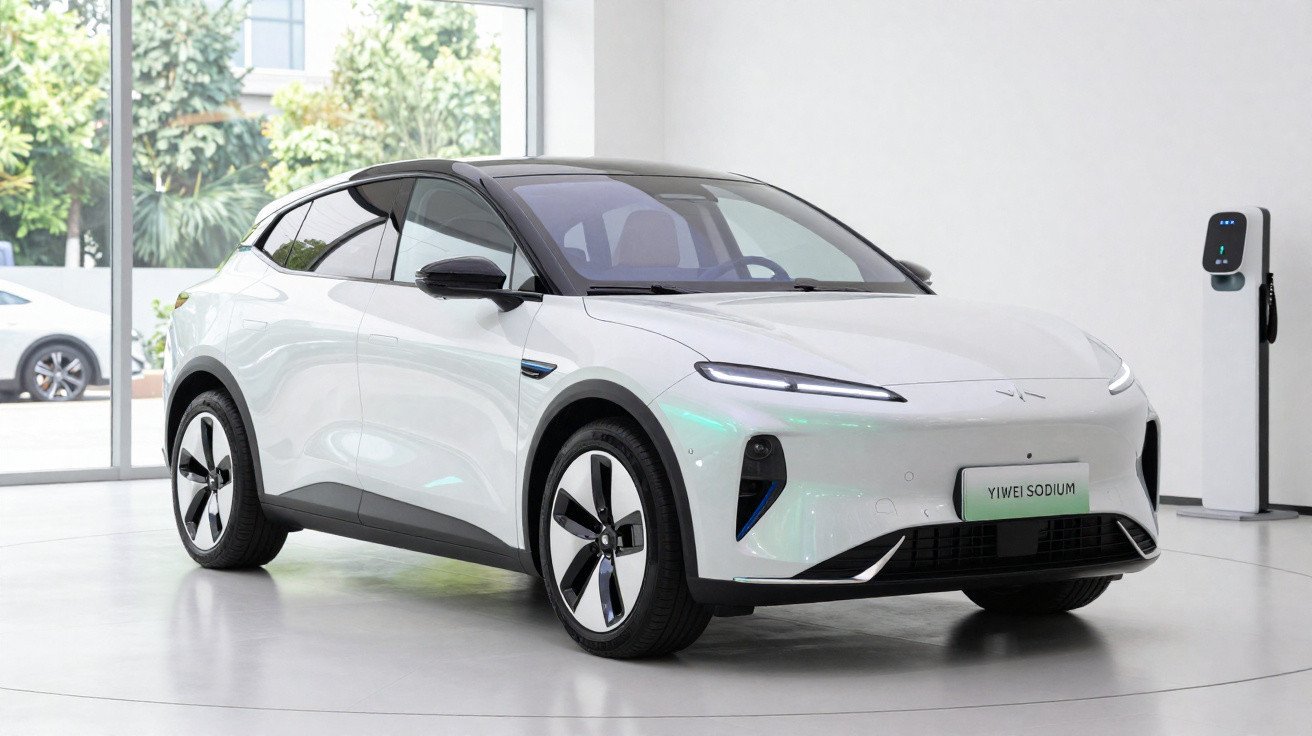
Yiwei EV enters mass production with sodium-ion batteries
Yiwei, JAC’s (Jianghuai Automobile Group) new all-electric Chinese car brand, has begun mass-producing the first electric car fitted with sodium-ion batteries.
The final name for this small city car has yet to be confirmed. For now, it is simply known as the Yiwei EV, with the first Chinese deliveries due to start later this January.
Using cylindrical sodium-ion cells supplied by fellow Chinese company HiNa Battery, the Yiwei EV employs JAC’s UE (Unitized Encapsulation) module technology, based on a honeycomb-style design.
Sodium-ion technology began with Sehol
Although Yiwei is the first manufacturer to mass-produce an electric vehicle using this battery technology, the story began with another Chinese marque: Sehol.
Sehol was owned by Volkswagen Anhui until 2021, after which it joined JAC’s portfolio of brands. It was announced in 2023 that the Sehol brand would be discontinued, with every model renamed and incorporated into either JAC Motors or Yiwei.
The compact electric car featured here is one such model. It was first revealed almost a year ago as a prototype under the Sehol brand, carrying the E10X name. It remains unclear whether it will retain that designation when it reaches the market as a Yiwei, or whether it will be given a new one.
What is already confirmed is that this small electric car has a battery with just 25 kWh of capacity, capable of charging from 10% to 80% in only 20 minutes.
Its range is rated at 252 kilometres under China’s CLTC driving cycle, which is considerably more generous than Europe’s WLTP test cycle.
As a rule, CLTC figures can be 20% higher than WLTP results. On the European approval cycle, this electric car’s range should therefore be around 200 km.
What is the main difference from a “conventional” battery?
Beyond the raw materials used, the key difference compared with the lithium-ion batteries found in most electric vehicles - NMC and LFP units - is cost, which naturally has an important effect on the car’s final price.
Because they do not use metals such as lithium or nickel, sodium-ion batteries “are a low-cost solution that promotes the popularisation of electric vehicles for the masses”, as Yiwei president Xia Shunli explained in comments to Car News China.
However, this technology has been used more widely in stationary energy-storage applications - for instance, in homes - largely because its energy density is lower than that of LFP (lithium iron phosphate) and NMC (nickel, manganese and cobalt) batteries.
To put this into perspective, the sodium-ion battery in this Yiwei has an energy density of 120 Wh/kg. An LFP battery can reach 160 Wh/kg, while an NMC battery can achieve 270 Wh/kg, making this the principal limitation of sodium-ion batteries.
In other words, a sodium-ion battery requires more material than a lithium-ion battery of equivalent capacity, meaning that it takes up more space and weighs more.
Source: Car News China




Comments
No comments yet. Be the first to comment!
Leave a Comment