
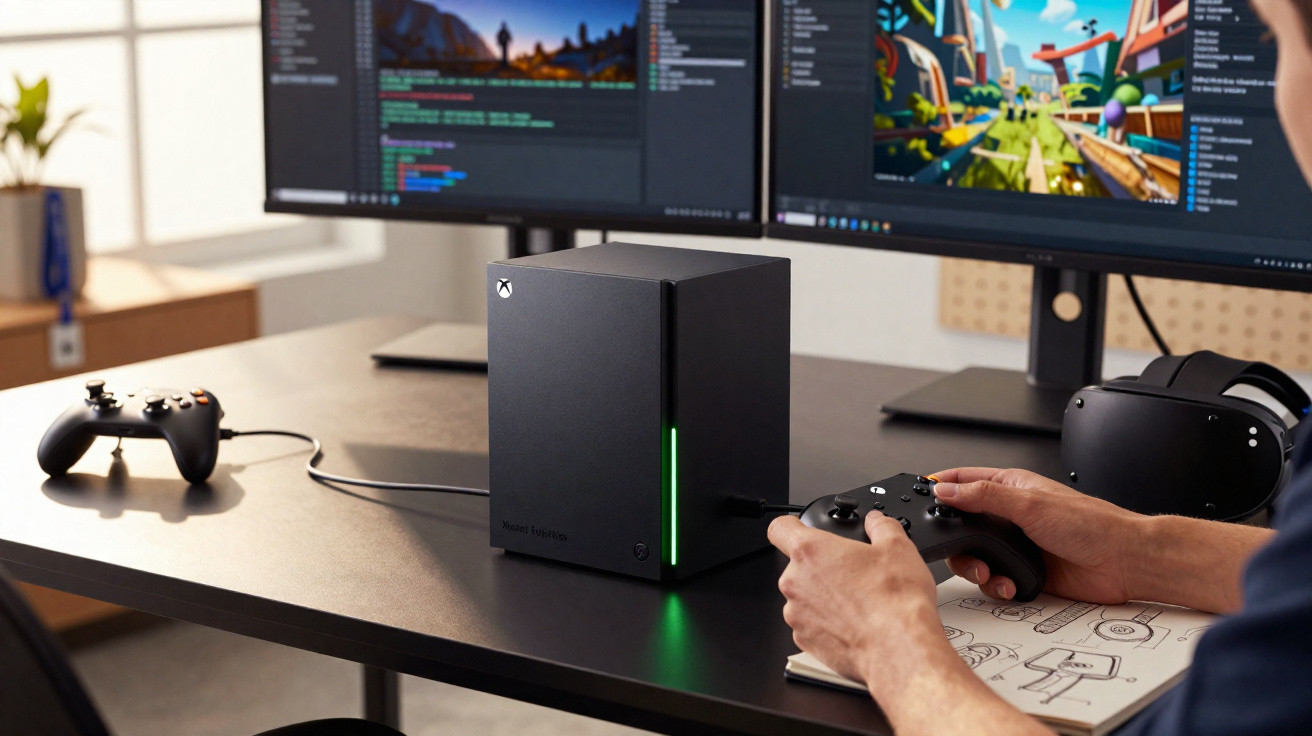
Microsoft officially refers only to new developer equipment, but unofficially almost every sign points to Project Helix, the internal codename for the next console generation. Newly released photographs of an XDK prototype reveal plenty: the forthcoming Xbox is expected to move closer to PC gaming than ever and noticeably reshape Microsoft’s entire gaming ecosystem.
What the new Xbox images actually show
The latest speculation was prompted by a post from Microsoft’s official Game Dev channel. It shows an unassuming black-and-white unit carrying a clear XDK label: an Xbox Development Kit of the sort supplied to studios preparing games for hardware that has yet to be released.
That detail is particularly telling, as ordinary console customers never encounter such systems. XDKs are strictly for developers and usually emerge several months, and occasionally years, ahead of a new generation reaching the market.
Many characteristics of the prototype on show strongly recall earlier Xbox devkits, while also signalling that entirely new hardware is likely operating inside.
Visually, the casing looks surprisingly familiar. Those familiar with Xbox hardware may be reminded of the Project Scorpio era, whose development kit eventually led to the Xbox One X. That raises several intriguing possibilities:
- Is Microsoft deliberately reusing older devkit casings to disguise the new hardware?
- Could this be a very early test machine with a placeholder design?
- Or are we already seeing the broad shape of the next Xbox generation?
There are no official answers at present. Microsoft has not commented further on the speculation, deliberately leaving the community without certainty. That lack of clarity is giving forums and social media even more room for imagination.
Project Helix: more than a conventional console
The concept behind Project Helix is where things become especially interesting. According to comments from Asha Sharma, Microsoft’s new gaming chief, the platform is not intended to be simply another, somewhat more powerful Xbox. Instead, the focus is on a hybrid machine that moves even closer towards a PC.
Microsoft is reportedly targeting a device that combines console convenience with computer-like flexibility. This aligns with the company’s strategy in recent years, during which Windows, Game Pass and Play Anywhere features have already softened the boundaries between console and PC.
Project Helix is intended to act as a bridge between the living-room console and the traditional PC – a system that feels like an Xbox but carries considerably more PC DNA beneath the surface.
Several areas are specifically in focus:
- Greater PC compatibility: Games that currently primarily exist on Steam and similar services could arrive on the new Xbox far more easily.
- PC-like architecture: Developers should be able to make better use of their established tools and workflows without making complex adjustments for a specialist platform.
- Deeper Game Pass integration: Whether through cloud gaming, downloads or Play Anywhere features, everything is intended to run on a shared technical foundation.
For studios, this could mean fewer obstacles when launching a game simultaneously for Windows PC and Xbox. Players, meanwhile, may gain a wider selection, particularly in genres that have so far largely flourished only on PC, such as complex strategy titles and simulations.
Why Microsoft is using GDC for this teaser
The Game Developers Conference, held in San Francisco, is an industry event rather than a major consumer show. It brings together programmers, designers and technical leaders, which is clearly the audience Microsoft wants to address right now.
By publishing images of an XDK prototype specifically around GDC, the company is making a clear statement: studios should begin preparing mentally for the next Xbox generation. The pattern has precedent. Development kits for the Xbox One and Series X also appeared well before the first console trailers.
The photographs shown are intended less for fans than as a signal to developers: “It is starting, set your course.”
Microsoft naturally also knows that the community will dissect every detail. This dual effect is intentional: it provides early technical communication for the industry while also carefully fuelling online rumours.
Xbox at a turning point: why Project Helix matters
The circumstances surrounding Project Helix appear far from ordinary. Xbox is facing a pivotal moment. Internal restructuring, the departure of prominent executives and debate over exclusive titles have recently shaken perceptions of the brand considerably.
Against that backdrop, the next console has to deliver more than merely “higher resolution and more FPS”. It must demonstrate that Microsoft intends to remain a long-term player in the console market rather than relying only on cloud services and subscription models.
The new hardware needs to fulfil several roles at once:
- Restore credibility among core gamers
- Convince third-party publishers to support the platform
- Provide the best possible technical foundation for Game Pass as a central product
- Blend with PC gaming so effectively that players do not feel at a platform disadvantage
If it succeeds, Project Helix could become a blueprint for future console generations, not just at Microsoft. Should the approach fail, the Xbox brand risks falling even further behind.
What the hybrid concept could mean for players
The details known so far could have several tangible implications for everyday gaming in the living room. A PC-like architecture might, for instance, offer more settings for graphics, frame rate or mods. Fans of more complex games are already hoping for ports that have previously bypassed the console market.
A closer relationship with Windows ecosystems could also bring practical benefits: a unified store, shared save data and effortless cross-play. Anyone moving between PC and console would experience considerably less friction.
Ideally, the distinction between a “PC game” and a “console game” will eventually feel like nothing more than a technical footnote – rather than a genuine barrier.
Naturally, the concept also carries risks. The more closely a console resembles a PC, the greater the chance that the system will feel more complicated. PC players may welcome menus packed with settings, but excessive complexity in the living room often creates frustration. Microsoft will need to strike a very careful balance over how much freedom it offers.
How devkits shape development for a new console
To put the significance of the current images into context, it helps to consider the normal process behind a new console. Devkits typically pass through several stages:
| Stage | Characteristic | Target audience |
|---|---|---|
| Early prototypes | Often bulky, sometimes housed in PC cases, with hardware not yet finalised | Core studios, internal teams |
| Mature devkits | Appearance resembles the eventual console, with features largely finalised | A broader developer community |
| Preview hardware | Nearly identical to retail units | Press, influencers, test laboratories |
The XDK prototype now shown suggests that Project Helix has at least moved beyond the concept stage into serious developer infrastructure. Studios can begin porting games, optimising engines and testing new features long before the actual console arrives in shops.
Terminology and context: what XDK and hybrid mean
Anyone unfamiliar with gaming terminology can easily stumble over abbreviations such as XDK. It simply stands for “Xbox Development Kit” – a specialist version of the console equipped with debugging tools, monitoring functions and, in some cases, additional memory. It enables developers to find errors more quickly, measure performance and test features that remain hidden on retail devices.
In this context, the term hybrid does not describe a handheld design like the Nintendo Switch. Instead, it refers to the merging of two platform worlds: PC and the traditional living-room console. Hybrid systems use similar architectures and identical development environments, often sharing a common software foundation.
For players, this could lead to very concrete advantages: shorter porting times, more simultaneous releases and steadier performance, as studios can transfer their expertise directly from PC development. It also creates new scenarios, such as a game launching on PC first and requiring only a small additional step to run on Project Helix.
How far Microsoft will actually take this concept remains unknown. The first XDK prototype images primarily demonstrate one thing: the direction has been set, and the next Xbox generation is taking shape at a time when gaming, cloud services and the traditional PC are becoming more intertwined than ever before.






Comments
No comments yet. Be the first to comment!
Leave a Comment