
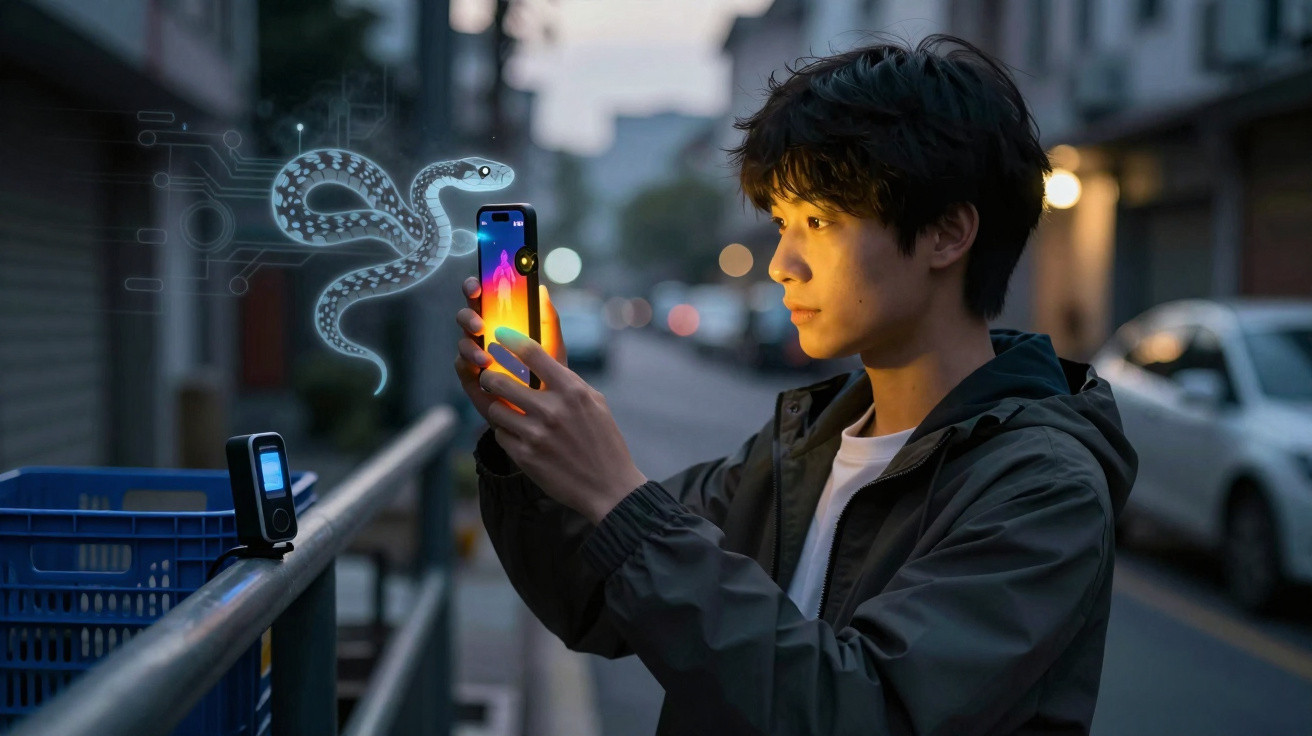
Something has just emerged from the laboratory that could radically reshape what we expect from smartphone cameras: a tiny sensor inspired by the heat-sensing ability of venomous snakes makes infrared radiation visible - in 4K resolution and without complex cooling. This is precisely the combination that has so far been missing to bring thermal cameras out of the professional niche and into the mass market.
How snakes “see” - and what researchers are learning from them
Some snake species, including vipers, have specialised pit organs between their eyes and nostrils. These sensitive membranes respond to minute differences in temperature, creating a kind of built-in thermal image of their surroundings. This allows a snake to detect a mouse even when it is sitting completely still in grass after dark.
The membrane warms slightly more wherever it receives more infrared radiation - in other words, thermal radiation. These variations trigger electrical signals that travel to the brain, where they are combined with ordinary vision. The result is a blended view of the visible scene and a thermal image, which is highly useful when hunting at night.
A team at the Beijing Institute of Technology and the Changchun Institute of Optics has reproduced this exact principle. Its aim was to create an artificial sensor that, like a snake’s organ, works without active illumination, responds only to heat and can be integrated into compact cameras.
A natural heat-sensing organ becomes a high-resolution infrared sensor built on standard camera technology.
Instead of a biological membrane, the new design uses semiconductor materials. They act as the “translator”: infrared radiation is first converted into electrical signals and then into visible light. A conventional CMOS image sensor can then capture the result - the same type of sensor used in smartphone cameras.
Nanotechnology: turning heat into visible light
The key lies in several ultra-thin layers of material. The infrared detector itself uses quantum dots made from telluride compounds. These minute particles can be tuned to respond precisely to particular infrared wavelengths - in this case, up to around 4.5 micrometres.
However sensitive the system may be, it faces a major challenge: the sensor also produces interference signals from its own heat. These so-called dark currents can obscure genuine image information. To prevent this, the researchers incorporate a kind of blocking layer made from zinc oxide and a conductive polymer. This barrier stops random currents while allowing signals generated by real infrared radiation to pass through.
The next step is unusual: the sensor does not stop at producing an electrical signal. Positioned directly above it is a light-emitting layer made from phosphorescent materials, including iridium compounds. It converts the electrical signal back into visible light - specifically, a stable green glow.
In the end, the camera “sees” an entirely ordinary image - except that this image originally comes from thermal radiation.
In technical terms, the system achieves photon-to-photon conversion of more than six per cent in the near-infrared range. Crucially for everyday use, all of this works at room temperature, without the bulky cooling equipment previously required by high-quality infrared cameras.
4K infrared imaging without cooling - how it works
The entire structure sits on a conventional CMOS sensor with 4K resolution (3840 × 2160 pixels). For infrared technology, this is a milestone: until now, only expensive, actively cooled specialist systems have delivered comparable image sharpness.
During tests, the prototype produced clear, high-contrast images even under extremely low levels of infrared light. The sensor covers two important ranges:
- near infrared (SWIR): useful for seeing through fog, smoke and thin materials
- mid-wave infrared (MWIR): ideal for displaying temperature alone, such as in thermal images
The measured luminance is sufficient in both ranges to create bright images that are easy to interpret. At the same time, the sensor handles substantial differences in brightness without “blowing out” bright areas or allowing dark regions to lose all detail. Specialists describe this as a dynamic range of 33 to 38 decibels - an impressive figure.
Most strikingly, the sensor can detect signals as faint as the light from distant stars. Performance levels of 10⁻¹⁰ watts per square centimetre are far below what the human eye can still perceive. Such sensitivity is particularly important for night-time imaging and concealed structures.
Why a smartphone could suddenly “see” through smoke and plastic
The new layered structure expands the effective range in which cameras can detect anything from roughly 0.4 to 0.7 micrometres, the visible-light range, to 0.4 to 4.5 micrometres. It therefore makes scenes visible that conventional optics would simply render “black”.
In practical terms, this means:
- seeing through light fog and drifting smoke
- visibility in complete darkness using thermal radiation alone
- detecting objects behind certain plastics or types of glass
- displaying temperature differences directly as a high-resolution image
In laboratory tests, the prototype could even see through silicon wafers and filled chemical vials that appear completely opaque in ordinary light. This ability to reveal “invisible” structures is exactly what makes the technology appealing across numerous sectors.
From industry to cars: where the snake-inspired camera could help
In industrial settings, sensors of this kind could reveal weak points in machinery: overheating bearings, faulty solder joints on circuit boards and deteriorating cables would stand out through their heat patterns. Unlike today’s often low-resolution thermal cameras, they could reveal the finest details.
In agriculture, it could be possible to examine temperature differences in plants caused by stress. Disease hotspots or drought stress would become apparent early, before anything is visible to the eye. The same applies to the food industry: minimal temperature variations in packaged products could warn of cooling problems without opening the packaging.
Transport could experience one of the biggest changes. Cars, and autonomous vehicles in particular, would benefit greatly from a “second sight” that is unaffected by fog, darkness and glare. A pedestrian at the roadside, an animal on the carriageway or a broken-down vehicle emits heat - making it stand out clearly to the infrared sensor.
In medicine, compact and sensitive infrared cameras could support diagnosis: inflammation, circulatory disorders and poorly healing wounds produce characteristic thermal patterns. Small portable devices could make these signals visible directly at the patient, without contrast agents or radiation.
When will the technology reach smartphones?
The researchers stress that their approach relies on existing semiconductor-industry manufacturing processes. Put differently, the sensors could in principle be made in current production facilities without building entirely new factories. That reduces costs and makes mass production plausible.
For the first time, a high-resolution, genuine thermal imaging camera is within reach of everyday devices - from mobile phones to smart-home cameras.
If it can be integrated into smartphone modules, users could capture scenes that currently require specialist equipment:
- making heat leaks around windows and doors in the home visible
- locating concealed pipes and cables in walls
- camping and outdoor use: detecting animals or people at night
- checking electronics: identifying hot power supplies, laptops or sockets
Smart-home systems could gain new security functions as well. A camera that responds to temperature can detect people even when they are not directly within a beam of light or are obscured by shadow. Combined with conventional optics, this creates a considerably more robust surveillance system.
What terms such as infrared, dynamic range and SWIR mean
Infrared radiation is simply light with a wavelength longer than the eye can perceive. Our bodies continuously emit this radiation, more or less strongly depending on temperature. Sensors use these differences to generate thermal images.
Dynamic range describes how effectively a sensor can show very bright and very dark areas at the same time. A high value means that detail in dark corners is retained even when parts of the image are glowing very brightly.
The terms SWIR (Short-Wave Infrared) and MWIR (Mid-Wave Infrared) divide the infrared spectrum into zones with different properties. Shorter-wave ranges, for example, penetrate fog relatively well, while middle-wave ranges are particularly well suited to measuring temperature alone. A sensor covering both zones is far more versatile.
Opportunities and risks in everyday use
Greater visibility also brings greater responsibility. A camera that detects temperature differences could reveal sensitive information: is someone at home? Where are pipes and cables located, and where is expensive equipment kept? Such data may be just as valuable to burglars as to tradespeople.
Manufacturers must therefore build in clear limits and data-protection mechanisms - for example, by keeping raw data on the device and sending out only results that can be evaluated. Rules are also needed for the scenarios in which these sensors may be used, particularly in public spaces.
On the positive side, there is major potential for improved safety: earlier fire warnings, better orientation in burning buildings, safer night-time driving and new diagnostic options in medicine. When the snake-inspired technology is combined with AI analysis, it can identify patterns that the human eye might miss despite 4K resolution.





Comments
No comments yet. Be the first to comment!
Leave a Comment